

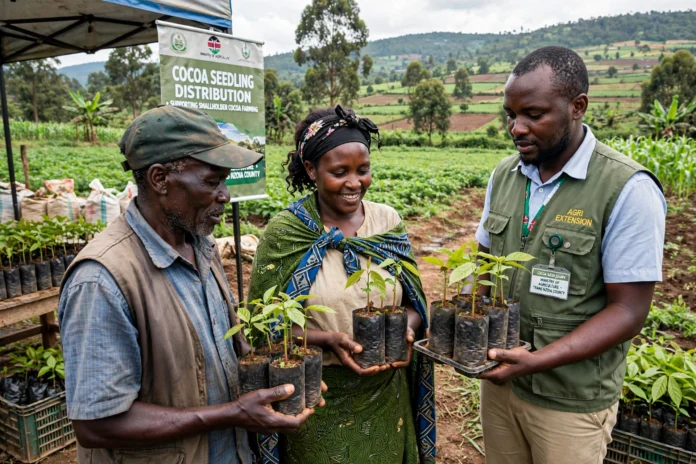
Kenya is making a fresh bid to diversify its agriculture sector with cocoa, positioning the crop as a new commercial cash crop.
President William Ruto announced the shift in Kitale, Trans Nzoia County, where he said the government has formally scheduled cocoa as a cash crop and will begin supplying seedlings to farmers.
The move is designed to open up a new revenue stream for farmers and deepen Kenya’s agricultural value chain at a time when African countries are pushing to earn more from what they grow, not just from exporting raw commodities.
Unlike traditional cash crops, cocoa’s value extends well beyond the farm. Its chain includes nurseries and seedling production, primary production, fermentation and drying, grinding, packaging, chocolate manufacturing, and branding all potential jobs and enterprises for Kenya.
For local farmers, agribusinesses and small processors, it could become a viable alternative income source, if it is matched with the right agronomy, water, financing and long-term extension support.
The global context is compelling. Africa already dominates cocoa production, with Côte d’Ivoire and Ghana accounting for more than half of the world’s supply. Yet the continent captures only a fraction of the final value, which is concentrated in overseas processing, manufacturing and retail.
By entering the sector, Kenya is signaling an intent to not only grow the crop but to eventually anchor part of the processing and value-addition locally and tap into regional markets.
The plan also fits into a wider continental strategy. Under the African Continental Free Trade Area (AfCFTA), countries are seeking to boost intra-African trade, build agro-processing capacity and create industrial jobs ambitions that a chocolate value chain could support.
Still, cocoa is not a plug-and-play crop. It thrives in warm, humid lowland tropics with well-distributed rainfall, fertile, well-drained soils and consistent moisture. Success in Kenya will hinge on proper agro-ecological zoning, selection of adapted varieties, and farmer training on good agricultural practices.
Experts note that distributing seedlings is only the first step. To make it commercially sustainable, farmers will need guaranteed off-takers, competitive and transparent pricing, post-harvest handling and storage infrastructure, and reliable access to extension and crop finance.
The Kitale launch is therefore the starting point, not the finish line. Whether cocoa becomes a meaningful cash crop will depend on how quickly the government, research institutions and the private sector can build a functional ecosystem around it from farm to factory to market.
If that link is built, cocoa could give Kenyan farmers a much-needed hedge against over-reliance on tea, coffee and horticulture, while advancing Africa’s push to turn its commodities into higher-value finished products.

