

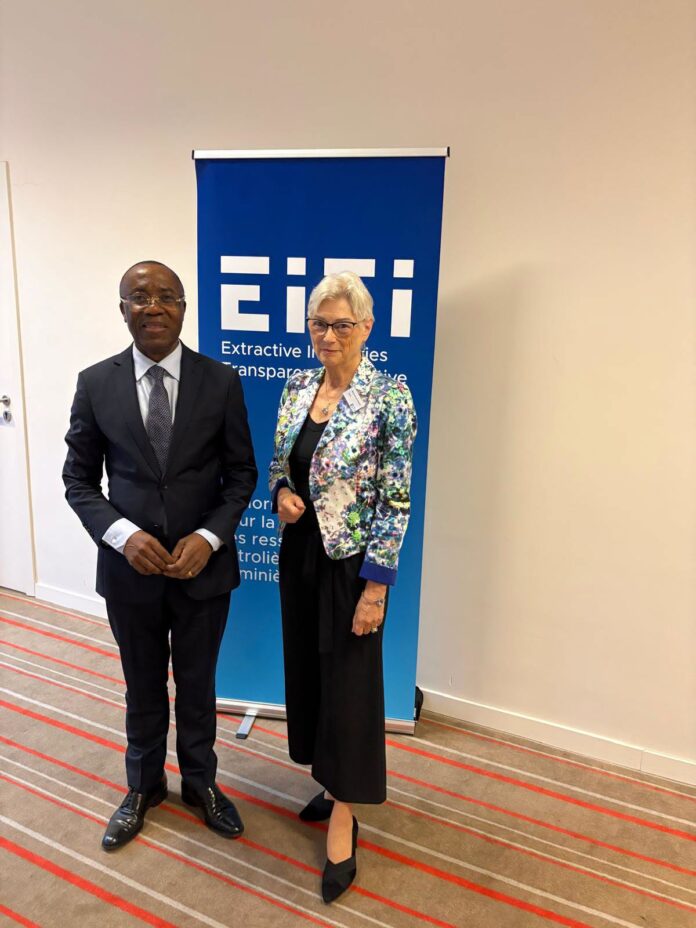
Cameroon is seeking to end its suspension from the Extractive Industries Transparency Initiative (EITI), as pressure mounts on African resource-rich countries to strengthen public accountability, disclose extractive revenues, and ensure mineral wealth delivers greater economic benefits to local communities.
Cameroon has renewed efforts to restore its standing in the Extractive Industries Transparency Initiative (EITI), placing transparency, civil society participation and the disclosure of petroleum contracts at the centre of its reform agenda.
The country’s Minister of Mines, Industry and Technological Development (a.i.), Professor Fuh Calistus Gentry, met EITI Board Chair Maria van der Hoeven on the sidelines of the 10th EITI Global Conference in Brussels, where he outlined measures intended to address the shortcomings that led to Cameroon’s suspension.
The discussions come as African governments face growing demands to move beyond extracting and exporting raw minerals towards building domestic industries, expanding local participation and ensuring resource revenues translate into jobs, infrastructure and economic development.
For Cameroon, restoring compliance with the EITI framework is an important step towards rebuilding confidence in the governance of its extractive industries. However, the broader challenge extends beyond transparency reporting to ensuring that citizens, local businesses and producing communities benefit more directly from the country’s natural resources.
During the Brussels meeting, Gentry highlighted measures to implement corrective actions under EITI Requirement 1.3, which concerns the enabling environment for civil society participation in the initiative. Effective participation by civil society organisations is essential to independent scrutiny of extractive revenues, government decisions and the management of public resources.
The minister also outlined plans to strengthen the Cameroon EITI National Secretariat through the appointment of a deputy national coordinator and additional technical personnel, measures intended to improve institutional capacity and accelerate implementation of the required reforms.
Another priority is closer cooperation with the National Hydrocarbons Corporation (SNH) to establish a timetable for publishing petroleum contracts, financial statements and sectoral data.
Greater disclosure of contracts and financial information can help citizens assess how extraction rights are awarded, how much governments receive from natural resources and whether companies and public institutions meet their obligations.
Cameroon also indicated that it intends to request an early validation once a clear timetable for implementing the necessary reforms has been established. The proposed validation would provide an opportunity to assess progress against the outstanding requirements, although reinstatement will depend on the applicable EITI processes and decisions.
The meeting was attended by Cameroon EITI National Coordinator Agnès Solange Ondigui Owona, EITI Senior Country Manager Ahmed Zouari and Regional Director Gilbert Makore.
Beyond transparency: Africa’s local content challenge
Cameroon’s efforts highlight a wider debate across Africa over how to convert mineral and petroleum wealth into lasting economic value.
The continent holds significant deposits of critical minerals, including cobalt, copper, lithium, manganese and graphite, which are increasingly important to electric vehicles, renewable energy systems and other technologies driving the global energy transition.
Yet many African economies continue to export substantial volumes of raw materials while importing higher-value processed products. This limits opportunities to build industrial capacity, expand skilled employment and retain more value within domestic economies.
Local content policies are increasingly central to efforts to address this imbalance. Depending on national legislation, such measures can promote local procurement, employment and skills development, technology transfer, domestic processing and opportunities for African-owned enterprises to participate in mining supply chains.
For Cameroon, stronger transparency systems could help provide the information needed to assess whether extractive agreements deliver fair returns to the state and create meaningful opportunities for domestic businesses and workers.
Publishing contracts and financial statements, however, does not automatically guarantee local economic benefits. Governments must also establish enforceable local content requirements, strengthen regulatory oversight, improve access to procurement opportunities and ensure revenues are managed in the public interest.
Transparent reporting can help citizens and oversight institutions determine whether companies meet their commitments, while credible public institutions can make it easier to monitor compliance and address irregularities.
A continental test of resource governance
Across Africa, the challenge is increasingly about linking good governance with industrial development. Countries seeking to capture more value from their mineral resources need both transparent revenue management and policies that encourage domestic manufacturing, processing and technical expertise.
These priorities are particularly significant as global competition for critical minerals intensifies. African governments are under pressure to negotiate investment agreements that balance the need for foreign capital and technology with national development priorities.
For Cameroon, the immediate task remains addressing the corrective measures associated with its EITI suspension and rebuilding confidence in the country’s extractive-sector governance.
The Brussels engagement signals the government’s willingness to pursue reforms, but the credibility of that commitment will ultimately depend on implementation, public disclosure and the protection of meaningful civil society participation.
As Africa pushes for a greater share of the value generated by its natural resources, Cameroon’s efforts underscore a fundamental principle: transparency is not an end in itself, but a foundation for accountable institutions, fairer resource management and a more inclusive extractive economy.

