

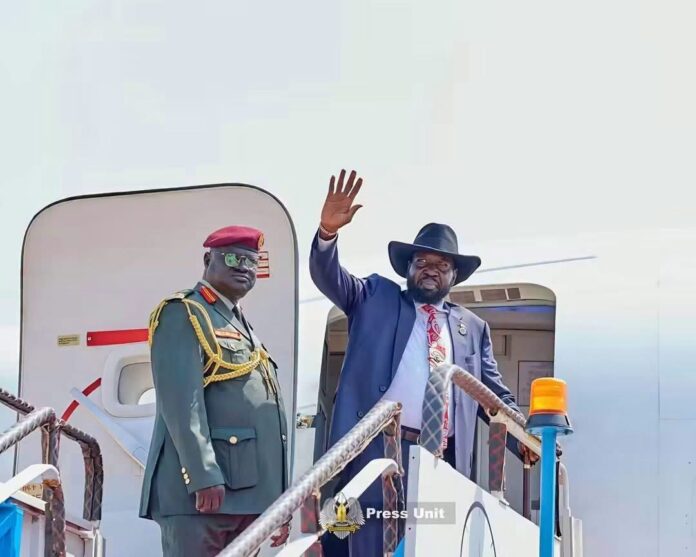
South Sudan President Salva Kiir Mayardit is in Nairobi to meet with President William Ruto at a pivotal moment for the young nation, as Juba prepares for presidential and general elections scheduled for December 22, 2026.
Kiir’s visit comes less than two months before the planned vote and shortly after he dissolved the transitional unity government and established a caretaker administration. His engagement with Kenya therefore carries both a political and regional dimension, as Nairobi remains an important partner in South Sudan’s peace process and economic integration.
Presidential Press Secretary Arek Aldo Ajou said the talks with Ruto will focus on bilateral relations, South Sudan’s electoral preparations and measures required to ensure peaceful, credible and successful elections.
“The security and success of the elections are important to stability in East Africa and beyond,” Ajou said.
The statement captures why Kiir’s visit is significant for Kenya. South Sudan’s political stability has direct implications for the wider East African region, including border security, refugee movements, cross-border trade and transport corridors linking the region to the Indian Ocean.
Kenya has previously played a role in South Sudan’s peace and political dialogue, including hosting mediation efforts aimed at broadening the peace process. Nairobi’s diplomatic engagement could become increasingly important as Juba seeks regional support for the December elections.
The election timetable has remained a central issue in South Sudan’s political transition. The December 22 vote would represent a major step in the country’s effort to move from the prolonged transitional arrangements established under the 2018 peace agreement.
For Kenya, the priority is likely to be stability around the electoral process. A peaceful political transition would help create a more predictable environment along the shared border and protect commercial links between the two countries. The outcome of the electoral process will also have implications for regional diplomacy, particularly given South Sudan’s strategic position between Kenya, Uganda, Ethiopia and Sudan.
Trade and economic interests
Economic cooperation will be equally important during the Nairobi talks.Kenya is a major source of goods and services for South Sudan, while Mombasa remains an important gateway for South Sudanese imports. Kenya exported goods worth about $219.8 million to South Sudan in 2024, according to UN Comtrade data, demonstrating the scale of the commercial relationship.
But the relationship remains heavily imbalanced, with South Sudan exporting relatively little to Kenya. Recent discussions between the two governments have consequently focused on reducing trade barriers, improving border procedures and lowering the cost of transporting goods.
In August, Kenya and South Sudan signed a joint communiqué aimed at removing trade barriers, strengthening border security and improving connectivity along the Nadapal-Juba corridor.
The corridor is strategically important because it provides South Sudan with a direct route towards Kenya and the Indian Ocean. Kenya has also been pursuing the development of infrastructure linking South Sudan to the Lamu Port-South Sudan-Ethiopia Transport (LAPSSET) corridor, potentially creating another major route for trade and investment.
The planned development of the Nadapal-Juba road could reduce transport costs and travel time while opening opportunities for businesses on both sides of the border. Kenya’s Transport Ministry has previously described the 350-kilometer Nadapal-Juba road as important for direct trade, job creation, and economic development.
Kiir’s discussions with Ruto are also expected to cover economic and infrastructure cooperation linked to Kenya’s Lamu refinery project, adding an energy dimension to the talks.
The state visit is therefore arriving at a strategically important intersection of politics, security and economics. For Kiir, Nairobi offers an opportunity to engage a key regional partner as South Sudan approaches the December elections. For Kenya, the visit provides an avenue to reinforce its role in South Sudan’s political transition while advancing trade, infrastructure, and regional connectivity.
With less than three months to the vote, the success of the Nairobi talks will be closely linked to whether the two governments can translate their longstanding political relationship into greater electoral stability, smoother cross-border commerce, and stronger economic integration across East Africa.

