


As Mazingira Day nears, a coalition of conservationists, volunteers and filmmakers says Kenya must stop counting trees planted and start protecting the forests still standing.
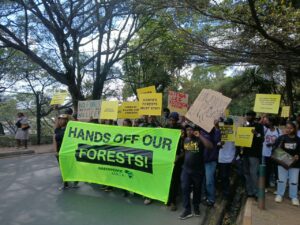
They came on foot, more than 200 of them, carrying a petition that had grown to over 60,000 signatures. Outside the Ministry of Environment, Climate Change and Forestry, the marchers were an unusual mix of people who rarely share a stage: a Greenpeace communications manager, a youth leader from the Ngong Forest Association, a wildlife filmmaker, and ordinary Kenyans who had signed their names online and now wanted to see them delivered in person.
Their message was simple. For years the government has marked Mazingira Day, the national environment day, by announcing how many trees it planted. This year, the marchers said, they wanted to hear how many forests it saved.
“We do not need any permission as Kenyans to protect our forest,” said Sherie Gakii, Communications and Story Manager at Greenpeace Africa and the lead of the Kenya Forest campaign. The march, she explained, was designed so that Cabinet Secretary Dr. Barasa’s office could not look away. “We’ve decided to march here in a way that they cannot ignore the 60,000 voices that have signed the petition.” Gakii accused the ministry of silence while, in her words, the country’s forests were being “massacred.”
A cascade of cuts
The grievances were laid out in detail in an open letter read aloud at the ministry’s gates, signed simply “Kenyans.” It began with a reminder of what forests do for the country. They are the water towers that feed the rivers supplying homes, farms and industries, they regulate rainfall, and they sustain the livelihoods of millions, especially forest-adjacent communities that have guarded them for generations. Then it listed, forest by forest, what the signatories say is going wrong.
In Meru, the Imenti Forest is a gazetted water tower and a dry-season refuge for elephants. On May 6, 2026, the principal secretary for forests issued concurrence for the excision of 2.7 hectares, and there are reports of plans for an airstrip, a golf course and a state lodge. The letter said aerial footage has shown work proceeding on the airstrip despite a court order blocking construction. “When public institutions do not respect court orders,” it warned, “every forest in Kenya is at risk.”
In Nairobi, the story repeats itself closer to home. Nairobi National Park, the country’s oldest and the only one of its kind beside a capital city, is facing what court filings describe as the relocation of the Nairobi Animal Orphanage and a 1,300-vehicle parking facility, built largely on land the park’s management plan designates a low-use zone. Some 4,542 Kenyans have gone to court to protect the park. According to the petitioners, they were kept out of a court-ordered site inspection in July.
Ngong Forest, gazetted in 1932 at about 2,850 hectares, has been whittled down by repeated excisions to 1,224. In July this year, heavy machinery entered it to clear a road linking Talanta Stadium to Bomas, while an eco-lodge went up inside the sanctuary block. The Environment and Land Court issued conservatory orders halting both, in a case brought by the Law Society of Kenya, the Green Belt Movement and Just Parks. “Nairobi needs roads,” the letter said, “but it does not need to lose what is left of this forest to get them.”
Then there is Karura, the forest that Professor Wangari Maathai’s struggle helped save. In February 2026, trees were cleared around the ranger’s village to house National Youth Service personnel, without consulting Friends of Karura, the community forest association that co-manages the forest under an agreement running to 2041. The petitioners asked the ministry to confirm that commitment publicly and restore the cleared area with indigenous trees, as the Karura management plan provides. The Aberdare, Mau and Suam forests, the letter added, face the same pressures.
The law that opened the gate
For Gakii, these cases are not isolated. They follow a pattern that the letter summed up in one line: “First a road, then a way leave, then a building, then the forest shrinks.” The campaigners point to a legal change as the thing that could turn that pattern into a routine. The Forest Conservation and Management Act, Amendment Act 2026, took effect on June 16 and allows the Kenya Forest Service to grant easements and wayleaves for roads and utilities across gazetted public forests. Combined with illegal logging and land grabbing, the letter argued, this puts every public forest in the country within reach of the next project.
Gakii was blunt about what she wants done with it. The section that makes this possible, she said, should be repealed, and Kenya needs stronger forest governance in its place. Policy recommendations will follow, she added, and she wants the minister to engage campaigners closely as they are drafted.
You can rebuild buildings, but you can’t rebuild forests
Among the marchers was Sham Patel, a conservation filmmaker and friend of Nairobi National Park, who said the evidence of failure is easy to find. He pointed to Imenti, where he said a lodge, airstrip and golf course were being carved out of a protected forest that local people still use and that elephants still cross to reach the mountain, with no environmental impact assessment, no paperwork and no public transparency.
He pointed to Ngong Road Forest, where a road is being cut through to connect the Talanta Stadium. “You can break buildings, you can rebuild them,” he said, “but you can’t rebuild forests.”
Patel’s frustration centered on how decisions are made. Public participation forums, he said, tend to happen after a project has been announced and the cutting has started. “That means straight away it’s like you’re living in a dictatorship where whatever they say goes.” He wants planning that involves people from the start, and an accountability system in which civil society checks in with the Cabinet Secretary roughly every three months.
In the near term, he wants an end to all construction inside Nairobi National Park. He said Kenya has a rare chance to show the world that people and wildlife can share a capital city, and that it keeps squandering it. He also warned of what lies ahead if the cutting continues: “a slow desertification of our country.”
The people who live beside the trees
For Joseph Ihachi, a Greenpeace volunteer and youth representative at the Ngong Forest Association, the issue is personal and local. He has worked in the forest space for three years, leading young people in mobilizing for conservation and ecosystem restoration. He listed forests under threat, including Ngong, the Aberdare and Karura, and Nairobi National Park, which is not a forest but is a green space under the same pressure.
What communities lack, Ihachi said, is a voice. “They have been coming, doing everything, whatever they want, as long as it meets their own needs without consulting the community,” he said of those who push projects into forest areas. He argued that the people who live next to forests are the first caretakers of the ecosystem and should be consulted before any development, as the Constitution’s requirement for public participation demands.
He also wants resources mobilized so communities can use forest ecosystems sustainably, and wants the government to be open and accountable in how those resources are managed. “This forest is not for the government,” he said. “We are there for the forest and the forest is there for us.”
Planting versus protecting
The petition’s sharpest argument is aimed at the government’s flagship program. The 15 billion trees initiative, running from 2022 to 2032, aims to lift national tree cover to 30 percent. The petitioners were careful to say that Kenyans support growing trees. But they argued that tree-planting numbers can hide the loss of what already exists. A seedling on a hillside, the letter said, “cannot do the work of an indigenous forest that has taken centuries to grow. It cannot hold a water tower together.” It cannot shelter the elephants of Imenti or the rhinos of Nairobi National Park. “Growing tree cover while shrinking our forest cover,” the letter said, “is a contradiction.”
 That is why the timing matters. Mazingira Day falls on Saturday, October 10, in the middle of Mazingira week, and national celebrations are expected to culminate in a synchronized attempt to plant millions of trees. Kenyans will turn out, as they always do. But this year the campaigners want a different question put at the center of the day. “We want a protection plan, not a planting tally,” the letter said.
Their demands are specific. They want the government to halt destructive projects in Imenti, Nairobi National Park, Ngong Road Forest, Karura, Suam and other protected forests, and to respect every court order protecting them. They want the logging ban upheld, including a restatement of the ban on the Mau Forest Complex. They want public disclosure of every excision, easement and license affecting public forests, along with meaningful participation by community forest associations. And they want firm action against illegal logging and land grabbing, including investigations, prosecutions and the recovery of public forest land.
They also want accountability that continues past this week. The letter asks the ministry to use Mazingira Day to present its forest protection plan and to report publicly every year after on protection outcomes, not only trees planted.
That would mean disclosing how much natural forest has been lost or degraded, which excisions and easements have been approved, what has been done about illegal logging, and how many of the trees already planted have survived. The ministry has 30 days, the petitioners said, to respond in writing to each demand.
The ministry’s answer
The petition was received on behalf of Cabinet Secretary Dr. Barasa, who was not present. The official who accepted it said the ministry, the Cabinet Secretary and, as he put it, even the President are committed to conserving and restoring the country’s forests, and defended the 15 billion tree target as a task for everyone. “It’s not something that you will say that those people versus us,” he said, calling on environmentalists, conservationists and other groups to be part of the journey.
He noted that gazetted forests are public forests and that citizens have a right to know what is happening in them.
He did not commit to any of the demands. The issues raised, he said, would need time for the ministry and its technical staff to study, and he suggested that some of the concerns might stem from a lack of proper information, which the government should share. What he offered was a meeting.
The Cabinet Secretary, he said, would have liked to receive the petition herself and has already said she is willing to meet the campaigners’ leadership. He proposed that leaders of the conservation groups come to the ministry on Tuesday at about 10 a.m. for a one-on-one session with her, with a wider meeting possible afterward. “We will look at them and address them appropriately,” he said as he accepted the documents.
What comes next
For the campaigners, a meeting is a beginning, not an answer. Gakii said the first thing they want is a written response within 30 days, and the second is a clear road map for protecting forests, one they expect to see every Mazingira Day from now on. If the government does not act, she said, Greenpeace and its partners will not stop. “The conversation doesn’t end with this march,” she said, and she invoked Wangari Maathai, whose fight for Karura is the reason it still stands. “It’s up to Kenyans to uphold her legacy and keep defending our forest.”
She was also careful about what the campaign is not. “As environmentalists, we are not against development. We are saying that development should be sustainable.” Development, she argued, only deserves the name when it lets both people and the environment thrive.
Now the ministry has a stack of signatures, a four-point list of demands, a 30-day clock and a Saturday on which, as the open letter put it, “Kenyans will be listening.” The ministry will mark Mazingira Day in front of a public that has asked it to measure success by what it protects.

