
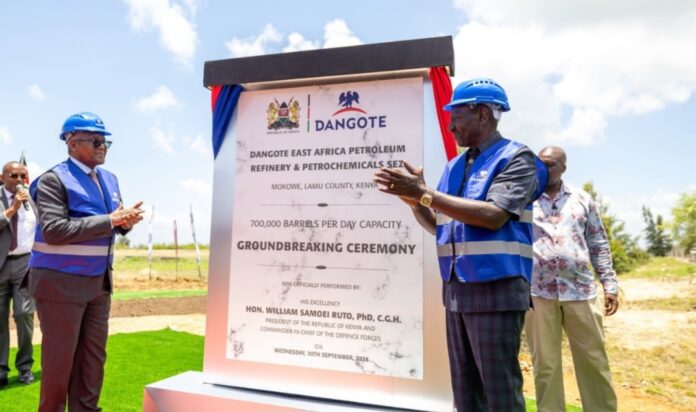
What began as an informal conversation in April has evolved into one of East Africa’s largest planned industrial investments, with Nigerian billionaire Aliko Dangote revealing how discussions with President William Ruto and Ugandan President Yoweri Museveni eventually led to a $16 billion oil refinery project in Lamu.
Speaking in Nairobi ahead of Wednesday’s groundbreaking ceremony, Dangote recalled how the refinery idea emerged during discussions that initially centred on fertilizer supplies before expanding into a much larger regional energy project.
“This project started as a joke,” Dangote said, recounting his April meeting with President Ruto.
According to Dangote, he met Ruto alongside Museveni, where the leaders began discussing the possibility of establishing a refinery to serve the wider East African region.
The initial proposal placed the refinery in Tanga, Tanzania, reflecting the importance of the existing crude oil infrastructure linking Uganda to the Tanzanian coast.
At the time, Ruto publicly described the proposed facility as a joint regional refinery that could process crude from several countries, including Kenya, Uganda, South Sudan and the Democratic Republic of Congo.
Dangote also publicly committed to leading the construction if the participating governments reached an agreement.
But the Tanga proposal did not remain the final plan.
As feasibility assessments progressed, Dangote said his team examined possible locations along the East African coast before identifying Lamu as the most suitable site.
The decision was influenced by the availability of water, land and the depth of the port, factors Dangote said would allow the facility to receive large vessels carrying crude from international markets.
“We began talking about the refinery…we had already discussed it and agreed that, yes, we would be able to build a refinery,” Dangote said in an interview with Citizen TV.
Dangote said the project eventually moved from the original Tanga concept to Lamu after the technical assessment showed that the Kenyan coastal location offered better conditions for the planned refinery.
He said the project would not depend exclusively on crude produced in East Africa, with the refinery expected to source oil from international markets as well as the region.
The planned facility will have a processing capacity of about 700,000 barrels of crude oil per day, according to reports on the project, putting it at a scale comparable to Dangote’s major refining ambitions in Nigeria. The investment is estimated at about $16 billion.
For Dangote, however, the project is larger than the construction of another refinery.
It forms part of a broader argument that African countries should process more of their own raw materials instead of exporting them and subsequently importing finished products.
The planned Lamu refinery is expected to supply petroleum products to Kenya and other markets across East Africa, potentially changing how the region sources refined fuel.
Its proposed location also gives it access to the Indian Ocean and major shipping routes, allowing the facility to draw crude from beyond East Africa.
Dangote credited Ruto for his role in turning the initial discussions into a concrete investment, even joking about the Kenyan president’s influence over him.
“I must congratulate you Dr. William Ruto because I don’t know the magic you’re using on me,” Dangote said.
The remark captured the unusual speed with which the idea moved from an April conversation to a project whose groundbreaking is scheduled for September 30.
Ruto has similarly linked the project to the April discussions, saying that what began as conversations about a refinery for the region had evolved into a commitment to build the facility in Lamu.
The shift from Tanga to Lamu also illustrates the strategic competition developing among East African coastal ports as governments seek to position themselves as regional energy and logistics hubs.
Tanga had initially appeared to have an advantage because of its connection to Uganda’s crude oil pipeline infrastructure. But Dangote’s assessment placed greater emphasis on port depth, land and access to water, ultimately favouring Lamu. (Nation Africa)
The project nevertheless faces questions beyond its economic promise.
A Kenyan court has been asked to consider a land dispute involving residents affected by the proposed development, while conservation concerns have also been raised around Lamu. Dangote has maintained that the project will proceed despite the legal challenges, although the dispute could affect activities at the site. (Financial Times)
If completed as planned, the refinery would make Lamu a major petroleum-processing and industrial hub while giving East Africa additional domestic refining capacity.
But its origins remain striking: an April conversation involving Ruto, Museveni and Dangote that initially focused on a regional refinery in Tanzania has, within months, become a $16 billion industrial project planned for Kenya.
What Dangote once described as a “joke” has now become a multibillion-dollar bet on East Africa’s energy future.

