
Africa’s growing importance to the global supply of critical minerals is prompting a broader debate about how the continent can use its natural resources to build industries, create productive capacity and capture more value from the global energy transition.
The debate took centre stage in New York during the Africa Critical Minerals Investor Forum, where African political and economic leaders, investors, mining specialists, development-finance representatives and U.S. capital-markets professionals examined how international financing could support a shift from mineral extraction towards processing and manufacturing.
The forum was held on September 23 on the margins of the 81st United Nations General Assembly under the theme “From Mine to Markets: Financing Africa’s Critical Minerals Through U.S. Capital.”
The gathering came as critical minerals move higher on the international economic agenda because of their role in batteries, electricity networks, renewable-energy systems and advanced technologies.
For Africa, the issue presents a significant economic opportunity, but participants at the forum focused on a central question: whether the continent can turn its position as a major source of minerals into broader industrial development.
Africa supplies approximately 75% of global manganese, 70% of cobalt and nearly 20% of copper, according to International Energy Agency figures cited at the forum.
However, Africa captures less than 1% of the value generated from manufacturing clean-energy technologies and their components.
That gap between supplying raw materials and capturing value further down the supply chain formed an important part of the discussion.
The forum argued for a model in which minerals become inputs into wider industrial ecosystems rather than simply commodities exported after extraction.
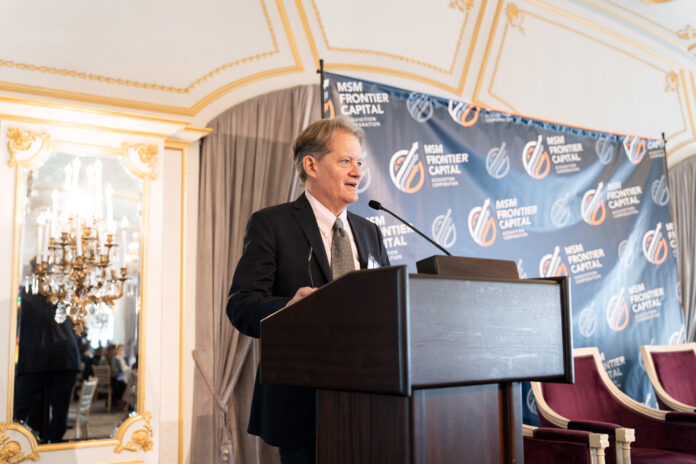
Muazzam Mairawani, Founder and Group Chairman of MSM Group and Chairman of MSM Frontier Capital Acquisition Corporation, said the continent’s problem was not a shortage of opportunities but the availability and speed of capital needed to develop them.
“Africa does not suffer from a shortage of opportunity. Africa suffers from a shortage of capital moving at the speed of opportunity,” Mairawani said.
The statement reflects a challenge that extends beyond mining.
Developing a mine is only one part of the mineral value chain. Processing and refining require additional facilities, while manufacturing requires reliable energy, transport, logistics, technology and access to markets.
The infrastructure required to support those activities also requires substantial investment.
Mairawani argued that Africa should therefore approach critical minerals as part of a wider industrial strategy.
“Africa’s future will not be built by one sector. It will be built by an industrial ecosystem,” he said.
Under that approach, mining would connect with energy, manufacturing, agriculture, logistics and global markets.
The implications extend across several areas of the economy.
Minerals could provide inputs for manufacturing. Energy resources could power industrial facilities. Ports could serve as gateways for both mineral exports and manufactured goods. Logistics networks could connect mines and factories with domestic, regional and international markets.
The objective would be to build economic activity around natural resources rather than treating extraction as the final stage of the process.
The timing of the investor forum was significant.
Earlier on September 23, United Nations Secretary-General António Guterres announced the Country Support Mechanism on Critical Energy Transition Minerals, a new initiative designed to help resource-rich developing countries establish sustainable, responsible and resilient mineral value chains.
The mechanism is intended to help ensure that greater benefits from the energy transition reach the countries and communities where critical minerals originate.
The first six partner countries identified for the mechanism are Guinea, Indonesia, Madagascar, Nigeria, Zambia and Zimbabwe.
The UN initiative placed the question of value capture firmly on the international agenda.
The investor forum approached the same issue from the perspective of finance.
If resource-rich countries are to capture more value from critical minerals, they need capital to build processing plants, refineries, industrial facilities, energy infrastructure and logistics networks.
They also need companies capable of attracting and deploying international investment.
That was one reason the forum placed considerable attention on access to U.S. capital markets.
A session on African country risk and the rule of law examined issues including political stability, contract enforceability and governance.
Those considerations are important for international investors assessing long-term projects and determining how capital can be deployed.
The forum subsequently examined the practical pathway to U.S. markets.
The session, titled “Financing the Pathway to U.S. Markets,” was moderated by Crocker Coulson of AUM Advisors and featured Joe Riggio, Founding Partner at Jett Capital; Mitch Nussbaum, Co-Chair at Loeb & Loeb LLP; Patrick A. Sturgeon, Managing Partner at Brookline Capital Markets; and Gracelin Baskaran, Director of the Critical Minerals Security Program.
The panel examined transaction structures, due diligence, governance requirements, legal considerations and the use of U.S. public markets and SPAC structures to finance and consolidate critical-minerals opportunities.
The discussion pointed to another part of Africa’s challenge.
The continent may possess large mineral resources, but resources alone do not create investment-ready businesses.
Projects need appropriate structures, credible governance and the ability to absorb capital and convert it into productive assets.
That means building businesses that can operate across complex value chains.
It also means addressing the infrastructure gap.
The global minerals market is increasingly characterised by concentrated refining capacity.
According to figures cited during the forum, the average share of the top refining country across key energy minerals reached approximately 70% in 2025.
For Africa, this concentration presents an opportunity to develop more processing and refining capacity.
But doing so requires capital on a scale that can support industrial infrastructure rather than only individual extraction projects.
The discussion also raised questions about ownership.
If a mineral is extracted in Africa but processed elsewhere, a significant part of the value chain remains outside the producing country.
If processing and manufacturing are developed locally or regionally, more economic activity can potentially take place closer to the source of the resource.
That includes jobs, industrial capabilities, technology development and business ownership.
The question of ownership therefore sits alongside the question of investment.
Foreign capital can provide financing, but the broader objective discussed at the forum was to use capital to build capabilities and long-term value within Africa.
The forum attracted senior African political and economic figures, including Somali President Hassan Sheikh Mohamud, IGAD Executive Secretary Dr. Workneh Gebeyehu, former Nigerian President Olusegun Obasanjo, Nigerian Vice President Kashim Shettima Mustapha, HRH Muhammadu Sanusi II, 16th Emir of Kano and former Governor of the Central Bank of Nigeria, Dr. Mansur Muhtar, Chairman of Bank of Industry Nigeria, and Dr. Issa Faye, Director General of Global Practices and Partnerships at the Islamic Development Bank.
Their participation reflected the broader significance of the critical-minerals discussion.
The issue is increasingly connected to economic development, industrialisation, energy security, international finance and global supply chains.
The global energy transition is increasing demand for minerals, while governments and companies are looking for secure and diversified supplies.
For Africa, the combination creates an opportunity to attract investment into a sector that is becoming increasingly important to the world economy.
But participants stressed that the opportunity should not be measured only by the volume of minerals extracted.
The larger measure is what happens after extraction.
Does the mineral feed an African processing facility?
Does it support manufacturing?
Does the infrastructure built around mining contribute to broader industrial development?
Do African companies develop the capabilities required to participate in global markets?
And does a greater share of the resulting economic value remain within African economies?
Those questions were at the centre of the “From Mine to Markets” concept.
Mairawani outlined a vision in which gas can power African industries before being exported, minerals can become inputs for batteries and advanced manufacturing, agriculture can evolve into agribusiness and ports can develop into industrial gateways.
The approach effectively treats natural resources as foundations for wider economic ecosystems.
The challenge is turning that vision into investable projects.
That is where capital markets enter the discussion.
The forum’s focus on U.S. markets was aimed at exploring how African opportunities can be connected with international investors and financing structures.
For investors, the availability of credible projects matters.
For African governments, the ability to attract capital must be linked to broader economic priorities.
For companies, the challenge is demonstrating that their projects can operate within the legal, governance and financial frameworks required by international markets.
The forum therefore placed capital at the centre of Africa’s next critical-minerals challenge.
The continent has the resources.
The global economy has the demand.
International investors have capital.
But the infrastructure, companies and industrial systems required to connect those elements still need to be built.
Mairawani described the immediate task in simple terms: “Now we must convert confidence into capital. And capital into industries.”
That transition could determine the extent to which Africa benefits from the global critical-minerals economy.
Rather than measuring success only by exports, the emerging debate is increasingly focused on processing capacity, manufacturing, infrastructure, technology, jobs and ownership.
The UN’s new mechanism has placed greater value capture from critical minerals on the global development agenda.
The New York investor forum added the financial dimension, focusing on how capital can support the industries required to make value addition possible.
Together, the developments underline a broader shift in the critical-minerals debate.
For Africa, the opportunity is no longer simply about having the minerals the world needs.
It is about building the economic systems that can turn those minerals into lasting industrial value.
As Mairawani concluded, “The greatest investment story of the twenty-first century will not simply happen in Africa. It will be led by Africa.”

