

KIGALI — Rwanda’s agreement to bring Formula One racing back to Africa could mark a turning point in the continent’s relationship with the global sports industry, offering an opportunity to convert its growing commercial importance into greater bargaining power, investment and economic returns.
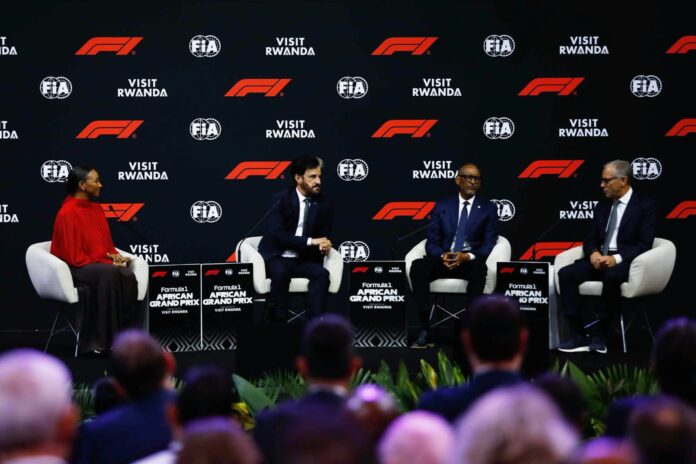
President Paul Kagame joined Formula One President and Chief Executive Officer Stefano Domenicali and FIA President Mohammed Ben Sulayem in Kigali to announce the historic agreement, opening the way for the championship’s return to Africa after more than three decades.
For Rwanda, the deal represents an opportunity to attract international investment, expand tourism and strengthen its position as a destination for major global events. For Africa, however, its significance extends beyond hosting a prestigious sporting competition: it raises the question of whether the continent can negotiate a greater share of the commercial value generated by global sports.
Africa last hosted a Formula One Grand Prix in South Africa in 1993. Its return would come as the continent’s governments increasingly seek to use their markets, youthful populations and expanding consumer economies to secure more favourable terms in international trade, investment and cultural partnerships.
“Bringing Formula One back to Africa is an opportunity to demonstrate what our continent can achieve through ambition, investment and international partnerships. Rwanda wants to ensure that this opportunity creates lasting economic benefits, opens doors for our young people and strengthens Africa’s position on the global stage,” Kagame said.
For decades, Africa has attracted global sporting brands through its audiences, sponsorship potential and tourism appeal, yet the commercial infrastructure and ownership of many major sporting properties have remained concentrated outside the continent.
Rwanda’s initiative presents an opportunity to challenge that imbalance, provided African governments negotiate from a position of strategic strength rather than competing against one another to secure high-profile events.
Turning market potential into bargaining power
Formula One is not simply a sporting championship. It is a global commercial ecosystem encompassing broadcasting rights, sponsorship, hospitality, technology, logistics and premium tourism. Hosting a race gives the host country international visibility, but the economic value retained locally depends heavily on the terms of the agreement.
For Rwanda, the critical question is not only how many spectators will attend or how many television viewers will see Kigali’s name. It is how much of the resulting economic activity will benefit Rwandan businesses, workers and investors.
That means negotiating arrangements that encourage local procurement, workforce training, technology transfer and investment in infrastructure that serves the wider economy beyond race weekend.
It also means establishing transparent financial terms, assessing public expenditure against expected returns and ensuring that the costs of hosting do not outweigh the benefits.
“Returning Formula One to Africa is an important opportunity to connect our sport with new audiences and build partnerships that can create value beyond the race itself. Rwanda’s ambition provides a platform to strengthen those connections and contribute to the long-term development of motorsport in the region,” Domenicali said.
The commercial terms of the agreement will ultimately determine how much leverage Rwanda can exercise and how the benefits are distributed. International visibility alone does not guarantee favourable financial returns.
A stronger negotiating position would allow Rwanda to seek commitments on local employment, supplier participation, technical training and investment in industries linked to motorsport. Such provisions could help transform a sporting event into a platform for building domestic capabilities.
A continental strategy, not a competition for prestige
The agreement also raises an important question for the African Union and regional economic blocs: can African countries coordinate their approach to global sporting investments rather than compete in ways that weaken their bargaining position?
Countries often compete for international events by offering incentives, infrastructure and other concessions. While competition can attract investment, uncoordinated bidding may also encourage host governments to absorb disproportionate costs while commercial rights holders retain much of the revenue.
Africa could strengthen its position by developing common principles for negotiating major sporting agreements, sharing expertise in infrastructure development and event management, and establishing regional supply chains that allow businesses across several countries to participate.
Such cooperation would not require African governments to surrender national interests. Instead, it could help them identify the terms that generate sustainable economic returns and avoid commitments that expose public finances to excessive risk.
Rwanda could also use the event to deepen regional participation through tourism packages, transport links, hospitality partnerships and technical training involving neighbouring countries. That would expand the economic benefits beyond the host nation while strengthening East Africa’s appeal as a destination for international events.
Beyond tourism and global visibility
The potential benefits extend into engineering, automotive technology, digital broadcasting, data analytics and sports management. Partnerships with universities, technical colleges and private companies could help young Africans acquire skills relevant to high-value industries.
For Rwanda, these opportunities could complement its broader strategy of attracting investment and positioning Kigali as a centre for international business and events.
But the wider African objective should be more ambitious than hosting races or attracting foreign visitors. It should involve building the expertise, enterprises and commercial relationships needed to participate in the industries behind global sporting competitions.
This requires governments to distinguish between the prestige of hosting an event and the economic value it actually delivers. Independent cost-benefit assessments, transparent contracts and clear targets for local participation would be essential.
Rwanda’s Formula One agreement could therefore become a test of Africa’s ability to convert its growing market importance into concrete negotiating gains.
If the country secures meaningful local investment, skills transfer and business participation, it could offer a model for other African governments seeking better terms from global sporting and entertainment companies.
The ultimate measure of success will not simply be Formula One’s return to Africa. It will be whether Africa can use that return to secure a stronger position in the global sports economy, retaining more value, developing local capabilities and negotiating partnerships on terms that serve its long-term interests.

