
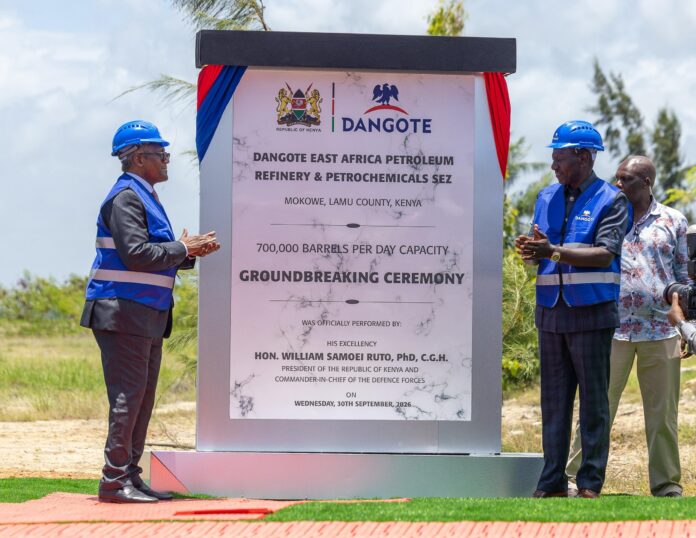
Kenya has moved closer to becoming a major regional petroleum-processing hub following the groundbreaking of a planned $16 billion Dangote refinery in Lamu, with Afreximbank positioning the project as a potential driver of energy security, industrialisation and intra-African trade.
The refinery, which is planned to process 700,000 barrels of crude oil per day, is expected to supply refined petroleum products to Kenya and other East African markets while creating about 60,000 direct and indirect jobs.
The project was launched in Lamu against a backdrop of continued disruption and uncertainty in global energy and shipping markets, highlighting the economic risks faced by African countries that rely heavily on imported refined petroleum products.
For East Africa, the proposed refinery could change regional fuel trade by allowing a greater share of petroleum consumed in the region to be processed within Africa rather than imported as finished products from overseas markets.
The facility is expected to process crude sourced from African producers, including Uganda, and produce products such as petrol, diesel and aviation fuel. Its location in Lamu also places it within the broader LAPSSET corridor, giving the project strategic links to Lamu Port and planned transport networks connecting Kenya with Ethiopia, South Sudan and other regional markets.
The investment is expected to generate business opportunities beyond the refinery itself, particularly in engineering, construction, logistics, manufacturing, transport, storage and other services required to support a large-scale energy complex.
The development comes as Kenya seeks to strengthen its industrial base and expand the role of Lamu Port as a regional logistics and trade gateway.
The refinery is planned as part of a wider industrial complex that will include petrochemical facilities, storage infrastructure, pipelines and a power-generation component. The combination of refining and downstream industrial activity could allow more value to be retained within the region from crude oil production and trade.
Afreximbank has linked the project to its broader strategy of supporting African industrialisation and increasing trade in value-added products. The bank has previously financed major projects involving the Dangote Group, including the group’s large-scale refinery in Nigeria.
The bank’s involvement also reflects a wider push to build African capacity to finance and trade refined petroleum products within the continent.
In 2025, Afreximbank established a $3 billion Revolving Intra-African Oil Import Financing Programme, aimed at supporting the purchase of refined petroleum products from African refineries. The programme is designed to facilitate between $10 billion and $14 billion in intra-African petroleum imports.
The Lamu project therefore fits into a broader shift towards developing African refining capacity and strengthening regional petroleum supply chains.
Afreximbank has also become a significant financial partner to Kenya. In 2023, it launched a $3 billion Kenya Country Programme covering infrastructure, industrial development, export manufacturing, climate adaptation, agriculture and support for small and medium-sized enterprises.
Part of that programme has been directed towards industrial and special economic zones. Afreximbank, together with the Kenyan government and ARISE Integrated Industrial Platforms, is supporting the development of the Dongo Kundu Integrated Industrial Park in Mombasa and Naivasha Special Economic Zone II, with about $1 billion earmarked for the two projects.
The bank has also partnered with KCB Group on an $800 million financing framework for enterprises operating in the Vipingo Special Economic Zone in Kilifi County.
These investments form part of Kenya’s broader effort to develop manufacturing and export capacity while positioning the country as a gateway to East and Central African markets.
The Lamu refinery could reinforce that strategy by linking energy production with port infrastructure, industrial development and regional trade.
The project’s timing is also significant for Africa’s energy security. Disruptions around major international shipping routes, particularly the Red Sea and Bab el-Mandeb, have exposed the vulnerability of countries that depend on long and expensive international supply chains for fuel.
Greater refining capacity within Africa would not remove the continent’s exposure to global crude prices or international shipping, but it could shorten some supply chains and reduce dependence on imported finished petroleum products.
The investment is nevertheless moving ahead amid concerns over land, environmental protection and community interests in Lamu. Legal challenges surrounding aspects of the project could influence its implementation and construction timetable.
The environmental dimension is particularly important because Lamu is home to sensitive coastal ecosystems and communities whose livelihoods depend heavily on fishing, tourism and other marine-related activities.
For Dangote Group, the Lamu investment represents a major expansion of its industrial footprint beyond West Africa. The company already operates the 650,000-barrel-per-day Dangote refinery in Nigeria, one of Africa’s largest petroleum-processing facilities.
A second major refinery in East Africa would give the Nigerian conglomerate a significant position in the continent’s petroleum value chain and potentially create new trade links between West and East Africa.
For Kenya, the project offers the prospect of increased industrial activity, employment and regional fuel exports, while for neighbouring countries it could provide an additional source of refined petroleum products.
The economic impact, however, will ultimately depend on the project’s construction timetable, crude supply arrangements, infrastructure connectivity, financing, regional demand and the resolution of outstanding legal and environmental issues.
If completed as planned, the Lamu refinery would substantially increase Africa’s refining capacity and could strengthen Kenya’s position as an energy, logistics and industrial hu

