
The African Export-Import Bank (Afreximbank) has extended a €40 million revolving working capital facility to Cameroon’s Prometal SA, supporting the company’s expansion and strengthening local manufacturing capacity in the country’s steel and metallurgical sector.
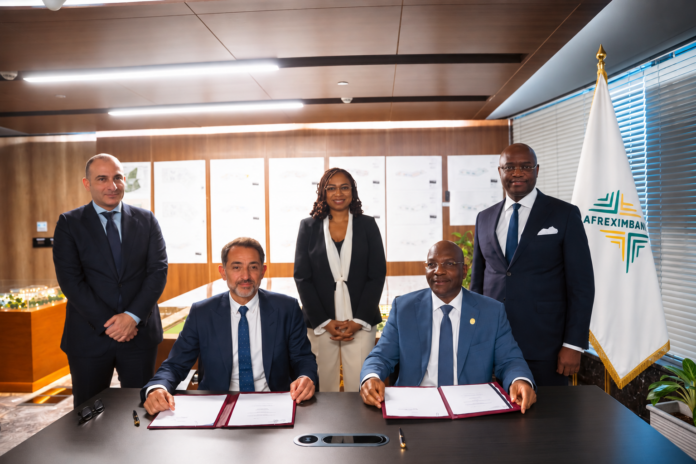
Afreximbank and Prometal SA signed the financing agreement on September 28 at the bank’s headquarters in Cairo, Egypt. The facility will provide working capital financing and guarantees to support Prometal’s industrial operations and growing production requirements.
The agreement was signed by Denys Denya, Senior Executive Vice President of Afreximbank, and Hayssam El Jammal, Chief Executive Officer of Prometal SA.
The financing will enable Prometal to process and transform semi-processed steel into finished products, including construction materials and agricultural equipment. It is also expected to strengthen the company’s ability to respond to rising demand from Cameroon’s construction, infrastructure, industrial and agricultural sectors.
Afreximbank President and Chairman of the Board of Directors, Dr George Elombi, said the facility reflects the bank’s strategy of supporting African industrial companies capable of driving domestic production and regional value chains.
“This facility is in step with Afreximbank’s commitment to accelerate industrialisation, ensuring that the continent realises maximum value from its natural resources,” Elombi said.
He added that supporting companies such as Prometal would help expand Africa’s domestic manufacturing capacity while creating value chains that extend beyond individual markets.
For Prometal, the financing marks another phase in its strategy of expanding production and reducing dependence on imported manufactured goods.
El Jammal said the partnership with Afreximbank would help the company advance its industrial expansion while increasing the production of goods that are still largely imported into African markets.
“Our mixed-matrix strategy combines, on one hand, vertical integration across the value chain from the processing of raw materials to the production of finished goods, and, on the other hand, horizontal expansion into new markets,” he said.
He said the strategy is aimed at strengthening African production capacity, reducing import dependence and retaining more value within African economies.
The financing comes as African countries seek to deepen industrialisation by increasing domestic processing and manufacturing, reducing reliance on imported finished products and developing regional value chains.
Prometal SA has invested in expanding manufacturing capacity in Cameroon, with a focus on import substitution and the development of locally produced steel and industrial goods.
The group operates through two principal business lines — Prometal Acier and NOVIA Industries.
Prometal Acier is the group’s core steel and metallurgical business. It operates seven industrial plants with an aggregate annual production capacity of approximately 360,000 tonnes of finished steel products.
The company produces steel products for sectors including construction, infrastructure and agriculture, positioning it as a significant player in Cameroon’s industrial and regional steel market.
NOVIA Industries, established in 2018, represents Prometal’s expansion into agribusiness. The company has developed production capacity of approximately 500 tonnes of edible oil per day and 160 tonnes of soap per day, making it a significant producer of refined palm-oil products and related by-products.
The €40 million facility therefore extends beyond working capital support, providing financing for a company operating across interconnected manufacturing and agribusiness value chains.
The transaction also reflects Afreximbank’s broader strategy of using trade and industrial financing to support African companies, expand productive capacity, and facilitate greater intra-African trade.
For Cameroon, the expansion of local steel production could support the availability of materials for infrastructure and construction while strengthening domestic manufacturing linkages with agriculture and other productive sectors.

