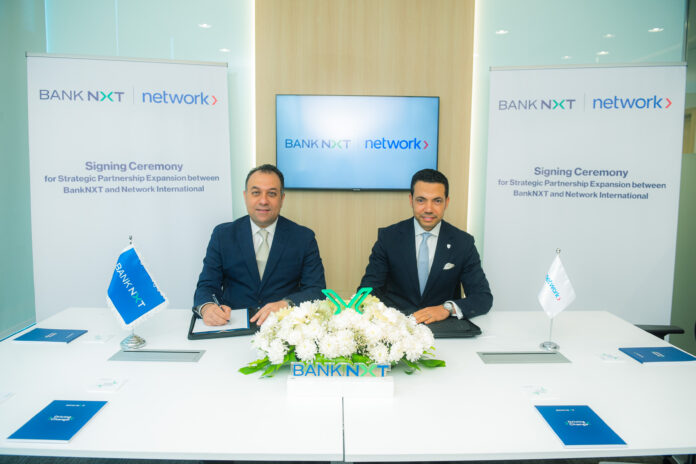
Bank NXT’s expanded partnership with Network International highlights how African financial institutions are investing in digital infrastructure as governments increasingly turn to domestic borrowing, local capital markets, and private investment to finance development.
Egypt’s Bank NXT has extended its collaboration with Network International to modernise its payments infrastructure, highlighting the growing role of financial technology in Africa’s economic transformation and the continent’s broader drive to strengthen its domestic financial systems.
Under the agreement, Bank NXT will migrate its automated teller machine (ATM) and debit card portfolio to Network International’s end-to-end processing platform. The move is expected to streamline operations, strengthen security controls and improve customer experience while enabling the bank to introduce new services more efficiently.
The partnership comes as African countries face mounting pressure to finance infrastructure, expand digital economies and reduce dependence on expensive external borrowing. Although roads, railways, energy systems and water networks remain major investment priorities, digital payments infrastructure is increasingly important to financial inclusion, trade and business growth.
Tamer Seif El-Din, chief executive officer and managing director of Bank NXT, said the collaboration would support the bank’s expansion strategy by improving operational efficiency and delivering secure, digitally advanced banking services.
He said the migration would help the bank introduce innovative services faster while responding to the changing needs of Egypt’s banking customers.
Dr Reda Helal, Group Managing Director for Processing, Africa and Growth Markets at Network International, said the partnership reflected the company’s commitment to supporting banks across the Middle East and Africa as they modernise their financial services.
The collaboration also demonstrates how African banks are relying on specialized technology providers to upgrade essential infrastructure without necessarily developing every component of their payment systems in-house.
Domestic borrowing becomes a critical financing tool
The investment comes against a wider shift in Africa’s development financing model, with governments increasingly tapping domestic debt markets to fund spending as external borrowing becomes more expensive.
According to the African Development Bank’s 2025 African Economic Outlook update, Africa’s domestic public debt increased from approximately 29 per cent of total public debt in 2010 to 38 per cent in 2024, reaching nearly $500 billion.
The figures illustrate the growing importance of local financial markets in mobilising resources for national development. Governments raise domestic financing through treasury bills, government bonds and other local-currency instruments, which can help fund public investment and reduce exposure to exchange-rate fluctuations associated with foreign-currency debt.
However, domestic borrowing does not automatically translate into infrastructure investment. Governments must allocate the proceeds to productive projects, while managing repayment costs and ensuring that public borrowing does not restrict private businesses’ access to credit.
The African Development Bank estimates that the continent faces an annual financing gap of approximately $402.2 billion to accelerate structural transformation by 2030, underscoring the scale of the challenge facing governments seeking to build transport networks, expand electricity access and improve digital connectivity.
Kenya offers a recent example of efforts to mobilise domestic capital for infrastructure. In October 2026, the country’s National Infrastructure Fund began deploying its 340 billion Kenyan shilling ($2.62 billion) seed capital through domestic government bonds, with the objective of supporting investment in commercially viable sectors, including energy, transport, information and communications technology, agriculture and water.
The approach illustrates how domestic financial instruments can be incorporated into broader infrastructure investment strategies, although their development impact will depend on project selection, governance and the fund’s ability to attract additional capital.
Mobilising local savings for long-term investment
Beyond government bonds, African countries have an opportunity to channel domestic savings held by pension funds, insurance companies and other institutional investors into infrastructure projects.
A joint study by the World Bank, International Finance Corporation and African Development Bank estimated that Africa’s infrastructure financing gap stood at between $130 billion and $170 billion annually. It identified domestic institutional investors as a potential source of long-term capital for infrastructure, affordable housing and sustainable development.
This approach could help African economies finance projects in local currencies while providing pension funds with longer-term investment opportunities. However, unlocking this capital requires credible projects, predictable regulation, and transparent procurement and investment structures that protect savers.
The broader challenge is that domestic borrowing can also increase pressure on public finances. The African Development Bank reported that Africa’s total public debt exceeded $1.8 trillion in 2025, while rising debt-servicing costs have constrained governments’ capacity to invest in development. For banks and fintech providers, modernising payments systems is therefore part of a wider effort to build financial infrastructure capable of supporting economic growth. Secure digital transactions can help businesses operate more efficiently, broaden access to financial services and support the expansion of formal economic activity.
Bank NXT’s partnership with Network International reflects this shift, positioning payment processing as an essential component of Egypt’s digital transformation.
Ultimately, Africa’s infrastructure financing challenge will require more than borrowing. Governments must combine domestic revenue, local capital markets, private investment and development finance while ensuring that projects generate measurable economic and social returns.
For Egypt and the wider continent, stronger digital financial systems can help create the foundations for a more connected economy, even as governments seek sustainable ways to finance the roads, energy networks and other infrastructure needed for long-term development.