


Kenya’s exporters have gained a fresh two-year window to deepen their access to the United States market under the renewed African Growth and Opportunity Act (AGOA). Still, the reprieve comes at a time when China is making an increasingly aggressive push to open its market to African products through a sweeping zero-tariff policy.
The contrasting trade offers from Washington and Beijing are creating a new competitive landscape for African exporters, with Kenya among the countries positioned to benefit from both markets.
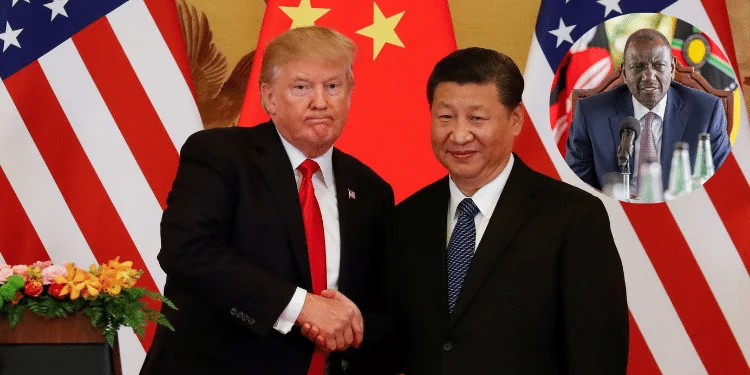
US President Donald Trump has signed legislation extending AGOA until December 31, 2028, providing eligible Kenyan products with continued preferential, duty-free access to the US market. The extension follows months of uncertainty after the programme expired in September 2025 and was temporarily renewed. The new legislation also extends key provisions supporting Africa’s apparel industry.
For Kenya, the US decision is particularly important because of the country’s dependence on the American market for manufactured exports. The textile and apparel industry alone supports more than 66,000 direct jobs, making continued AGOA access critical for factories, workers and investors operating in the country’s Export Processing Zones.
Investment, Trade and Industry Cabinet Secretary Lee Kinyanjui said the extension provides much-needed certainty for exporters, manufacturers and investors planning production and investment decisions around the US market.
But while Kenya celebrates the extension, another major development is reshaping Africa’s trade opportunities ,China’s decision to grant zero-tariff treatment to all 53 African countries with which it maintains diplomatic relations.
China’s policy took effect on May 1, 2026. It covers 100 per cent of tariff lines for African countries with diplomatic ties to Beijing. For the 33 African least-developed countries that already enjoyed zero-tariff treatment, the existing arrangement continues, while 20 non-LDC countries, including Kenya, are benefiting from the new two-year preferential arrangement running to April 30, 2028.
This places Kenya in a potentially advantageous position. Kenyan exporters can now look towards two of the world’s largest consumer markets, each offering preferential treatment, although through significantly different trade frameworks.
Two markets, different trade models.AGOA and China’s zero-tariff initiative are not identical.
AGOA is a US trade preference programme under which eligible sub-Saharan African countries receive duty-free access for thousands of products, subject to eligibility requirements and rules governing areas such as apparel and sourcing. Its extension to 2028 gives businesses greater certainty, but the programme remains subject to periodic renewal by Congress.
China’s approach, by contrast, represents a unilateral expansion of market access to African countries with diplomatic relations with Beijing. Chinese authorities say the zero-tariff arrangement is part of a broader package that includes negotiations on Economic Partnership Agreements for Shared Development and measures to facilitate African agricultural and food exports.
The difference could become increasingly significant for Kenya as it seeks to diversify its export destinations.China is already Africa’s largest trading partner, and Beijing has been attempting to increase imports from the continent to address the imbalance in bilateral trade. In 2025, China-Africa trade reached a record $348 billion, although African exports to China remained substantially below Chinese exports to the continent.
China opens the door wider
For Kenya, the Chinese market presents opportunities beyond traditional commodities.The first day of the expanded Chinese zero-tariff programme saw Kenyan avocados enter China with tariff savings. Chinese authorities have also highlighted African agricultural products such as citrus, coffee, wine, pharmaceutical raw materials and other products as potential beneficiaries.
This could create opportunities for Kenya to increase exports of avocados, coffee, tea, flowers, meat products, leather and processed agricultural goods.
However, tariff-free access alone does not guarantee increased exports. Kenyan producers must still meet China’s quality, phytosanitary, packaging, certification and supply-chain requirements.
China has sought to address some of these barriers by upgrading “green channels” for African agricultural and food products, streamlining quarantine procedures and introducing risk-based customs management.
Kenya must use both opportunities .The simultaneous availability of preferential access to the US and Chinese markets gives Kenya an opportunity to pursue a more diversified export strategy rather than becoming overly dependent on one destination.
Kinyanjui has already urged exporters to use the extended AGOA period to move beyond apparel and expand into value-added agricultural products, leather and leather products, pharmaceuticals and manufactured goods.
The same strategy could apply to the Chinese market. The real challenge is therefore not simply whether Kenya has access to foreign markets, but whether it has the industrial capacity to supply them competitively.
Kenya needs to invest in processing, manufacturing, standards, logistics and technology if it is to transform tariff preferences into sustained export growth.
A new China-US competition for African trade
The AGOA extension and China’s zero-tariff initiative also reflect a broader contest for economic influence in Africa.
Washington is using preferential market access to strengthen commercial ties with African economies, while Beijing is combining tariff reductions with investment, infrastructure, trade facilitation and broader economic partnerships.
For Kenya, the competition offers an opportunity rather than a dilemma. With AGOA now secured until 2028 and China opening its market to African products, Nairobi has two major export windows that can support industrialization, investment, and job creation. The priority should be to ensure Kenyan businesses are capable of taking advantage of both.

