
The rapid digitisation of traditional medicine knowledge and the growing use of artificial intelligence in health research are opening new possibilities for innovation while raising questions over who owns, controls and benefits from knowledge held by Indigenous Peoples and local communities.
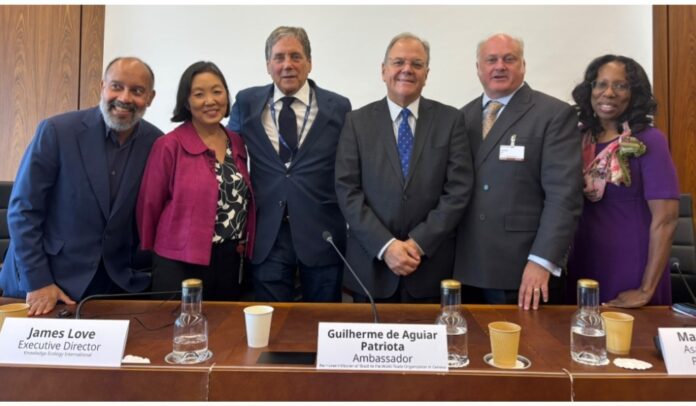
Experts from international organisations, academia, governments and civil society raised the concerns during a side event co-organised by the World Health Organization (WHO) and Knowledge Ecology International (KEI) on September 22, 2026, on the sidelines of the 53rd Intergovernmental Committee (IGC) at the World Intellectual Property Organization (WIPO).
The discussion, held under the theme “Intellectual Property and Traditional Medicine: Rethinking Access, Benefit Sharing and Data Governance,” examined how intellectual property, access and benefit-sharing and data governance systems can support innovation in traditional medicine without undermining the rights of the communities that have developed and preserved the knowledge.
Dr Suerie Moon, Co-Director of the Global Health Centre at the Graduate Institute, who moderated the panel, described the discussion as timely amid rapid technological and legal changes affecting traditional medicine knowledge.
The emergence of artificial intelligence has added a new layer to an already complex debate.
AI systems can process large volumes of information and potentially accelerate research into medicinal compounds and treatments derived from traditional medicine. But as traditional knowledge is converted into digital databases and made available for research, questions arise over whether the original knowledge holders can be identified, consulted and fairly compensated.
Margo A. Bagley of Emory University said AI could accelerate drug discovery based on traditional medicine knowledge, while simultaneously making it harder to trace the contributions of the communities from which that knowledge originated.
The concern is particularly significant where traditional medicine knowledge has historically been transmitted orally or within communities and has not been documented through conventional intellectual property systems.
Once such knowledge enters digital databases, its movement across borders and its use by researchers, technology companies and other institutions can become difficult for communities to monitor.
James Love, Director of KEI, presented findings from two draft WHO papers examining legal and intellectual property considerations surrounding traditional medicine databases.
He highlighted the difficulty of protecting community rights when traditional medicine information is stored and accessed across different jurisdictions, where intellectual property and data governance rules may differ.
Love proposed federated data governance as one possible approach, alongside benefit-sharing arrangements tailored to the circumstances of particular communities.
Such models could allow information to contribute to evidence generation and research while giving communities greater control over how their knowledge is accessed and used.
For WHO, the challenge is not simply to promote traditional medicine but to ensure that its development is safe, effective and evidence-informed while respecting the people and ecosystems connected to it.
Manjeet Singh Saluja of the WHO Global Traditional Medicine Centre said the organisation is working on initiatives including an intellectual property toolkit for traditional medicine and a framework aimed at promoting respectful knowledge exchange with Indigenous Peoples.
He also emphasised the importance of recognising Indigenous and local communities’ rights while safeguarding biodiversity.
The debate comes as international efforts to strengthen protections for genetic resources and associated traditional knowledge gain momentum.
Reflecting on the recently adopted WIPO Treaty on Intellectual Property, Genetic Resources and Associated Traditional Knowledge, Guilherme de Aguiar Patriota, Ambassador of Brazil to the World Trade Organization, described the agreement as an important step towards greater transparency and recognition of Indigenous Peoples and local communities within the international intellectual property system.
He stressed, however, the importance of securing ratifications and ensuring effective implementation of the treaty.
For traditional medicine practitioners and knowledge-holding communities, the issue extends beyond whether their knowledge can be used for scientific research. It also concerns who has authority over the knowledge, whether consent was obtained before it was documented or commercialised, whether communities receive recognition and whether benefits arising from its use return to them.
The speakers therefore examined governance models for traditional medicine databases, including the role of prior informed consent and mechanisms for equitable benefit-sharing.
A recurring message throughout the discussion was that Indigenous Peoples and local communities should not be treated merely as repositories of information for researchers to extract.
Instead, they should participate in decisions about how their knowledge is documented, stored, accessed, researched and commercialised.
This becomes increasingly important as AI and digital technologies make it possible to combine traditional knowledge with scientific databases and computational tools at unprecedented speed.
Without appropriate safeguards, experts warned, the same technologies that could help advance research and innovation could also make attribution, provenance and accountability more difficult.
Closing the event, Saluja stressed that responsible governance of traditional medicine knowledge should protect community rights and authority, preserve attribution and provenance, promote equitable benefit-sharing and establish responsible and traceable data governance.
Dr Moon said the discussion had helped draw attention to the complexity of the intellectual property and traditional medicine ecosystem while moving towards concrete proposals.
The emerging debate therefore places traditional medicine at the intersection of health innovation, artificial intelligence, intellectual property and Indigenous rights with the question no longer only being what technology can discover from traditional knowledge, but also who should have a say in what happens to that knowledge once it enters the digital world.

