
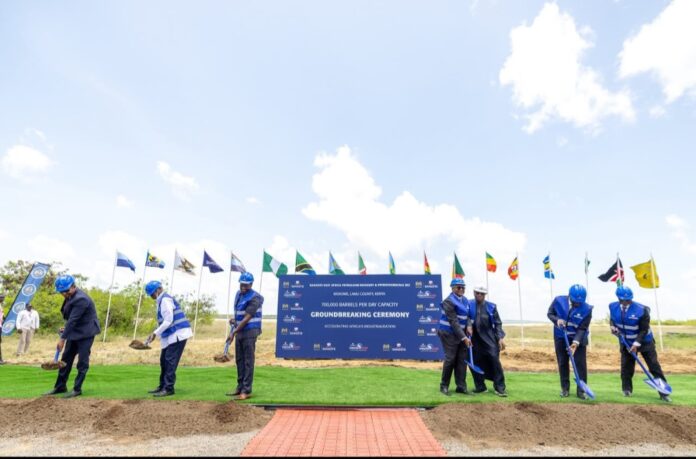
Kenya’s biggest industrial bet since independence is moving from the drawing board to the ground, but the $16 billion Lamu oil refinery is arriving with a question that could prove as important as the size of the investment itself: who gets to shape the development of the coast?
Nigerian billionaire Aliko Dangote and President William Ruto are expected to break ground on the proposed refinery, with construction scheduled to begin on November 1. Once completed, the facility is projected to process 700,000 barrels of crude oil a day, matching the capacity of Dangote’s flagship refinery in Nigeria and making it the largest industrial project in East Africa by processing capacity.
Dangote describes the Kenyan venture as a major industrialisation project rather than simply an oil business.
The refinery will be accompanied by a 1,000-megawatt power plant, designed to supply the facility while also supporting other industries expected to emerge around it.
At peak construction, Dangote says the project could create about 60,000 jobs, potentially transforming Lamu from a largely coastal and tourism-dependent economy into a major industrial and energy centre.
But even before construction begins, the project is confronting a familiar challenge in large infrastructure projects across Africa: development ambitions are colliding with demands from communities over land, compensation and environmental protection.
Some Lamu residents have protested over compensation for land being used for the refinery.
Dangote has rejected the claims, arguing that his company is taking only the land it requires from what the government made available.
He has also dismissed the protests as being driven by local marketers and international interests, insisting that the refinery will proceed and remain on schedule for completion in 2030.
For community organisations, however, the dispute is not simply about compensation.
Walid Ali, co-founder of the Save Lamu campaign group, says residents want access to the project’s environmental impact assessment findings so they can understand what safeguards are being proposed.
The group has also raised concerns about community participation, arguing that residents have not been sufficiently engaged in decisions surrounding the project.
That tension places the refinery at the centre of a bigger question about Kenya’s development model: whether communities living around major investments are treated as beneficiaries and participants, or primarily as populations affected by decisions made elsewhere.
The stakes are particularly high in Lamu, an area with important ecological, cultural and economic interests.
The refinery is also significant because Kenya does not produce crude oil at the scale required to feed a 700,000-barrel-a-day facility.
Critics have therefore questioned why a refinery of this size should be located in Kenya rather than in an oil-producing country such as Uganda or Tanzania, both of which are developing infrastructure to move crude towards international markets.
Kenya’s Energy and Petroleum Minister Opiyo Wandayi argues that the absence of domestic crude production does not make the project unviable.
Refineries, he says, can buy crude on international markets.
Dangote makes the same argument, pointing to Singapore, a major refining and trading centre despite producing virtually no crude oil of its own.
The distinction is important because the proposed refinery is being conceived less as a facility dependent on Kenyan oil and more as a regional and international processing hub.
Its location on the coast could allow crude to be imported and refined for markets in Kenya and elsewhere in the region.
That could potentially change the economics of East Africa’s fuel supply chain.
Kenya currently depends heavily on imported refined petroleum products. A domestic refinery capable of processing hundreds of thousands of barrels of crude each day could reduce the country’s dependence on imported finished fuels and create new opportunities for storage, transportation, manufacturing and related industries.
But the existence of a refinery does not automatically translate into cheaper fuel.
The international price of crude oil remains a major component of the final price paid by consumers, meaning increased refining capacity alone cannot insulate Kenya from movements in global oil markets.
The more immediate industrial promise may therefore lie beyond the petrol station.
Dangote sees electricity as one of Africa’s biggest barriers to industrialisation. The proposed Lamu power plant is intended to address that problem by providing reliable electricity for the refinery and creating additional capacity for industries that could locate around it.
His wider ambitions illustrate the scale of the strategy.
Dangote says he has around $50 billion worth of projects in the pipeline, including plans to develop 10,000 megawatts of electricity generation capacity across Africa by 2030, with the possibility of doubling that capacity depending on demand.
The Lamu project would consequently become part of a broader attempt to move African economies from exporting raw materials towards processing and manufacturing.
For Kenya, that ambition fits into a longstanding desire to turn Lamu into more than a port.
The refinery could reinforce the coastal county’s role as an energy, logistics and industrial corridor, potentially attracting manufacturers that require large and reliable supplies of electricity.
Yet the size of the proposed investment also raises the consequences of getting the development model wrong.
If the project generates employment and new industries while communities feel excluded from decisions about their land and environment, the economic gains could coexist with deep local grievances.
The controversy emerging before construction therefore offers an early test of whether large-scale industrialisation can be built alongside meaningful community participation.
For Dangote, the message is clear: the refinery will go ahead.
For communities raising concerns, the question is whether going ahead is enough.
The project will ultimately be judged not only by how many barrels it processes or how much money it attracts, but also by whether the industrial transformation promised for Lamu translates into tangible opportunities for people living beside it.
With construction due to begin on November 1 and completion targeted for 2030, Kenya now has four years to demonstrate whether its largest industrial project can deliver both scale and inclusion.
Lamu is about to become a test case for a new phase of African industrialisation one where the measure of success may extend beyond what is built to include who benefits, who participates and what is protected along the way.

