
Eritrea and the United States are seeking to open a new phase of economic engagement, with trade and investment emerging as a central focus of high-level talks in Washington following the removal of US sanctions targeting Eritrean entities and officials.
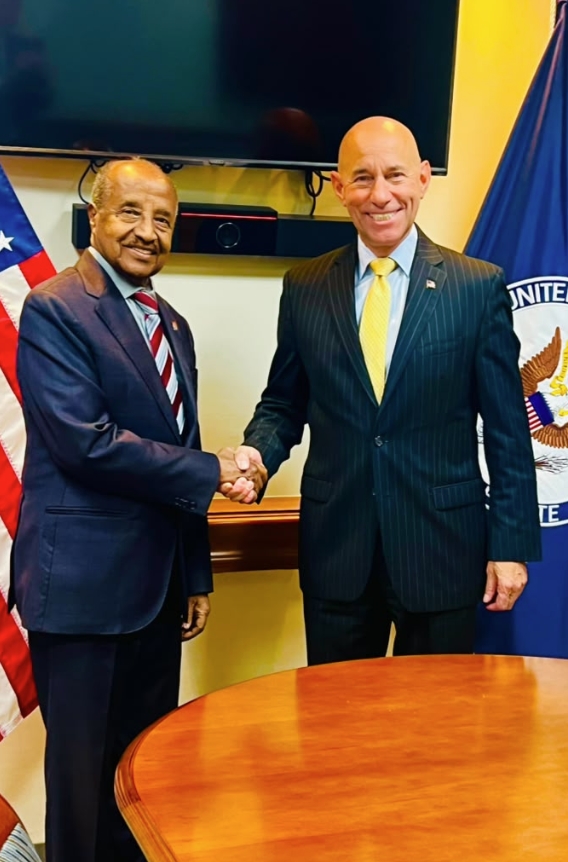
A senior Eritrean delegation led by Foreign Minister Osman Saleh met US Under Secretary of State for Political Affairs Allison Hooker and Assistant Secretary of State for African Affairs Frank Garcia in Washington, where the two sides discussed expanding bilateral trade, investment and economic cooperation.
The talks come as US-Eritrea commercial relations remain extremely limited. According to the United States Trade Representative (USTR), two-way US goods and services trade with Eritrea stood at an estimated $31.8 million in 2025, down 50.7 percent from 2024. Goods trade accounted for only $4.8 million, while services trade was estimated at $27 million.
Foreign Minister Osman described the removal of the US sanctions as an important step toward establishing a new relationship between the two countries. He said Eritrea wants the next phase of engagement to be based on what he termed a constructive, mutually beneficial partnership, with greater emphasis on trade and investment.
The Eritrean minister said the two countries should use the opportunity to address what he described as missed economic opportunities and explore new areas of cooperation while avoiding relationships that create structural dependency.
The development follows the US decision in September not to continue sanctions imposed under Executive Order 14046, which had targeted Eritrean individuals and entities, including the ruling People’s Front for Democracy and Justice, the Eritrean Defence Forces and the Red Sea Trading Corporation. The US government action took effect after the national emergency underpinning the sanctions was not continued beyond September 17, 2026.
The lifting of the sanctions removes a major constraint that had complicated financial and commercial engagement between the two countries. However, the scale of the trade relationship means that rebuilding commercial ties would require more than the removal of sanctions.
US goods exports to Eritrea fell sharply to about $4.6 million in 2025, from $45.6 million in 2024, while US imports from Eritrea declined to approximately $200,000. Services trade was considerably larger, with US exports of services to Eritrea estimated at $14 million and imports at $13 million.
The United States and Eritrea are also connected through the US-COMESA Trade and Investment Framework Agreement (TIFA), which provides a regional mechanism for dialogue on trade and investment. Eritrea, however, is not currently eligible for the US African Growth and Opportunity Act (AGOA).
During the Washington meetings, Osman also called for a review of what he described as pressure policies adopted by previous US administrations. He outlined Eritrea’s interest in cooperation on regional peace and security, including developments in the Horn of Africa, Red Sea, Gulf of Aden and Nile Basin.
Under Secretary Hooker said the US decision to lift the sanctions reflected President Donald Trump’s approach of developing bilateral partnerships based on mutual benefit. She also pointed to areas of convergence between the two sides’ priorities.
The talks with Assistant Secretary Garcia similarly focused on expanding economic and diplomatic engagement. Both sides agreed that future consultations should move toward more substantive discussions on trade and investment, regional stability and outstanding bilateral issues.
The economic discussions are unfolding against a rapidly changing geopolitical environment in the Horn of Africa and Red Sea. Eritrea’s strategic coastline, including its proximity to the Bab el-Mandeb Strait, gives the country importance in discussions over Red Sea security and maritime trade. Recent regional tensions have further increased international attention on the Red Sea corridor.
For Eritrea, the renewed US engagement presents an opportunity to seek greater access to international trade and investment. For Washington, deeper economic ties could provide another channel for engagement with a strategically located Horn of Africa country.
The immediate challenge will be translating the diplomatic opening into concrete commercial activity. With bilateral trade still below $32 million annually, the two countries have substantial scope to expand their economic relationship if the political rapprochement develops into practical agreements on investment, commerce and private-sector engagement.

