


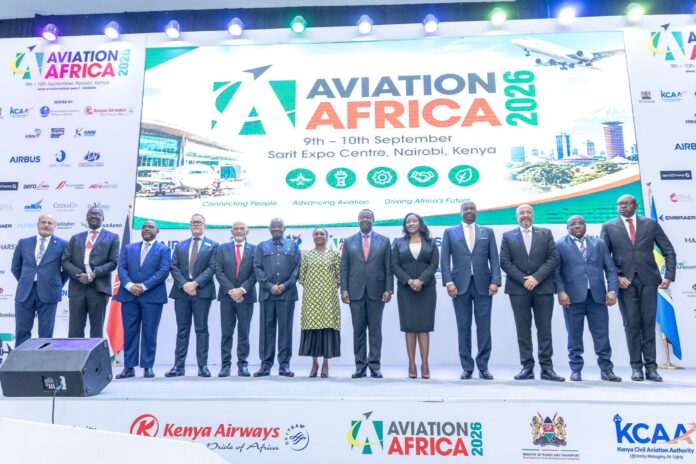
African governments are being urged to embrace open-skies policies and remove barriers that continue to make travel across the continent expensive, time-consuming and unnecessarily complicated, as policymakers push aviation to play a bigger role in Africa’s economic transformation.
Prime Cabinet Secretary Musalia Mudavadi has called on African states to accelerate the implementation of the Single African Air Transport Market (SAATM), arguing that improved connectivity could unlock new opportunities in trade, tourism, investment and employment.
Speaking during the 10th Aviation Africa Summit and Exhibition at the Sarit Expo Centre in Nairobi, Mudavadi said Africa’s aviation industry could become a stronger driver of regional integration if governments opened more routes and harmonised regulations.
He said the continent’s economic ambitions would remain constrained as long as travellers and businesses faced costly and indirect journeys between neighbouring African countries.
“Many journeys between neighbouring African countries still require transit through destinations outside our continent,” Mudavadi said.
“This increases travel time, raises costs, limits trade and constrains economic integration.”
SAATM, a flagship initiative of the African Union under Agenda 2063, seeks to create a unified African air transport market by allowing eligible African airlines greater freedom to operate across the continent.
The initiative aims to remove restrictive bilateral agreements, expand airline networks and encourage competition, ultimately making air travel more accessible and affordable.
Mudavadi said the successful implementation of open-skies policies would help transform aviation from a largely national industry into a continental economic enabler.
“Aviation is not just a means of transportation. It is an enabler of trade, tourism, investment, healthcare, education, humanitarian assistance and cultural exchange,” he said.
“It connects people, markets and opportunities. For Africa, a continent of immense geographical diversity and enormous economic potential, aviation is a strategic necessity.”
The summit brought together policymakers, aviation regulators, airline executives, investors, innovators, development partners and industry professionals to discuss the opportunities and challenges shaping African aviation.
Mudavadi said greater cooperation among African governments was necessary to address persistent barriers that have slowed the growth of intra-African air travel.
He called for harmonised regulations, mutual recognition of aviation standards, stronger safety oversight and coordinated investment in airport infrastructure.
African governments, he said, must remove unnecessary restrictions while ensuring that aviation growth does not compromise safety, security or consumer protection.
The push for open African skies is also closely linked to the African Continental Free Trade Area, which seeks to create a larger integrated market for African goods and services.
Mudavadi said improved aviation connectivity would make it easier for traders, investors and professionals to move across borders, supporting the growth of regional value chains and new business opportunities.
He argued that the benefits of aviation liberalisation would extend beyond airlines and airports, creating employment across tourism, logistics, manufacturing, hospitality and other sectors.
“Better connectivity means lower travel costs, stronger trade and tourism, greater investment and more jobs,” Mudavadi said.
Kenya is positioning itself to benefit from the expected expansion of regional aviation by investing in airport infrastructure, technology, safety and aviation skills.
Mudavadi said the modernisation of Jomo Kenyatta International Airport would strengthen Kenya’s role as a regional and global aviation hub while supporting the country’s wider economic ambitions.
However, he stressed that infrastructure alone would not be sufficient unless African countries worked together to create a more integrated aviation market.
The Prime Cabinet Secretary said governments must also prepare for rapid technological changes transforming the global aviation industry.
He called for greater investment in artificial intelligence, advanced data analytics, digital air traffic management, biometrics, cybersecurity and automation.
Such technologies, he said, could improve operational efficiency, passenger experience and aviation safety while helping African airports and airlines compete globally.
Climate change is another major challenge that will shape the industry’s future.
Mudavadi said Kenya supports global efforts to make aviation more sustainable and encouraged greater investment in sustainable aviation fuels, energy-efficient airport infrastructure, carbon-reduction initiatives and climate-resilient aviation systems.
He also emphasised the need to invest in people, particularly the next generation of African pilots, engineers, technicians and aviation professionals.
As African economies expand and passenger demand increases, Mudavadi said the continent must ensure it has the skilled workforce needed to sustain a modern and competitive aviation industry.
He said the implementation of SAATM offered African governments an opportunity to turn political commitments on integration into practical economic gains.
With more open skies, airlines could serve new destinations, businesses could access wider markets and African cities could become more closely connected without depending on transit hubs outside the continent.
Mudavadi said Africa’s aviation future would ultimately depend on governments moving beyond policy declarations and embracing cooperation.
“One connected African sky means bigger markets, greater opportunity and a more prosperous Africa,” he said.

