

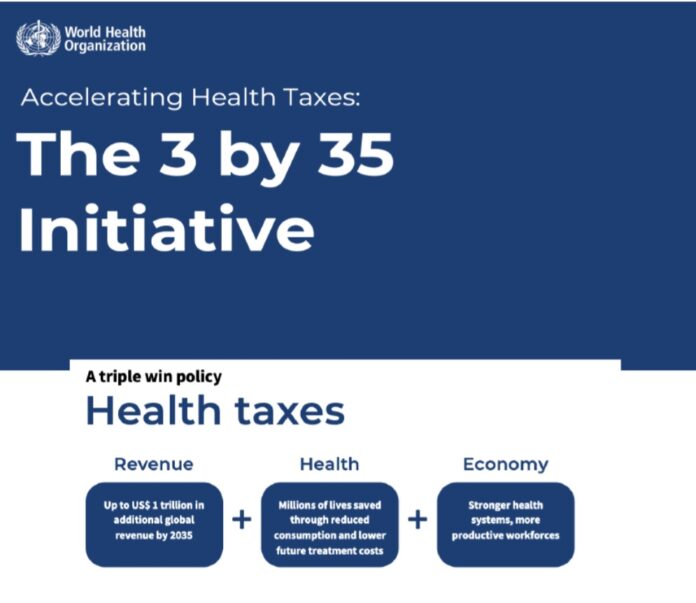
Governments need to substantially increase taxes on tobacco, alcohol and sugar-sweetened beverages if they are to make these products less affordable and reduce their impact on public health, the World Health Organization (WHO) has said.
The call comes under the WHO 3 by 35 Initiative, which seeks to achieve a 50 per cent real increase in the prices of cigarettes, alcohol and sugary drinks by 2035 through stronger health taxes.
WHO says existing tax levels remain too low in many countries despite evidence that higher prices can discourage consumption while generating additional government revenue for health and other public priorities.
The disparity is particularly evident in the taxation of sugary drinks.
WHO data show that the highest total tax share on a comparable sugary drink was recorded in Timor-Leste, where taxes account for approximately 53 per cent of the retail price.
Globally, however, the total tax share on sugary drinks averages only about 22 per cent — roughly two-thirds lower than the tax share imposed on cigarettes.
Alcohol taxation is more widespread, with at least 167 countries applying national excise taxes.
Yet population-weighted excise taxes account for only about 21 per cent of the retail price of beer and 28 per cent of spirits.
WHO also found that alcohol has not consistently become less affordable across countries.
Between 2022 and 2024, beer became less affordable in only 31 per cent of countries, while spirits became less affordable in just 22 per cent.
Automatic tax adjustments remain uncommon, with fewer than one in four countries that impose specific alcohol taxes requiring regular increases.
At least 25 countries also continue to exempt wine from excise taxation, creating differences in the way alcoholic products are taxed.
WHO says the experience of the past 15 years demonstrates that tax reform is possible even in countries facing complex economic and political conditions.
However, the organisation argues that small or occasional increases are unlikely to deliver the scale of price change required to significantly affect affordability.
Under the 3 by 35 Initiative, WHO is calling for a 50 per cent real price increase by 2035. Achieving that target would require nominal prices to roughly double globally on average.
For cigarettes, WHO estimates that the average price would need to rise from about US$4.70 to US$9.60 per pack.
The comparable price of beer would need to increase from approximately US$1.30 to US$3.10 per 330 millilitres, while a 330-millilitre serving of a sugar-sweetened beverage would need to rise from about US$0.90 to US$1.90.
The adjustment would need to be even greater in low-income countries, where prices would need to more than triple to achieve the target.
WHO is urging governments to develop long-term tax roadmaps rather than relying on isolated tax increases.
It is also calling for taxes to be automatically adjusted to account for inflation and income growth, while closing loopholes and eliminating preferential treatment for cheaper products.
Comparable tobacco, alcohol and sugary-drink products should also be covered appropriately so that consumers and producers cannot simply shift towards cheaper alternatives that remain lightly taxed.
The initiative comes as governments face the dual challenge of reducing consumption of products associated with major health risks while generating domestic revenue.
WHO is seeking to support implementation through its newly launched 3 by 35 Initiative on Health Taxes website, which is intended to accelerate health-tax reforms, facilitate knowledge exchange, strengthen country-level advocacy and mobilise global partnerships.
The organisation also plans to publish country case studies documenting progress, experiences and lessons from governments implementing health-tax reforms under the initiative.
Countries supporting the initiative are expected to share their experiences and perspectives through the platform as the campaign develops.
For WHO, the central challenge is moving health taxes from modest, irregular measures to sustained policies that prevent harmful products from becoming increasingly affordable.
The 3 by 35 target therefore places affordability at the centre of the tax debate, calling for governments to use taxation not only as a revenue tool but also as part of broader public-health policy.

