
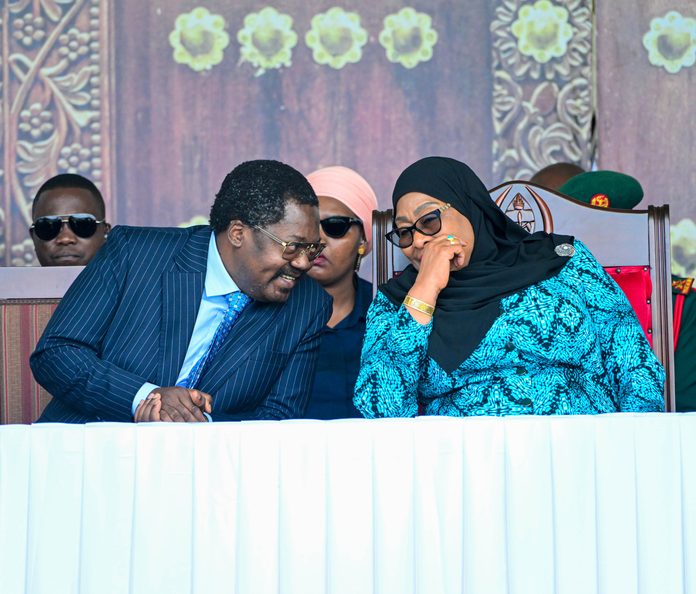
Tanzania has entered a fresh political transition after Vice-President Dr Emmanuel John Nchimbi announced his resignation from office and retirement from active politics and public service.
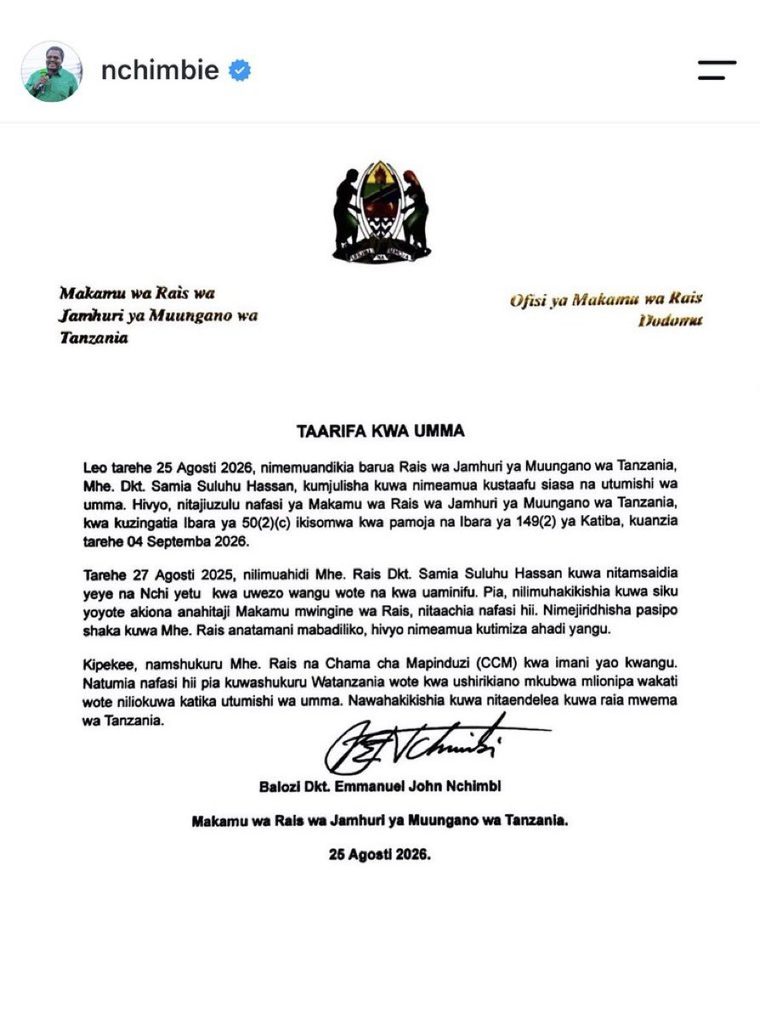
Dr Nchimbi said his resignation will take effect on September 4, 2026, ending a vice-presidential tenure of less than a year.
In a public notice issued from Dodoma on August 25, Nchimbi said he had formally submitted his resignation to President Samia Suluhu Hassan. He cited Articles 50(2)(c) and 149(2) of the Constitution of the United Republic of Tanzania as the legal basis for his departure.
But it is the explanation for his resignation that has attracted the most political attention.
Dr Nchimbi said that when he accepted the position, he promised President Hassan that he would serve the country faithfully and leave whenever she felt a change was necessary.
He now says he is satisfied that the President wants a different person in the position and has chosen to honour that commitment.
The statement is significant because Dr Nchimbi did not attribute his departure to illness, personal circumstances, political disagreement or any public dispute. Instead, he presented the resignation as a voluntary decision made because the President wants a change.
Why is Nchimbi leaving?
While the official explanation is straightforward, the political circumstances surrounding the resignation are likely to generate debate within Tanzania.
One possibility is that President Dr Samia Suluhu wants to reconfigure her political team and strengthen her position within CCM as the ruling party enters another important phase.
CCM has already begun preparations for its next internal leadership cycle, including a roadmap towards its 2027 internal elections. The changes taking place within the party are therefore likely to be viewed through the wider lens of leadership, succession and political influence.Another possibility is that Nchimbi’s role no longer fits the President’s current political strategy.
His appointment as Suluhu’s runningmate in 2025 was widely seen as strategic. He was a senior CCM figure with extensive experience in government and party structures, including serving as CCM Secretary-General and chairman of the party’s youth wing.
There has also been speculation in recent weeks about Dr Nchimbi’s position. However, such reports should be treated carefully. Earlier this month, Tanzania’s Information Services Department suspended a newspaper over a report concerning alleged pressure on Nchimbi to resign, citing concerns over accuracy and verification.
The most cautious interpretation is that President Suluhu has decided to make a change at the vice-presidential level, while Dr Nchimbi has agreed to facilitate the transition.
Who could replace Nchimbi?
The successor question is now likely to dominate political discussions within CCM.
President Suluhu will have to consider several factors, including political loyalty, experience, regional balance, gender, age, party influence and the delicate constitutional relationship between Mainland Tanzania and Zanzibar.
A new vice-president could also be selected with an eye on the longer-term succession dynamics within CCM.
Among senior figures who could attract attention is Prime Minister Mwigulu Nchemba, whose experience and position make him an important figure to watch. However, there is currently no credible public confirmation that he has been selected or formally considered for the position.
Other senior cabinet ministers and influential CCM leaders could also emerge depending on President Suluhu ‘s political calculations.
The President could alternatively favour a figure from Zanzibar, particularly if she wants to reinforce the Union’s political balance while introducing a new political personality into the presidency.
Dr Nchimbi himself was selected as Suluhu’s running mate in 2025 after former Vice-President Philip Mpango left the position. Hassan said at the time that she consulted senior CCM leaders before making the choice.
This demonstrates that the vice-presidential appointment is not simply a personal presidential decision. It carries significant implications for party unity, regional representation and the wider balance of power within Tanzania’s ruling establishment.
Nchimbi’s resignation closes a long political career
Born in Mbeya in 1971, he rose through CCM’s youth structures before becoming a member of the party’s National Executive Committee and later chairman of the Umoja wa Vijana wa CCM (UVCCM).
He entered Parliament in 2005 representing Songea Urban and subsequently held several government positions, including Deputy Minister for Information, Culture and Sports; Deputy Minister for Labour, Employment and Youth Development; Deputy Minister for Defence and National Service; Minister for Information, Culture and Sports; and Minister for Home Affairs.
He later served as Tanzania’s ambassador to Brazil and Egypt before returning to the centre of CCM politics.
In January 2024, he became CCM Secretary-General, placing him at the heart of the ruling party’s organisational machinery. His selection as Hassan’s running mate for the 2025 election subsequently elevated him to the country’s second-highest constitutional office.
His resignation is therefore more than the departure of a Vice-President. It marks the exit of a politician who rose through almost every major layer of Tanzania’s ruling party.
A new chapter for CCM
Dr Nchimbi’s departure gives President Suluhu an opportunity to reshape the political team around her as CCM prepares for its next phase.
The immediate question is who will occupy the vice-presidency. The bigger question is what that appointment will reveal about Suluhu ‘s preferred political allies, the Mainland-Zanzibar balance and the emerging succession calculations within CCM ahead of the 2027 party elections and the 2030 political cycle.
For now, Nchimbi has left without publicly accusing anyone or revealing a political dispute within the ruling CCM party.

