

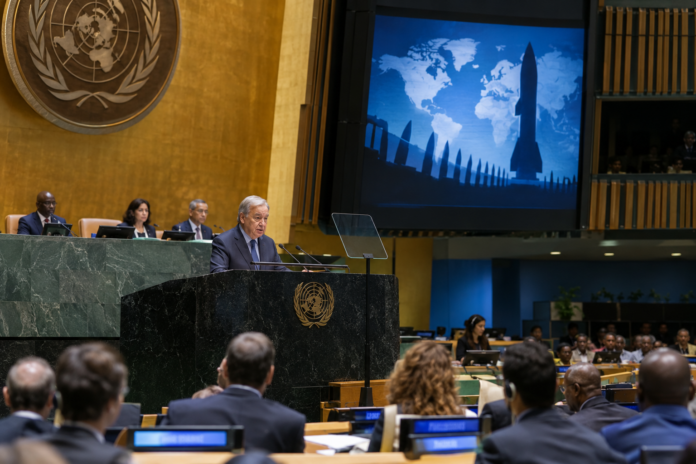
United Nations Secretary-General António Guterres has warned that the world is facing its most dangerous nuclear moment since the end of the Cold War, as efforts to advance nuclear disarmament continue to face major diplomatic setbacks.
Speaking on Tuesday at a United Nations General Assembly plenary meeting marking the International Day for the Total Elimination of Nuclear Weapons in New York, Guterres called for renewed dialogue among nuclear-armed states to reduce the risk of nuclear weapons being used.
“We meet at the most dangerous nuclear moment since the end of the Cold War,” Guterres said, pointing to the expansion and modernization of nuclear arsenals and developments in technology that can increase the risks of miscalculation.
He described recent setbacks in arms-control diplomacy as warning signs rather than isolated diplomatic failures.
One of the setbacks he highlighted was the expiration in February of the last remaining US-Russia treaty imposing limits on their strategic nuclear arsenals. Guterres urged the two countries to return to negotiations and pursue arrangements that can reduce nuclear risks.
The Secretary-General also pointed to the failure of the 2026 Review Conference of the Treaty on the Non-Proliferation of Nuclear Weapons (NPT) to reach consensus on a substantive outcome.
The conference, held from April 27 to May 22 in New York, ended without consensus. The UN said the failure came at a time of heightened international tensions and elevated nuclear risks.
Guterres said the international community must use dialogue, diplomacy and negotiation to prevent the use of nuclear weapons and ultimately eliminate the nuclear threat.
His warning comes as nuclear-armed states continue to differ sharply over the role of nuclear weapons in national and international security.
Representatives from China, India and Pakistan were among those attending the UN meeting. China’s representative defended Beijing’s nuclear capabilities, describing them as an indispensable force for deterring nuclear war and safeguarding peace, security and strategic stability.
Japan used the meeting to reaffirm its support for the Comprehensive Nuclear-Test-Ban Treaty (CTBT) and its early entry into force.
Japanese Ambassador to the United Nations Kazuyuki Yamazaki also highlighted Tokyo’s efforts to preserve the historical lessons of Hiroshima and Nagasaki and pass them on to future generations.
The UN Secretary-General has repeatedly described a world free of nuclear weapons as a central disarmament objective. Following the NPT conference in May, he said the failure to reach consensus was particularly concerning given the international security environment and called on states to make full use of available diplomatic channels to reduce tensions and nuclear risks.
The NPT remains a central instrument of the international nuclear non-proliferation and disarmament framework. The treaty seeks to prevent the spread of nuclear weapons, advance nuclear disarmament and promote cooperation in the peaceful uses of nuclear energy.
For Guterres, the immediate challenge is to prevent the deterioration of arms-control efforts from becoming a permanent feature of international relations.
His appeal to nuclear powers was therefore direct: return to dialogue, reduce tensions and take steps to ensure that nuclear weapons are never used.

