

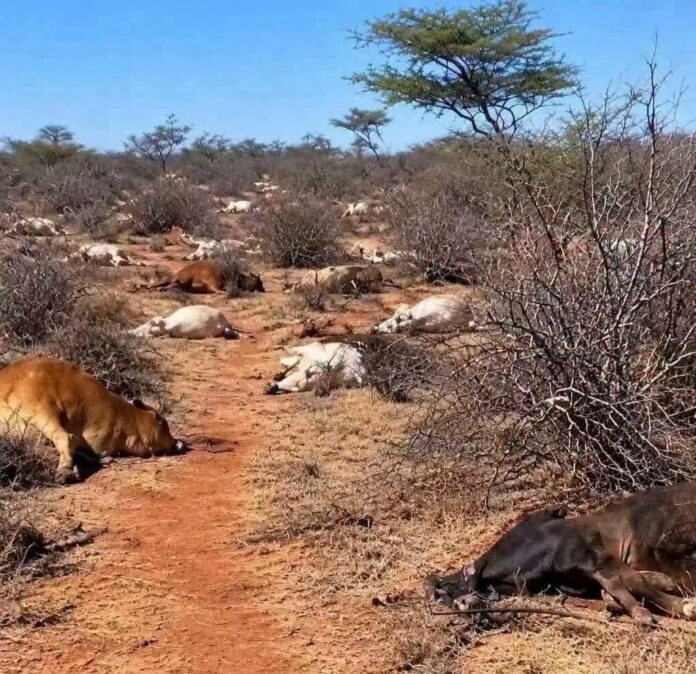
The Kenya Veterinary Association (KVA) has called for an independent investigation into the shooting of hundreds of livestock during a security operation in Samburu County, warning that the losses could deepen poverty among pastoralist families already affected by insecurity.
The association wants security authorities to establish how many animals were killed or injured, which units were involved and whether officers acted within the law and established rules of engagement.
The controversy follows a security operation in parts of Samburu after a series of attacks and cattle-rustling incidents along the Samburu-Isiolo border. Residents and local leaders have reported that cattle, goats, sheep and donkeys were shot during the operation.
Local accounts have put the number of animals killed at more than 700, while Samburu Governor Lati Lelelit has estimated the value of the reported losses at about Sh70 million.
In a statement issued on September 30, KVA said it was alarmed by reports and video footage showing livestock being shot during the operation.
Dr. Kelvin Osore, National President ,Kenya Veterinary Association, said the incident should be investigated as a matter of accountability and the lawful use of force.
“This incident cannot be viewed in isolation. It raises serious concerns about a security culture in which excessive and unaccountable force can be used against Kenyans and their property,” Dr. Osore said.
KVA acknowledged the threat posed by banditry, cattle theft and inter-community conflict, saying the State has a responsibility to protect lives and property.
However, it said security operations must remain within the Constitution and the law and should not result in the unnecessary destruction of property belonging to communities.
The association wants the Inspector General of Police and the National Police Service to establish the circumstances surrounding the killings, including the number of animals affected, the units deployed, the command structure and the applicable rules of engagement.
It is also calling for disciplinary or criminal action where investigations establish that officers acted unlawfully.
The scale of the losses remains subject to verification. Residents in Samburu East have reported that at least 517 animals ,415 goats, and 102 cattle were killed during a September 19 operation, while subsequent reports by local leaders have put the total number considerably higher.
Interior Cabinet Secretary Kipchumba Murkomen has defended the wider security operation against banditry but acknowledged that livestock were killed. He directed security agencies to exercise maximum caution to minimise collateral damage involving civilians and animals.
For KVA, the impact extends beyond the immediate loss of livestock.The association said animals are central to the economic and social survival of pastoralist communities, providing food, income and financial security while helping families pay for education, healthcare and other basic needs.
“For pastoral and agro-pastoral communities, livestock are not merely property,” KVA said. “The unnecessary loss of livestock can deepen poverty, undermine food security and inflame tensions in communities already burdened by insecurity.”
The association also raised animal-welfare concerns, citing Kenya’s Prevention of Cruelty to Animals Act, which provides legal protections against certain forms of unnecessary suffering and cruelty.
KVA said animal welfare should be considered in security planning, particularly in pastoral regions where large herds constitute a major component of household wealth.
The association is also demanding a comprehensive assessment of the losses and compensation for affected owners.
Samburu leaders have called for livestock to be counted and owners identified to establish the full scale of the damage. KVA has cited Article 40 of the Constitution, which protects the right to property and limits arbitrary deprivation of property.
The association further called for improvements in police training, oversight and reporting on the use of force, alongside stronger cooperation among security agencies, communities, veterinarians and local authorities.
“Protecting people, protecting livelihoods and protecting animals are not mutually exclusive objectives,” KVA said, urging authorities to combine security operations with community engagement, conflict prevention and access to justice.
The association said veterinarians are ready to support efforts to protect livestock health and pastoralist livelihoods in areas affected by insecurity.
The Samburu case now places pressure on security authorities to provide a detailed account of the operation as affected families await verification of their losses and possible compensation.

