

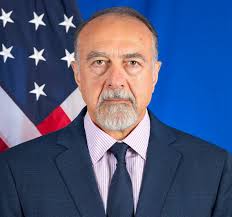
The US Senate’s confirmation of veteran diplomat Henry Wooster as Washington’s next ambassador to Kenya has restored a permanent American diplomatic presence in Nairobi at a strategically important moment, with trade, security, critical minerals and Kenya’s expanding ties with China increasingly shaping the bilateral relationship.
The Senate confirmed Wooster by voice vote on September 30, clearing the final hurdle for his appointment after the Senate Foreign Relations Committee considered his nomination at a September 16 hearing. The confirmation ends a prolonged period without a substantive US ambassador in Nairobi following Meg Whitman’s departure in November 2024.
Wooster arrives with extensive diplomatic and security experience, including service as US ambassador to Jordan and most recently as Chargé d’Affaires in Haiti, where he witnessed Kenya’s role in the multinational security mission. During his confirmation hearing, he described Kenya as one of Washington’s most consequential African partners and highlighted its security cooperation, technology sector and potential for expanded American trade and investment.
His appointment, however, comes against a wider geopolitical contest over Kenya’s strategic orientation.
During the confirmation hearing, Senate Foreign Relations Committee Chairman Jim Risch explicitly identified Kenya’s increasingly close relationship with China as an issue requiring Washington’s attention. Risch described Kenya as a US ally but also “a challenge”, citing Nairobi’s relations with Beijing alongside other foreign-policy disagreements.
This makes Wooster’s mission broader than traditional ambassadorial diplomacy. Kenya is an important security partner for Washington in East Africa, but it is also deeply economically connected to China through infrastructure, trade, investment and development cooperation. At the same time, Nairobi maintains relations with Russia and other emerging powers, reflecting Kenya’s effort to preserve room for manoeuvre in an increasingly competitive international system.
Rather than simply seeking to pull Kenya away from China, Washington’s approach appears increasingly centred on offering alternative partnerships in areas considered strategically important to the United States.
One of the clearest examples is critical minerals.At the centre of this emerging competition is Mrima Hill in Kwale County, where Kenya has identified deposits of niobium and rare-earth elements. The Ministry of Mining says geological work has confirmed the presence of niobium, yttrium, thorium, strontium and lanthanum. The deposit covers about 31.9 square kilometres and contains mineralisation with significant concentrations of niobium and rare-earth elements.
The significance of Mrima Hill extends far beyond Kenya’s mining sector. Rare-earth elements are important inputs for advanced electronics, high-strength magnets, clean-energy technologies and military applications, while niobium is used in specialised alloys, including aerospace and industrial applications.
That has placed Kwale within a much wider global competition over critical-mineral supply chains.
Reuters reported in September that Washington had offered assistance to Kenya in developing a critical-minerals processing industry, as the United States seeks to diversify supply chains and reduce dependence on China, which dominates important parts of the global rare-earth processing and refining industry. American officials have also backed local processing and value addition rather than simply exporting raw minerals.
The US interest is significant because Kenya is considering bids for development of Mrima Hill, with American-linked consortia among those competing for the project. The potential value of the deposits has been estimated in the tens of billions of dollars, although Kenya has yet to produce an economic viability report for the prospect.
For Washington, therefore, Wooster’s arrival provides an opportunity to deepen engagement with Kenya around minerals, technology, trade and investment while strengthening existing security cooperation.
For Nairobi, the competition creates leverage but also difficult choices. Kenya can potentially use interest from Washington, Beijing and other international partners to attract investment, technology and local processing while insisting on greater domestic value addition.
The stakes around Mrima Hill are also domestic. Community interests, environmental protection, cultural heritage and benefit-sharing will influence whether the project gains public legitimacy. Mrima Hill is regarded as a sacred site by sections of the local Digo and Mijikenda communities, adding social and environmental considerations to the commercial and geopolitical debate.
Wooster’s appointment thus comes at the intersection of Kenya’s economic ambitions and an increasingly competitive global order. His immediate task will be to translate Washington’s renewed strategic interest into practical economic and diplomatic engagement without reducing the relationship to a contest over which major power Kenya chooses.
For Nairobi, the emerging US-China competition offers another avenue to pursue its own interests. For Washington, Kenya represents both a critical security partner and a potential link in efforts to diversify strategic mineral supply chains.
The success of Wooster’s mission may ultimately depend less on geopolitical pressure and more on whether the United States can offer Kenya credible investment, technology, market access and long-term partnerships capable of competing for influence on economic as well as diplomatic grounds.

