

As Moscow prepares to host the third Russia–Africa Summit, Kenya and other African economies are seeking trade, investment, energy and technology partnerships that could strengthen their bargaining power amid intensifying competition between Western powers and the Russia-China-led Eurasian bloc.
Africa’s growing engagement with Russia and the expanded BRICS bloc is emerging as a test of whether the continent can convert geopolitical competition into industrial development, affordable financing, technology transfer and new export markets.
The Third Russia–Africa Summit, scheduled for October 28–29, 2026, in Moscow, will bring renewed attention to the continent’s economic relationships with Russia and other emerging powers at a time when African governments are seeking to diversify international partnerships, reduce vulnerabilities in global supply chains and secure a stronger voice in global governance.
The accompanying Russia–Africa Economic and Humanitarian Forum will operate under the theme “Developing Mutually Beneficial Cooperation and Realizing the Potential of All African Countries Together.” Its agenda includes trade, investment, peaceful nuclear energy, payment systems, digitalisation and food security.
For African economies facing high borrowing costs, infrastructure deficits, unemployment and exposure to external economic shocks, the summit presents an opportunity to move beyond diplomatic declarations towards commercially viable partnerships.
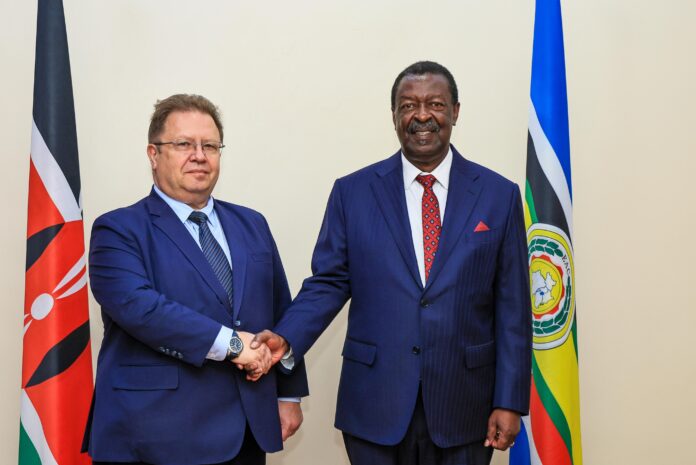
Kenya is already positioning itself to benefit. Ahead of the meeting, a Kenyan official said discussions with Russian Ambassador Vsevolod Tkachenko focused on expanding cooperation in trade, investment, energy, food security and emerging technologies, including artificial intelligence.
“Kenya’s place on the global stage must translate into real opportunities for our people,” the official said, underscoring Nairobi’s interest in securing new markets, investment and opportunities for young innovators.
BRICS expansion reshapes Africa’s diplomatic options
The Moscow summit comes as African representation within BRICS expands, giving the continent additional platforms to influence discussions on international finance, trade and global governance.
Three African countries are full BRICS members: South Africa, Egypt and Ethiopia. South Africa joined in 2011, while Egypt and Ethiopia became members in January 2024, making two African states part of the bloc’s latest major expansion.
Africa’s participation also extends to the partner-country category. Nigeria and Uganda are BRICS partners, a status that allows participation in selected meetings but does not confer the same rights as full membership. Uganda has publicly expressed its ambition to become a full member. Kenya, meanwhile, has signalled its intention to consider joining BRICS, according to its foreign policy framework.
The precise number of additional African countries currently seeking full membership has not been established by a verified, comprehensive public list. Globally, more than 30 countries expressed interest in participating in BRICS as members or partners during 2024, demonstrating the bloc’s growing appeal.
For Africa, the attraction lies in access to new markets, development finance, energy cooperation and alternative platforms for international economic engagement.
The New Development Bank, established by BRICS, offers a potential source of financing for infrastructure and sustainable development. Members can also coordinate on trade facilitation, local-currency settlement and reform of institutions such as the International Monetary Fund and World Bank. However, access to these benefits depends on concrete agreements, project viability and individual countries’ participation.
West-East rivalry creates opportunities and risks
The summit takes place against intensifying competition between Western powers and Russia, China and other emerging economies. Moscow is seeking to deepen relations with African states through economic cooperation, energy, education, agriculture and technology, while many African governments are looking to diversify their external partnerships.
For African leaders, the challenge is to secure better terms from competing partners without becoming entangled in geopolitical rivalries.
Russia offers opportunities in fertilisers, grain, nuclear energy, mining, military cooperation and technical education. China has a much broader commercial footprint across African infrastructure, manufacturing, telecommunications and renewable energy. Western partners remain important sources of investment, technology, export markets and development finance.
BRICS membership does not automatically guarantee cheaper loans, increased exports or immunity from Western sanctions. Nor does Russia–Africa cooperation eliminate the risks associated with sanctions, payment restrictions, currency volatility, and disruptions to international trade.
African governments will therefore need to assess each agreement against measurable national interests, including employment creation, local manufacturing, technology transfer and improved export capacity.
From diplomacy to jobs and industrialisation
For Kenya and other African economies, the October summit’s significance will ultimately depend on whether political engagement produces tangible economic results.
Opportunities in artificial intelligence, digital payments, food security and energy could help African businesses reach new markets and improve productivity. Cooperation in nuclear energy and industrial technology could also support long-term development, provided projects are financially sustainable and accompanied by skills development.
Africa’s bargaining power will be strongest when countries negotiate collectively through the African Union and the African Continental Free Trade Area, rather than compete individually for investment and market access.
The Moscow meeting should therefore be judged not by the number of declarations signed, but by the quality of investment commitments, market-access arrangements and financing delivered.
For Africa, the strategic objective is not to replace dependence on Western economies with dependence on Eastern powers. It is to build diversified partnerships that advance economic sovereignty, strengthen domestic industries and give African states greater influence over the global rules governing their development.

