
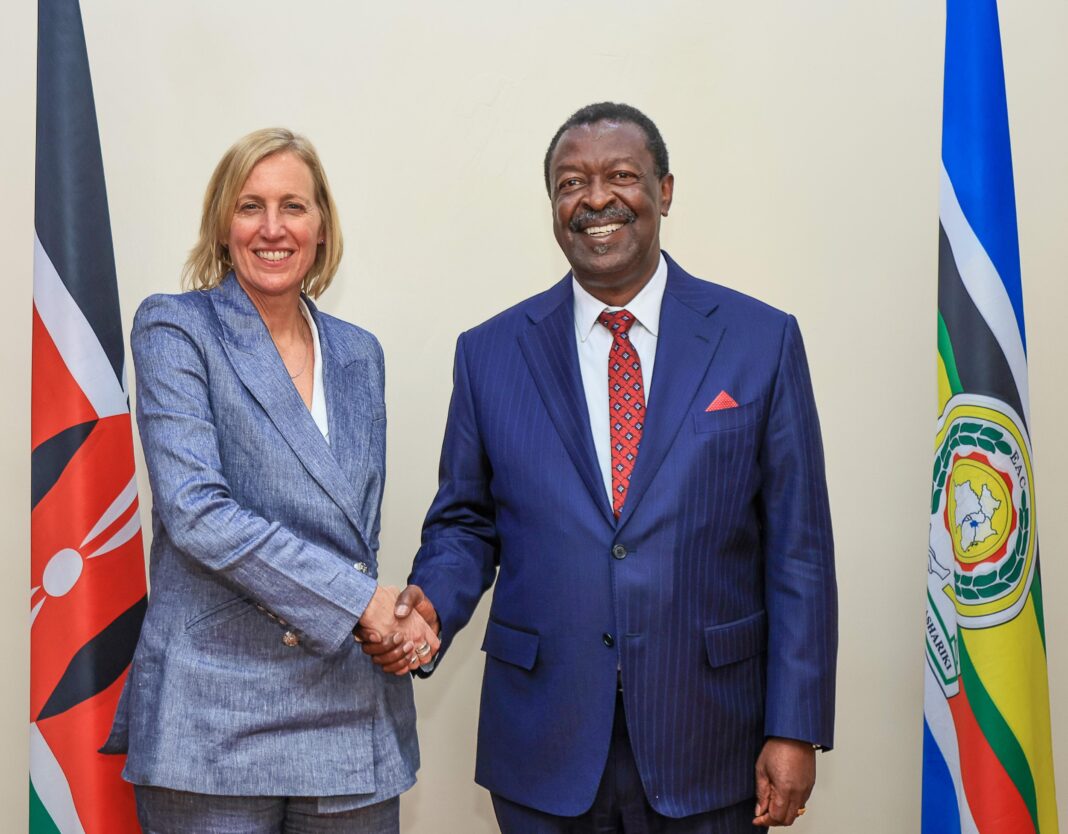

The United States and Kenya have committed a combined $2.45 billion over five years to strengthen the country’s health system, with a new bilateral framework shifting greater responsibility for financing and managing health programmes to the Kenyan government.
The Kenya Health Cooperation Framework brings together $1.6 billion in US resources and $850 million in investment from the Government of Kenya, marking a transition towards greater national ownership of HIV, tuberculosis, malaria and maternal and child health programmes.
Speaking at The Trust Summit at Glee Hotel in Nairobi on October 22, US Chief of Mission Susan Burns said the agreement builds on nearly five decades of bilateral health cooperation and aims to establish a more sustainable funding model while protecting patients’ access to essential services.
“Trust is the most important thing in any health partnership. It doesn’t appear in a budget table, but nothing works without it,” Burns said.
She noted that trust had enabled the two countries to maintain cooperation through changing circumstances, share evidence and address challenges while delivering essential health services to millions of Kenyans.
For nearly 50 years, the partnership has supported HIV treatment, malaria prevention, tuberculosis control, maternal and child health, laboratory systems, disease surveillance and outbreak preparedness through programmes including the US President’s Emergency Plan for AIDS Relief (PEPFAR), the President’s Malaria Initiative and the Centers for Disease Control and Prevention.
According to Burns, more than 1.3 million Kenyans receive HIV treatment through the partnership, while malaria incidence has been reduced by half. The United States also supplies approximately half of Kenya’s HIV, tuberculosis and malaria commodities annually.
“These results were not created by any single agreement or programme. We built that trust over decades through steady engagement, reliable technical cooperation, and results we could measure,” she said.
Kenya to assume greater financing responsibility
The framework follows the US Department of State’s America First Global Health Strategy, released in September 2025, which calls for bilateral agreements that reduce long-term dependence on external assistance and strengthen partner governments’ capacity to lead and finance their health systems.
Kenya became the first country to sign a bilateral health agreement with Washington under the new approach in December 2025.
Under the arrangement, US funding will decline from $414 million in 2026 to $161 million in 2030 as Kenya increases its domestic health spending and assumes greater responsibility for financing programmes.
Burns said the predictable funding schedule would allow the government to plan the transition and integrate essential health services into the Social Health Authority’s benefits package.
“What has changed is how we partner. We are moving from programmes run by outside implementers to programmes owned by sovereign governments,” she said.
The framework also introduces jointly agreed performance benchmarks, with government-to-government funding linked to milestones and disbursed through cost reimbursement arrangements.
The two governments will jointly monitor progress, share data and adjust implementation based on evidence, including through collaboration with county governments.
Burns said the approach was intended to make performance monitoring more useful for decision-making in Nairobi and across the counties, rather than treating it primarily as a reporting requirement for Washington.
The agreement also seeks to address longstanding challenges associated with disease-specific funding, fragmented programmes, reliance on implementing partners and differences between the two countries’ budget cycles.
During negotiations, Burns said, the partners agreed on three priorities: achieving greater Kenyan self-reliance, ensuring no patient loses access to services during the transition, and building a platform for continued bilateral health cooperation beyond the framework’s five-year period.
Ebola response tests bilateral cooperation
The partnership is also being tested by the recent Ebola case in Kenya, which Burns cited as an example of the importance of established institutional relationships and coordinated emergency responses.
She commended the Ministry of Health for rapidly isolating the patient and tracing contacts, saying the response reflected years of investment in Kenya’s health institutions.
“The United States remains in close coordination with the Government of Kenya, which has been an effective partner on health,” she said.
Burns said the United States had provided $887 million in direct health and humanitarian assistance for the global Ebola response since the outbreak began, including more than $10 million in new direct support for Kenya’s efforts to detect the virus and prevent further transmission.
She added that the United States stood ready to provide additional assistance if necessary.
“When a crisis hits, you can’t create trust on the spot. You draw on the trust you have already built,” Burns said, emphasising the importance of clear communication among government officials, technical experts and communities during public health emergencies.
Sustainability remains the central test
The framework signals a shift in US-Kenya health cooperation from a donor-funded model towards a partnership in which Kenya progressively assumes financial and operational responsibility.
However, its success will depend on whether increased domestic investment can offset declining external funding without disrupting essential services, particularly for patients who rely on HIV, tuberculosis and malaria programmes.
Implementation will also require the two governments to align approval processes, financial controls, budget cycles and delivery systems while maintaining access to medicines and other critical supplies.
Burns said the partnership would continue to rely on predictable support, open data sharing, joint monitoring and candid dialogue when implementation challenges arise.
“The United States and Kenya are showing that this model can work,” she said.
She described the long-term objective as a health system that Kenya leads, finances and sustains, with the United States remaining a partner in strengthening public health and responding to emerging threats.
The framework’s ultimate measure of success will be whether Kenya can progressively finance its health priorities while maintaining the gains achieved through decades of bilateral cooperation.
For both governments, the transition will test whether the trust built over 50 years can support a more locally financed, accountable and resilient health system.



