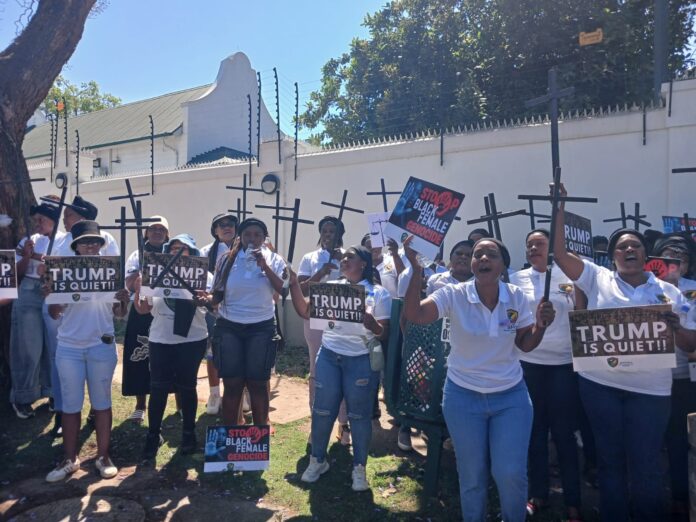
Black crosses planted outside the United States Embassy in Pretoria became a powerful symbol of mourning and defiance as women marched against South Africa’s persistent crisis of gender-based violence and femicide, demanding greater accountability from domestic authorities and international partners.
Scores of women gathered at the US diplomatic mission in Hatfield, Pretoria, challenging President Donald Trump’s administration over what they described as its silence on the killings of women in South Africa. The demonstrators called for greater international attention to the crisis, with some describing the scale of violence as a form of genocide.
The protest was organised under the banner of the newly formed Security Personnel Party of South Africa (SPPSA), which called for stronger solidarity with victims, increased support for organisations assisting survivors and a more decisive response to violence against women and girls.
The black crosses, placed outside the embassy, symbolised women whose lives had been lost to violence. Organisers said the memorial was intended to confront the public with the human cost of the crisis and challenge international partners to make the protection of women a priority.
Mandisa Mthimunye, SPPSA Protests Coordinator and activist, said the demonstration was a call for action rather than a symbolic gathering.
“Every black cross represents a life lost, a family left grieving and a future that was taken away. We cannot continue to treat the killing of women as ordinary crime while mothers, daughters and sisters live in fear. We are here to demand accountability and urgent action to protect women and girls in South Africa,” Mthimunye said.
Lethabo Mpete, councillor candidate for Ward 56 in Hatfield, Pretoria, said the fight against gender-based violence must extend beyond demonstrations and political statements to practical action within local communities.
Mpete said women should be able to move freely, access public spaces and participate in community life without fear of harassment, assault or violence. The candidate also called for stronger cooperation between local leadership, law enforcement agencies and organisations supporting survivors.
“Gender-based violence is not just a national crisis discussed by politicians; it is a community issue that affects families, neighbourhoods and the future of our children. We need safer communities, stronger support systems for survivors and leaders who are prepared to confront this problem instead of looking away,” Mpete said.
The Ward 56 candidate said prevention should begin at community level, with greater public awareness, early intervention and accessible reporting channels for people experiencing abuse.
Mpete added that protecting women required more than condemning violence after it occurred, arguing that communities needed to build an environment in which survivors could seek help without fear of stigma or intimidation.
“We must create communities where women and girls feel safe enough to speak out and confident that their complaints will be taken seriously. Local leadership, residents, police and support organisations must work together to challenge abusive behaviour, protect victims and ensure that perpetrators face the law,” Mpete said.
Protesters question US priorities
The demonstrators also questioned Washington’s engagement with South Africa, arguing that international relations should place greater emphasis on communities confronting violence, inequality and public health challenges.
The SPPSA alleged that the United States was supporting right-wing groups it believes are deepening divisions within South African society, instead of directing greater resources towards civil society organisations addressing urgent social problems.
The allegations were not independently substantiated in the information available. A response from the US Embassy was not provided.
Mthimunye said international partnerships should be judged partly by their contribution to the safety and wellbeing of vulnerable communities.
“We are asking the international community, including the United States, to look beyond political interests and stand with the women and families affected by gender-based violence. Support should reach organisations protecting survivors, helping families and preventing further abuse. Silence and indifference cannot be the answer when women are losing their lives,” she said.
The protesters argued that organisations providing shelter, counselling, legal assistance and other services to survivors require sustained support to continue their work.
They also called for greater recognition of community-based groups in identifying abuse, supporting affected families and challenging attitudes that allow violence against women to persist.
Calls for stronger accountability
South Africa has long struggled with high levels of gender-based violence, including domestic abuse, sexual assault and femicide. Campaigners have called for stronger law enforcement, faster access to justice, improved survivor services and more effective prevention programmes.
Advocates argue that addressing the crisis requires coordinated action from police, prosecutors, government departments, healthcare providers, community organisations and international partners.
The Pretoria demonstration sought to extend that pressure beyond South Africa’s borders, challenging foreign governments to consider how their diplomatic engagement and assistance can contribute to the protection of women and girls.
Organisers cited an annual figure of 23,000 women killed in South Africa. However, the figure could not be independently verified from the information available, and the period and definition used to calculate it were not specified. It should not be presented as an established national femicide statistic without further verification.
The protest organisers did not outline specific funding commitments or policy changes they wanted the Trump administration to announce. Their broader demand was for international attention and support to prioritise the protection of vulnerable communities and organisations working to prevent gender-based violence.
By choosing the US Embassy as the site of their demonstration, the protesters sought to turn a national social crisis into an international accountability issue.
The black crosses served as both a memorial to women who had died and a warning about the consequences of continued inaction. For the demonstrators, remembering the victims was inseparable from demanding measures that could prevent further killings.
Their message was clear: the fight against gender-based violence requires sustained action, stronger accountability and support for those working on the front lines of the crisis.