
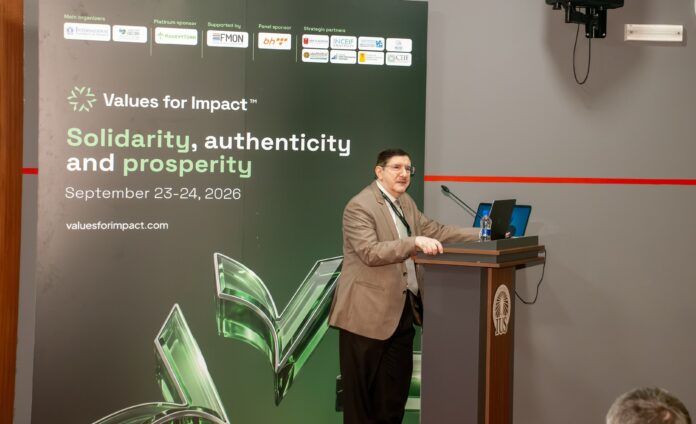
The Islamic Development Bank Institute (IsDBI) and the International University of Sarajevo (IUS) have called for stronger links between ethical principles, financial innovation and measurable economic outcomes, as experts examined how Islamic finance can support sustainable development and responsible investment.
The call emerged during the Values for Impact 2026 conference, held on September 23–24 at IUS in Sarajevo, Bosnia and Herzegovina. Under the theme “Solidarity, Authenticity and Prosperity,” the conference brought together academics, policymakers, financial experts and industry representatives to explore how financial systems can balance profitability with ethical responsibility.
Speaking at the opening, Dr. Sami Al-Suwailem, Acting Director General of IsDBI, said the significance of Islamic finance extended beyond its market size to the principles underpinning its approach to economic activity.
“Islamic finance, above all, is an idea, and we should never underestimate the power of ideas,” he said.
Dr. Al-Suwailem highlighted risk-sharing, financial resilience and stronger connections between finance and the real economy as principles increasingly attracting interest from regulators and policymakers beyond the Islamic finance sector.
Prof. Dr. Ali Osman Kuşakcı, Rector of IUS, said economic progress should reinforce ethical values rather than undermine them.
“The challenge is not to choose between values and progress. It is to build forms of progress that are economically productive, socially responsible and intellectually authentic,” he said.
He also emphasised the role of universities in translating talent into knowledge, knowledge into innovation, and innovation into sustainable value creation.
The conference was preceded by a masterclass, Islamic Finance for the 21st Century, delivered by Dr. Al-Suwailem and organised by the IUS Center for Islamic Finance, Innovation and Sustainability.
The session examined challenges facing the industry, including excessive debt, the distinction between risk-sharing and risk transfer, and the opportunities and ethical implications of artificial intelligence in financial services.
The main conference opened with a panel on technoparks and talent retention, moderated by Dr. Migdat Hodžić of ARTI Analytics. Participants included representatives from BH Telecom’s BHTech Lab, Norway’s Christian Michelsen Institute, the Federal Ministry of Education and Science, and Technopark Istanbul.
Another panel examined whether Islamic finance could provide a more effective funding model for startups. Moderated by Dr Šejma Aydin of IUS, the discussion featured experts from IsDBI, IE University, the Sarajevo Canton Ministry of Economy and the Mozaik Foundation.
Keynote addresses were delivered by Prof. Dr Mehmet Asutay of Durham University, Dr. Afan Kalamujić, Minister of Finance of Sarajevo Canton, and Semih Sel of Kuveyt Türk.
Beyond the policy and industry discussions, the conference featured more than 200 research papers presented across 12 academic sessions, highlighting the expanding scope of Islamic finance and its potential contribution to economic and social development.
Topics included green waqf donations in Indonesia, cryptocurrency inheritance in Malaysia, artificial intelligence ethics through the Maqāṣid framework, climate risk and banking stability, gamification in Islamic crowdfunding, and waqf governance in Bosnia and Herzegovina.
The discussions also explored how countries and institutions can create environments that encourage innovation, attract skilled professionals and retain talent. The emphasis on talent retention underscored the importance of connecting education, research, entrepreneurship and investment to generate long-term economic opportunities.
The conference concluded with a forward-looking forum examining the future of Islamic finance towards 2030. Participants considered which industry practices require reform, how institutions can strengthen their ethical foundations, and what measurable results should demonstrate genuine impact.
Dr. Al-Suwailem reiterated that the principles underpinning Islamic finance have broader relevance for the global economy.
“At its core, Islamic finance is a grand idea. It is moral, rational, and universal,” he said.
Rector Kuşakcı challenged participants to translate those principles into institutional reforms and practical outcomes.
“We should move from values to institutions, from institutions to action, and from action to measurable outcomes,” he said.
He reaffirmed the university’s commitment to its partnership with IsDBI, describing the relationship as a long-term collaboration aimed at building a shared future.
The conference highlighted a central challenge for Islamic finance and the wider financial sector: ensuring that ethical commitments translate into responsible investment, inclusive economic opportunities and sustainable development.