

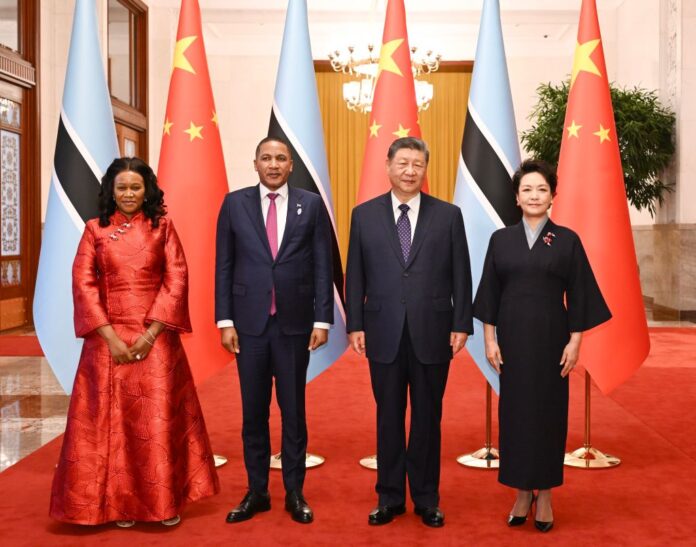
China and Botswana have elevated their bilateral relations to a comprehensive strategic cooperative partnership, signalling a renewed commitment to economic diversification, industrialisation and mutually beneficial cooperation in key sectors.
The agreement was announced on Tuesday following talks between Chinese President Xi Jinping and Botswana President Duma Gideon Boko in Beijing during the Botswana leader’s state visit to China. The two leaders also witnessed the signing of cooperation documents covering green minerals, healthcare, human resources, Belt and Road cooperation and implementation of the Global Security Initiative.
The upgraded partnership comes as Botswana seeks to reduce its dependence on diamonds, which have traditionally underpinned its export earnings and government revenue, while pursuing new sources of investment, employment and economic growth.
For China, the agreement strengthens bilateral cooperation with Botswana, a mineral-rich southern African country whose membership in the Southern African Development Community (SADC) provides opportunities for expanded regional trade, infrastructure development and industrial cooperation.
Xi said China was ready to strengthen cooperation with Botswana in the digital economy, agriculture, animal husbandry and smart education. He also called for improvements to the framework governing bilateral economic and trade relations.
The Chinese president encouraged Botswana to explore opportunities arising from China’s zero-tariff policy for African countries that maintain diplomatic relations with Beijing, potentially creating new avenues for Botswana’s eligible exports to the Chinese market.
The benefits, however, will depend on Botswana’s capacity to expand production, improve product competitiveness and meet Chinese market requirements.
Mineral cooperation and industrial value addition
Mineral resources emerged as a central pillar of the China-Botswana partnership, with Xi emphasising African ownership of natural resources and the importance of ensuring that mineral development serves local economic priorities.
“Africa’s resources belong to Africa,” Xi said, stressing that this principle should underpin mining cooperation between China and African countries.
He said China was willing to share its mining development experience, help African countries formulate strategies suited to their national circumstances and encourage Chinese companies to transfer green technologies adapted to African conditions.
Xi also called for China-Africa mining cooperation to move up the value chain and for the development of affordable, sustainable and innovative financing models.
For Botswana, stronger cooperation with China could create opportunities to expand mineral processing, develop manufacturing capabilities and strengthen domestic supply chains.
Although diamonds remain central to Botswana’s mining industry, economic diversification requires investment in other productive sectors and greater capacity to capture value from natural resources before they enter international markets.
Chinese investment and technology could support this transition. However, the long-term benefits will depend on agreements that promote local employment, skills transfer, environmental protection and participation by Botswana’s businesses.
Xi cautioned against turning Africa’s resources into instruments of geopolitical rivalry, saying China welcomed genuine contributions from all parties to Africa’s development.
Expanding trade and investment
Boko said Botswana valued its relationship with China and was ready to strengthen alignment between the two countries’ development strategies.
He welcomed more Chinese enterprises to invest and operate in Botswana while reaffirming his country’s commitment to the one-China principle and opposing moves towards Taiwan independence and external interference in China’s internal affairs.
The Botswana president also expressed support for stronger multilateralism, greater solidarity among developing countries and a more inclusive global governance system.
For Botswana, the priority is to translate these diplomatic commitments into commercially viable projects that expand exports, attract productive investment and create jobs.
Potential areas for cooperation include agricultural modernisation, renewable energy, digital services, manufacturing and mining-related industries. Technical education and skills development could also prepare Botswana’s workforce for emerging industries.
China’s zero-tariff initiative could complement these ambitions by improving access to its large consumer market. Nevertheless, preferential market access alone will not guarantee export growth. Botswana will need competitive production, reliable logistics and the capacity to meet regulatory and quality standards.
Both countries will also need to ensure that new investments support domestic industrial development rather than reinforce dependence on unprocessed commodity exports.
Strengthening China-Africa cooperation
The China-Botswana partnership reflects broader efforts by African countries to use international economic relationships to accelerate industrialisation, diversify trade and strengthen their position in global markets.
Boko said Botswana would maintain close coordination with China to promote Africa-China solidarity and cooperation while strengthening collaboration among developing countries.
The leaders also highlighted the historical significance of 2026, which marks the 60th anniversary of Botswana’s independence and the 105th anniversary of the founding of the Communist Party of China. Xi called for stronger exchanges between the two countries’ ruling parties and greater sharing of governance experience.
The two sides’ joint statement establishing the comprehensive strategic cooperative partnership provides a framework for advancing their bilateral relationship.
Ultimately, its success will depend on implementation, including measurable investment, stronger non-diamond exports, technology transfer and employment creation.
For Botswana, closer economic cooperation with China offers an opportunity to build a more diversified and resilient economy. For China, the partnership strengthens bilateral ties with Botswana and creates further scope for commercial cooperation across southern Africa.

