

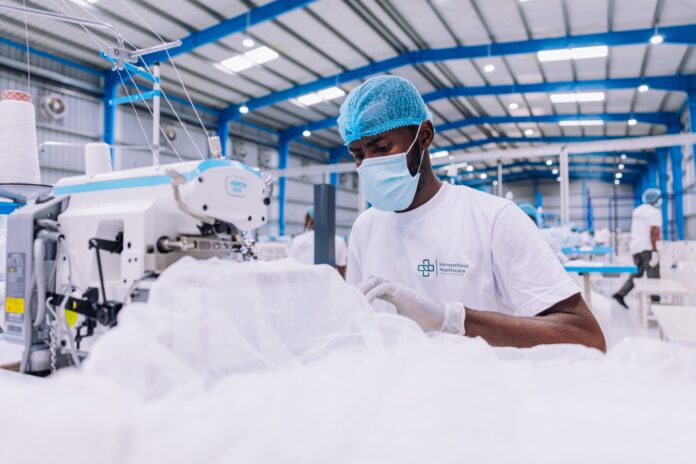
Harvestfield Healthcare FZE has begun commercial production of next-generation insecticide-treated mosquito nets in Nigeria, strengthening the country’s domestic capacity to manufacture a critical malaria prevention product.
The company started operations at its manufacturing facility in the Harvestfield Free Trade Zone in Ogun State on September 13, 2026. The facility is already supplying a World Bank-funded malaria programme serving 31 states across Nigeria.
The factory manufactures Synera DuoForte, a dual active ingredient long-lasting insecticidal net developed and owned by GDM Health Products under a manufacturing agreement with Harvestfield.
The facility is the first wholly Nigerian-owned manufacturing operation of its kind in the country producing dual active ingredient long-lasting insecticidal nets of the pyrethroid-chlorfenapyr class.
The nets combine a pyrethroid insecticide with chlorfenapyr, which works through a different mode of action. This approach is increasingly important as mosquito populations in Nigeria and other malaria-endemic countries develop resistance to pyrethroid insecticides traditionally used in mosquito nets.
While conventional insecticide-treated nets continue to provide a physical barrier against mosquitoes, resistance can reduce their insecticidal effectiveness. Dual active ingredient nets are designed to provide greater protection in areas where pyrethroid resistance is established, with the World Health Organization recommending this class of nets in such settings.
Synera DuoForte is WHO-prequalified, while the Harvestfield facility in Ogun State is an approved manufacturing location under the product’s prequalification. The facility is also certified by Nigeria’s National Agency for Food and Drug Administration and Control (NAFDAC) and holds ISO certification.
Jon Bastow, a representative of GDM Health Products, said the partnership would help expand access to the next-generation nets in Nigeria, which carries the world’s largest malaria burden.
“GDM is pleased to strategically partner with Harvestfield to bring Synera DuoForte to Nigeria, the country with the biggest global malaria burden, and support the prequalification of Harvestfield’s Ogun State manufacturing facility to make Synera DuoForte,” he said.
Coordinating Minister of Health and Social Welfare Professor Muhammad Ali Pate said strengthening domestic production was central to Nigeria’s health security.
“Building the capacity to manufacture our own health products is central to Nigeria’s health security,” Pate said. “A Nigeria-based facility producing next-generation insecticide-treated nets to international standard, and already supplying programmes across thirty-one states, is the kind of capability the Renewed Hope agenda was created to build.”
The investment builds on Harvestfield’s 26 years of experience in Nigeria’s vector-control sector. The company says it has distributed more than 42 million insecticide-treated nets across all 36 states and has been an exclusive national distribution partner for WHO-prequalified nets since 2018.
The shift from distribution to local manufacturing could also reduce Nigeria’s dependence on imported mosquito nets and shorten supply chains. Imported nets can require 45 to 60 days of ocean transportation, potentially limiting the speed at which supplies can be replenished during large-scale malaria control campaigns.
Dr Abdul Mukhtar of the Presidential Initiative for Unlocking the Healthcare Value Chain (PVAC) said the investment reflected efforts to move Nigeria from importing health products towards domestic production.
“PVAC exists to move Nigeria from importing its health products to making them,” Mukhtar said. “What matters is not only that a factory exists, but that it meets the standards international buyers accept and can supply at national scale.”
Beyond mosquito nets, the facility is expected to contribute to the development of local technical, quality-control and regulatory capabilities that could support wider healthcare manufacturing in Nigeria.
Harvestfield said the facility represents the first platform in a broader effort to expand healthcare manufacturing capacity in the country.
The investment comes as Nigeria seeks to strengthen domestic production of essential health commodities under the Federal Government’s Renewed Hope health agenda, the Presidential Initiative for Unlocking the Healthcare Value Chain and the Nigeria First procurement policy.

