
Nigeria is putting $300 million behind its renewable-energy transition, targeting solar systems, mini-grids and battery storage in a push to expand electricity access while reducing reliance on conventional power generation.
The Nigeria Distributed Renewable Energy (DRE) Fund, jointly managed by the Nigeria Sovereign Investment Authority (NSIA) and Africa50, marks a shift from renewable-energy planning towards large-scale deployment of decentralized clean-power projects. The initiative is supported by Sustainable Energy for All (SEforALL), the World Bank and the International Solar Alliance.
The fund was commercially launched on the sidelines of the United Nations General Assembly in New York in September 2026, with the World Bank providing an initial $25 million through the International Development Association. The remaining capital is expected to mobilise additional public and private investment into Nigeria’s growing distributed-energy market.
The initiative comes as Nigeria seeks to use renewable energy to address persistent electricity shortages while supporting economic growth, industrialisation and energy security.
Nigeria’s revised National Energy Policy targets 30 gigawatts (GW) of electricity-generation capacity by 2030, with renewable energy expected to account for 30 percent of the generation mix. The policy identifies solar, hydropower, wind and biomass among the country’s key renewable resources.
The new DRE Fund provides a financing mechanism for one of the most important elements of that strategy: expanding electricity supply without relying exclusively on the expansion of the national grid.
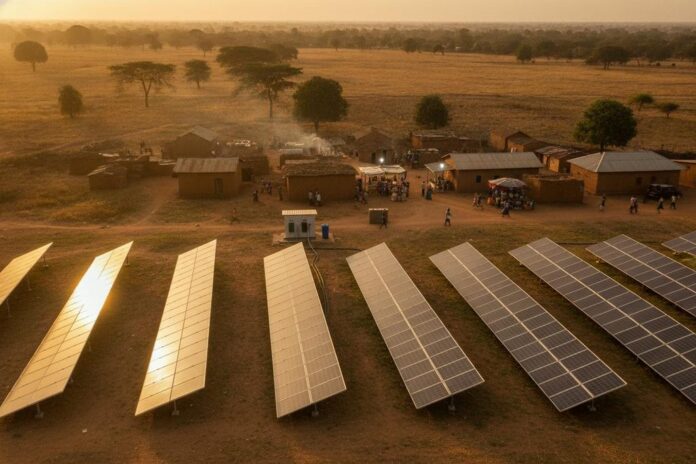
The fund will finance mini-grids, standalone solar systems, commercial and industrial renewable-energy installations, embedded generation, and energy-storage technologies. Such systems are particularly important for rural communities, households and businesses where grid connections remain limited or unreliable.
Nigeria’s large population and growing economy have created substantial demand for reliable electricity. Distributed renewable energy allows power to be generated closer to consumers, reducing dependence on centralised infrastructure and creating opportunities for businesses to operate their own clean-energy systems.
Solar power is expected to remain at the centre of this expansion. Nigeria has significant solar potential, while falling technology costs and improvements in battery storage are making decentralised solar systems increasingly viable for households, businesses and communities.
The government’s renewable-energy framework has also called for greater integration of solar power into the national energy mix, increased private-sector participation, support for local solar manufacturing and greater investment in research and development.
The new financing initiative is therefore significant because it could help move Nigeria’s renewable-energy industry from individual projects towards a broader commercial market.
The fund also aligns with the wider Mission 300 initiative led by the World Bank and African Development Bank, which aims to connect 300 million people across Africa to electricity by 2030. Nigeria’s experience with distributed renewable-energy financing could provide lessons for other African markets facing similar electricity-access challenges.
Financing remains one of the major barriers to expanding clean-energy infrastructure across Africa. Renewable projects often require significant upfront investment, while developers face challenges linked to currency volatility, tariffs, access to affordable finance and long project-development periods.
The $300 million DRE Fund is intended to help address some of these constraints by bringing together Nigeria’s sovereign investment institution, an African infrastructure investor and international development partners.
NSIA Managing Director Aminu Umar-Sadiq said the launch demonstrates that Nigeria’s distributed renewable-energy market is becoming investable and capable of operating at scale. Africa50 Group Chief Executive Alain Ebobissé has described the partnership as an effort to turn Africa’s growing electricity needs into investable opportunities.
The fund’s impact will ultimately depend on how quickly capital is converted into operating solar systems, mini-grids, battery-storage facilities and new electricity connections.
For Nigeria, however, the renewable-energy transition is increasingly about more than climate policy.
Reliable clean power is becoming closely linked to industrial development, digital connectivity, agricultural processing, small and medium-sized enterprises and the competitiveness of Nigerian businesses.
The $300 million fund consequently places distributed solar and other renewable technologies at the centre of Nigeria’s effort to build a more resilient and diversified energy system.
It also signals a broader shift in Africa’s energy landscape, where renewable power is increasingly being viewed not simply as an environmental alternative, but as an essential component of economic development and expanded electricity access.

