

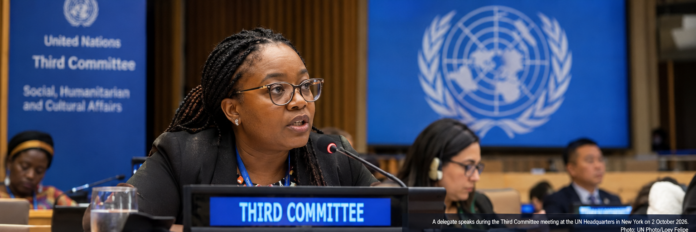
Climate change, poverty, armed conflict and rapid technological advances are intensifying pressure on social development and human rights, delegates told the United Nations General Assembly’s Third Committee as they called for stronger protection of vulnerable communities and civilians caught in war.
The discussion brought together concerns that are increasingly interconnected, from environmental degradation and widening inequality to online threats against women and human rights defenders and the growing humanitarian consequences of armed conflicts.
The meeting, held during the 81st session of the General Assembly, highlighted how climate change is no longer only an environmental concern but a social and economic crisis affecting livelihoods, food security and migration.
Mongolia’s representative said climate change, desertification and land degradation have deep social consequences, with rural communities, women and children facing disproportionate impacts.
For vulnerable developing countries, the burden is particularly stark. Suriname warned that countries contributing relatively little to global greenhouse gas emissions continue to face severe climate risks.
The country called for predictable international support, arguing that forest-rich countries should not be expected to shoulder the costs of environmental protection while the benefits are enjoyed globally.
Poverty remains a global fault line
The climate crisis is unfolding alongside persistent poverty and inequality.
The Gambia’s representative said poverty and inequality remain among the greatest obstacles to sustainable development three decades after the Copenhagen Declaration on Social Development.
She warned that poverty is increasing across Africa and the Global South, with almost 1 billion people approaching extreme poverty amid limited fiscal space and heavy debt-servicing obligations.
She also argued that the international financial system is reinforcing inequalities and restricting countries’ ability to invest in development, urging governments to translate commitments under the Pact for the Future into concrete action.
The discussion also highlighted the continuing importance of families, housing and employment in social development, although delegates differed over approaches to family policy.
Human rights face new threats online
The pressure on human rights is also extending into the digital sphere.
Norway’s representative warned that rights must apply equally online and offline, particularly as new technologies become embedded in everyday life.
Women in public life and human rights defenders are increasingly exposed to harassment, surveillance and other forms of technology-enabled repression, she said, stressing that human rights considerations must remain central from the development of new technologies through to their deployment.
Türkiye, meanwhile, pointed to the expansion of cybercrime, including ransomware and the online sexual exploitation of children, while welcoming the United Nations Convention against Cybercrime as a global instrument addressing such threats.
The debate also exposed divisions over the UN human rights system itself.
Liechtenstein raised concerns about funding for human rights mechanisms, warning that proposed 2027 budget reductions could affect the Office of the UN High Commissioner for Human Rights. Other delegations, including those from the Democratic People’s Republic of Korea, Eritrea and Iran, accused the human rights system of being used selectively or politically.
‘Wars must have limits’
The most urgent warnings centred on civilians living through armed conflict.
Yemen described the devastating social and humanitarian consequences of the conflict that has continued since 2014, including killings, abductions, arbitrary detention, restrictions on freedom of expression, property seizures and child recruitment.
The International Committee of the Red Cross said the consequences of the world’s approximately 130 armed conflicts fall hardest on people who are already most vulnerable.
These include sexual violence, recruitment of children, attacks on schools and medical personnel and food insecurity. Technology is also creating additional channels for sexual violence and child recruitment through social media and gaming platforms.
But the humanitarian consequences of conflict extend beyond direct attacks.
War can prevent farmers from reaching their fields while disrupting markets and essential water and energy systems. The ICRC warned that humanitarian assistance alone cannot address all these consequences, stressing the absolute prohibition against using starvation of civilians as a method of warfare.
The organisation urged States to uphold their obligations under the 1949 Geneva Conventions and reaffirm a basic principle: wars must have limits.
The Third Committee debate ultimately underscored a common challenge facing the international community: crises that once appeared separate are increasingly overlapping.
Climate shocks can deepen poverty. Conflict can destroy livelihoods and access to essential services. Digital technologies can expand opportunities while creating new avenues for abuse. And weakened international cooperation can leave vulnerable populations carrying the heaviest costs.
For the delegates gathered in New York, the challenge now is turning international commitments into action capable of protecting people both online and offline, in times of peace and during

