
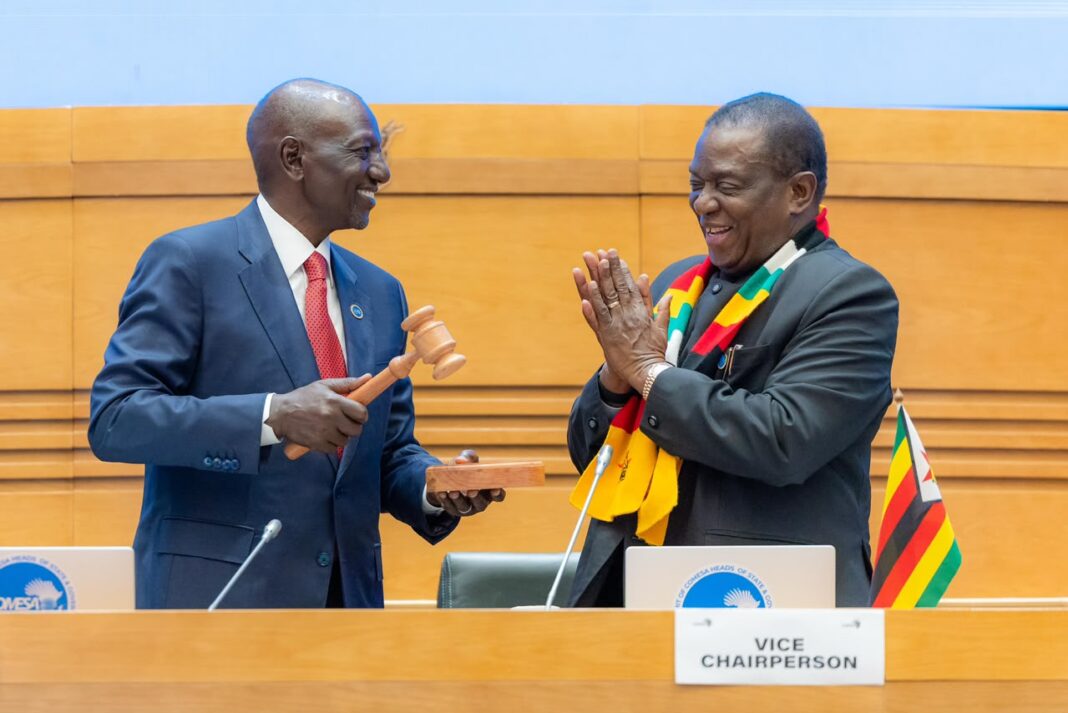

African leaders are meeting in Harare for the 25th Common Market for Eastern and Southern Africa (COMESA) Summit of Heads of State and Government, seeking to accelerate industrialisation, attract investment and expand intra-African trade as countries pursue greater economic independence.
Held under the theme, “One Market, One Future: Advancing Inclusive Industrialisation, Investment and Regional Integration in COMESA,” the summit focuses on turning regional integration commitments into practical economic opportunities through manufacturing, value addition, infrastructure development and stronger cross-border markets.
Kenyan President William Ruto, who arrived in Zimbabwe for the summit, said leaders would prioritise economic integration, peace and security, implementation of the African Continental Free Trade Area (AfCFTA) and the sustainable exploitation of Africa’s natural resources.
“At this summit, our priority must be to transform Africa’s regional markets into engines of industrial growth, investment and job creation. By removing trade barriers, strengthening regional value chains and adding value to our natural resources, we can build competitive industries that create opportunities for our people,” Ruto said.
The discussions come as African economies seek to move beyond exporting unprocessed agricultural commodities, minerals and other raw materials. Expanding local manufacturing and processing would enable countries to retain more value from their resources, create employment and develop industries capable of competing in international markets.
COMESA provides a framework for advancing this transition by connecting member states through trade cooperation, investment promotion and regional economic integration. A larger, more accessible market can help manufacturers achieve economies of scale, attract investors and distribute products across national borders.
For Zambia, a major copper producer, industrialisation is closely linked to reducing dependence on raw mineral exports and expanding domestic processing, manufacturing and related services.
Zambian President Hakainde Hichilema said: “Africa must move from exporting raw materials to producing finished goods that compete in regional and international markets. Through COMESA, we have an opportunity to strengthen industrial capacity, attract investment and develop regional value chains that create jobs, transfer technology and deliver greater prosperity to our citizens.”
The proposed industrial transformation also depends on reliable electricity, transport networks, access to affordable finance and predictable trade regulations. High logistics costs, border delays, inconsistent standards and limited access to capital continue to constrain businesses seeking to expand across African markets.
Regional cooperation could help address these obstacles by harmonising customs procedures, improving transport links and encouraging investment in industries that serve multiple countries. Sectors such as agro-processing, pharmaceuticals, textiles, fertiliser production and mineral beneficiation offer opportunities to deepen manufacturing capacity and reduce dependence on imported finished products.
The AfCFTA offers a wider continental framework for this ambition, while COMESA can help member states strengthen regional trade links and prepare businesses to compete in a broader African market. However, the benefits will depend on implementation, including the removal of non-tariff barriers and the effective application of agreed trade rules.
Industrialisation must also be inclusive, with small and medium-sized enterprises, women-led businesses and young entrepreneurs gaining access to markets, finance, skills and technology. Stronger regional supply chains could enable smaller firms to become suppliers to larger manufacturers and participate in cross-border commerce.
For governments, the challenge is to translate summit commitments into measurable results: increased trade between member states, higher levels of domestic processing, new manufacturing investments and jobs across the region.
The Harare summit therefore places COMESA’s integration agenda within a broader African development priority: building productive economies that export more finished goods, generate employment and capture a greater share of global value chains.
Its lasting impact will depend on whether leaders turn political commitments into coordinated policies and commercially viable projects that make regional integration deliver tangible benefits for African businesses and citizens.



