
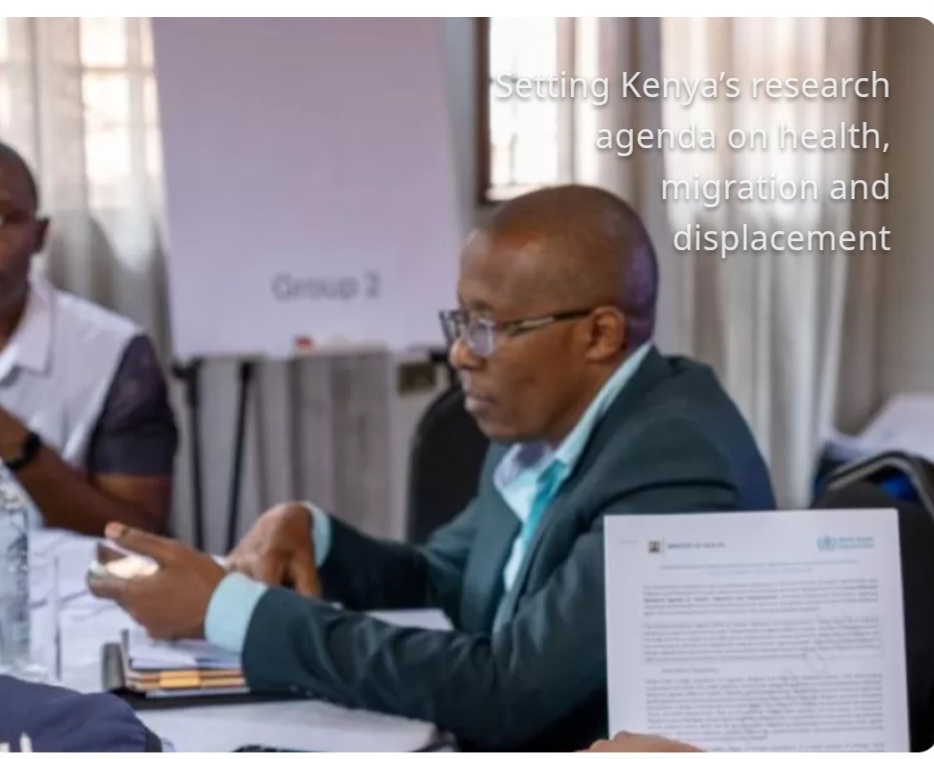

Kenya has taken a major step towards building a health system that leaves no one behind, following a national consultation to develop a research agenda on health, migration and displacement. The Ministry of Health, the World Health Organization’s Health and Migration Programme and the WHO Kenya Country Office convened 32 representatives from government, UN agencies, universities, civil society and partner organisations to identify evidence gaps and chart a roadmap for action.
The consultation, held in Nairobi, responds to a growing reality: migration and displacement are reshaping health needs across the country. People on the move often face interrupted care, limited access to services and wider social conditions that affect their wellbeing, while host communities also carry pressures on health services.
“Health operates on facts and figures. Migrants and refugees have a lot of health needs, and most of the time they are forgotten,” said John Ndungu, Director of Public Health at the Ministry of Health. He noted that the affected groups include pregnant women, older people and children under five who require vaccination, adding that health responses must serve both refugees and host communities.
Participants reviewed findings from a scoping review and earlier consultations, then prioritised evidence gaps across thematic areas. They also explored stronger collaboration among researchers, policymakers, health workers and communities to ensure that research responds to national and county-level priorities.
The initiative adapts WHO’s global research agenda on health, migration and displacement to Kenya’s context. Its central aim is not simply to produce more studies, but to ensure that evidence informs policy, planning, investment and day-to-day health-service delivery.[1]
“The challenge is not only to generate more evidence, but to ensure that evidence helps health systems respond to the realities of human mobility,” said Dr Santino Severoni, Head of WHO’s Health and Migration Programme.
A key message from the consultation was that migrants, refugees and displaced people must help shape the research and policies that affect them. Professor Salome Bukachi of the University of Nairobi said co-creating policies with affected communities makes them more people-centred and increases the likelihood that they will be accepted and used.
The process will also focus on noncommunicable diseases, a priority health challenge for displaced and migrant populations. The work is supported by the Grand Duchy of Luxembourg through the UHC Partnership, Kenya’s Ministry of Foreign Affairs and International Cooperation, and the Novo Nordisk Foundation.
The outcomes will now be consolidated into Kenya’s National Research Agenda on Health, Migration and Displacement, together with an implementation roadmap and action plan. WHO says it will continue supporting the Ministry of Health and partners to turn the priorities into action at national and county levels.
“This agenda belongs to Kenya, and that is its strength,” said Dr Neema Kimambo, WHO Representative to Kenya. “Migrants, refugees, displaced populations as well as host communities” should not be left behind on Kenya’s path to universal health coverage, she said.