
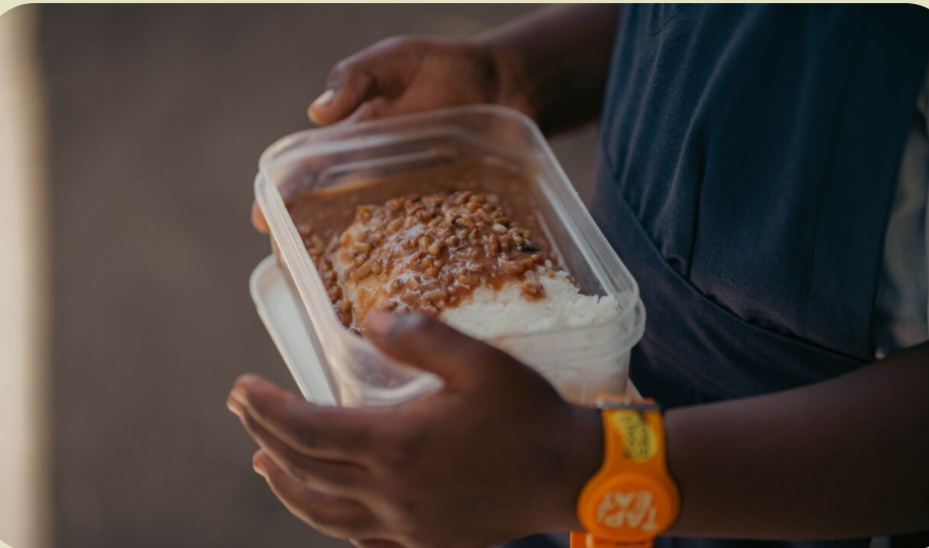

Every school day in Kenya, before lessons begin and long before most adults have finished their morning routines, Food4Education serves 700,000 children. The organisation’s ambition is even larger: to reach one million children a day by next year.
Behind each plate of food lies more than nutrition, it lies a quiet, expanding economy of farmers, suppliers, drivers, kitchen workers, technology systems, and families whose livelihoods depend on the simple certainty that a child will be fed.
This is the story Food4Education tells for World Food Day 2026, observed under the global theme “Innovate today. Nourish tomorrow.” The theme, set by the Food and Agriculture Organization, calls for practical innovation that makes safe, diverse and nutritious food accessible while protecting the planet for future generations. In Kenya, that innovation is taking the form of a school meal.
More Than a Plate of Food
A school meal may appear modest: maize, beans, rice, vegetables, perhaps a piece of fruit. Yet at scale, it becomes infrastructure. Food4Education has served more than 250 million meals and says it has injected more than $200 million into Kenya’s economy through its operations and supply chains. By 2030, it projects that figure will exceed $450 million, with about $150 million going directly to farmers.
That money does not disappear into a single transaction. It becomes income for a farmer planning the next planting season, wages for a kitchen worker, business for a transporter, and demand for local suppliers. In this sense, the meal in front of a child is also an investment in the people and systems behind it.
Founder and CEO Wawira Njiru frames the mission as building “Africa’s school feeding economy”—one that is locally rooted, financially sustainable, and able to endure. With Africa’s youth population set to grow dramatically in the coming decades, she argues that feeding and educating children today is not charity alone; it is preparation for the continent’s economic future.
Precision at Scale
Feeding hundreds of thousands of children daily requires discipline that resembles running a logistics company as much as a charity. Food4Education’s Chief Operations Officer, Wairimu Nyandia, describes cost-per-meal economics as “non-negotiable.” The true cost of a meal includes demand forecasting, procurement, kitchen efficiency, transport, waste reduction, and payment systems.
Technology sits at the centre of this operation. The organisation’s Tap2Eat platform processes about two million transactions daily, helping manage payments, track meals, and generate operational data. That information allows the programme to identify inefficiencies and improve delivery critical when even small losses multiply across hundreds of thousands of meals.
The model now supports more than 6,000 jobs across operations and supply chains. As Food4Education moves toward one million meals a day, the challenge is not simply to grow bigger, but to preserve accuracy, accountability, and quality while expanding.
Evidence Behind the Impact
Meal numbers reveal reach, but not necessarily transformation. Food4Education’s Head of Impact, Lia Mayka Mumbo, points to research suggesting that every dollar spent on school feeding generates an additional two dollars in the local economy. Still, she insists that the deeper question is what those dollars make possible in real lives: whether a child concentrates better in class, whether a parent has more disposable income, and whether a farmer can invest confidently because a reliable buyer exists.
Philanthropy, in this view, is not merely a funding source. It creates space to test ideas, ask difficult questions, and generate evidence that governments can use when deciding how to finance and expand school feeding. After nearly 15 years of delivering meals, Food4Education sees its research as a resource for other communities and countries seeking workable models.
Government Ownership Matters
A promising pilot can demonstrate possibility, but scale requires public commitment. In Kenya, more than 700,000 children are fed daily across 19 counties. Fifteen of the 29 centralised kitchens supporting the system have been financed and built by government, while county co-financing and affordable parent contributions help sustain delivery.
Government Relations Lead Vincent Gitau argues that school feeding becomes durable when it is treated as public infrastructure rather than a temporary project. A transparent cost-per-meal model gives governments something they can budget for, while Tap2Eat offers traceability and verification.
Food4Education is now sharing its experience through technical assistance in more than 10 African countries, including Zambia, Uganda and Ethiopia. The approach is deliberately not to export a Kenyan blueprint, but to help each government build a system suited to its own procurement capacity, infrastructure, financing realities, and policy priorities.
A Market for Farmers
For farmers, the hardest part of agriculture is often not growing food—it is knowing whether there will be a market for it. Climate shocks, droughts, floods, and rising costs of fertiliser, fuel, and transport have made that uncertainty sharper. Food4Education’s Senior Manager for Policy, Stella Kimani, argues that predictable institutional demand can change that equation.
The organisation sources about 80% of its food locally, creating steady demand for Kenyan farmers, aggregators, suppliers, and transporters. That reliability allows producers to plan, invest, and seek financing with greater confidence. Well-designed school menus can also send market signals for nutritious foods, aligning what farmers grow with what children need for healthy development.
The programme has shown flexibility when markets shift. When maize prices rose sharply in 2022, menus were adjusted to include more rice, beans, and lentils rather than passing costs to families. In Murang’a, when about 5,000 smallholder farmers faced a mango surplus with limited buyers, Food4Education purchased 1.3 million mangoes for school meals.
Feeding the Future
The story of Food4Education is ultimately about connection: between a child’s ability to learn and a farmer’s ability to earn; between a kitchen in Nairobi and a farm in Murang’a; between today’s meal and tomorrow’s workforce. It suggests that solving hunger is not only about producing more food, but about building systems that make nutritious food affordable, reliable, and locally beneficial.
As World Food Day 2026 reminds the world to “innovate today” so that it can “nourish tomorrow,” Kenya’s school-feeding economy offers a concrete example of what that can look like: a child fed, a farmer paid, a job created, and a government equipped to sustain the system long after the cameras leave.