
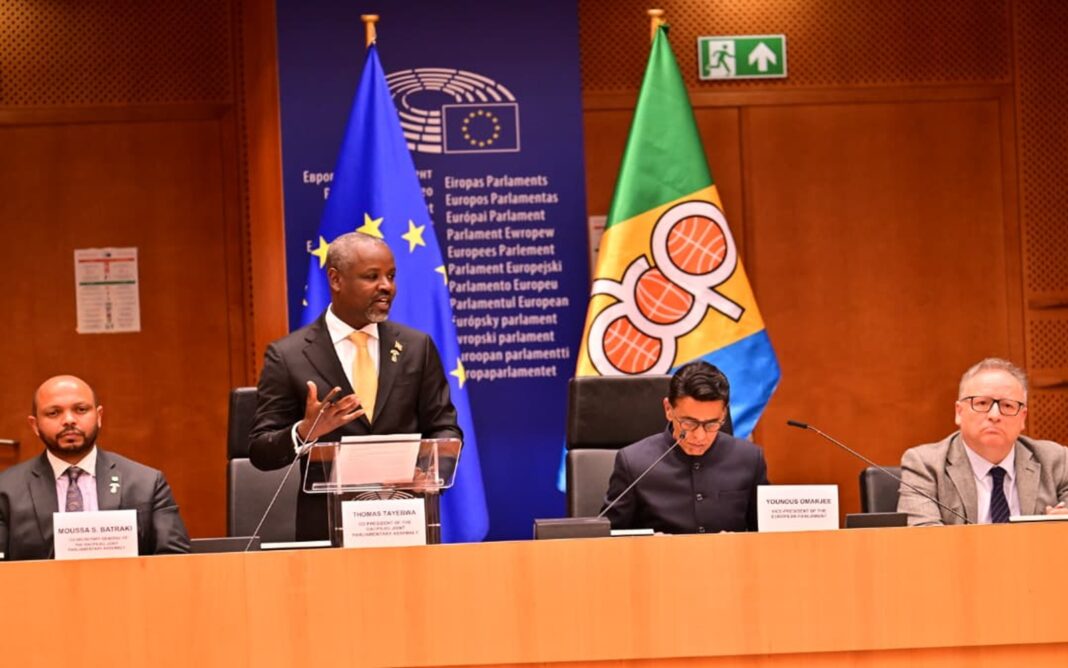

Parliamentarians from Africa, Europe, the Caribbean and the Pacific have called for a renewed approach to international cooperation, urging stronger multilateralism and more equitable global partnerships amid growing geopolitical and economic uncertainties.
The call was made during the opening session of the Organization of African, Caribbean and Pacific States-European Union (OACPS-EU) Joint Parliamentary Assembly in Brussels, Belgium, where legislators highlighted the need to reshape international partnerships to deliver tangible economic and social benefits to member states.
Deputy Speaker of Uganda’s Parliament and Co-President of the OACPS-EU Joint Parliamentary Assembly, Thomas Tayebwa, said future cooperation must move beyond diplomatic commitments and be anchored in equality, mutual respect and shared solidarity.
He challenged participating countries to pursue partnerships that address the economic and development priorities of member states, particularly those in Africa, the Caribbean and the Pacific, where access to investment, technology and employment opportunities remains critical.
Tayebwa said the OACPS was seeking a restructured economic partnership with the European Union that prioritises local economic transformation rather than relationships centred primarily on trade and political dialogue.
“The OACPS would like to see an economic partnership that delivers tangible benefits, including investment, local value addition, skills development and decent employment in our countries,” Tayebwa said.
His remarks underscored the growing demand among developing economies for international partnerships that support industrialisation, strengthen domestic production capacity and create sustainable employment.
For African countries in particular, the proposed approach presents an opportunity to deepen economic cooperation with European partners while advancing value addition, technology transfer, skills development and investment in productive sectors.
The assembly also placed climate change and environmental sustainability among its key priorities, with delegates expected to explore practical solutions to shared challenges, including climate financing and the transition towards sustainable economic development.
The discussions come at a time when developing countries are seeking a stronger voice in international institutions and greater access to financial resources to address climate vulnerabilities, infrastructure gaps and economic inequalities.
The opening ceremony brought together several prominent international leaders who reaffirmed the importance of parliamentary diplomacy and multilateral cooperation in addressing global challenges.
Among those who addressed the gathering were Nobel Peace Prize laureate and President of Timor-Leste, José Ramos-Horta; European Parliament President Roberta Metsola; Jamaica’s Prime Minister Andrew Holness; and European Parliament Vice-President Younous Omarjee.
Their participation highlighted the importance of maintaining dialogue between regions despite increasing geopolitical tensions, shifting economic alliances and growing international uncertainty.
The parliamentary sessions will be co-chaired by Tayebwa and his European Union counterpart, Francisco Assis.
The two leaders reaffirmed their commitment to ensuring that parliamentary deliberations translate into practical outcomes for the nearly two billion people represented by OACPS and EU member states.
The Joint Parliamentary Assembly provides a platform for legislators from the two blocs to discuss political, economic, social and environmental issues affecting their regions.
Beyond diplomatic engagement, the meeting is expected to strengthen parliamentary oversight of cooperation agreements and encourage policies that respond to the development needs of member countries.
For the OACPS, the central message is that future relations with Europe must be measured not only by the strength of diplomatic ties but also by their contribution to investment, economic opportunities, local industries and improved livelihoods.
The assembly therefore offers an opportunity to redefine longstanding partnerships and establish a more balanced framework for cooperation in an increasingly complex global environment.



