
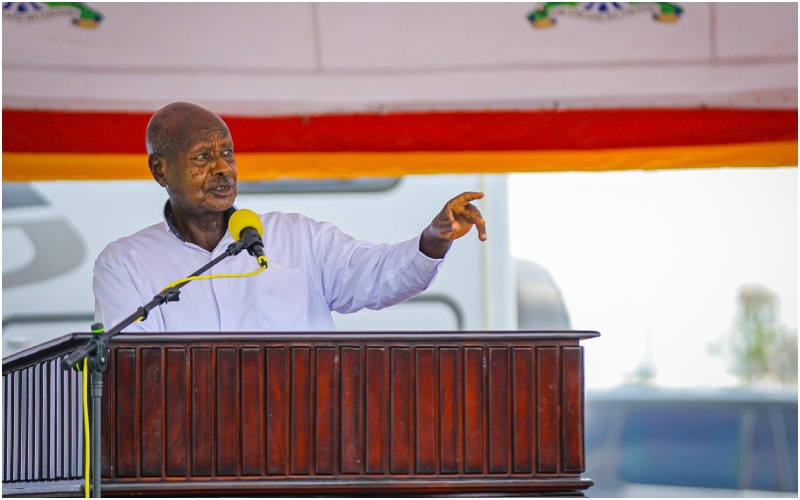
KIKUUBE, Uganda—President Yoweri Museveni has officiated the historic national occasion as Uganda formally named its crude oil blend, “Pearl Sweet.”
The Wednesday, September 2, 2026, ceremony marked a significant milestone in the East African nation’s journey toward first oil, giving Ugandan crude a clear commercial identity that can be recognised and traded on the global market.
Speaking at the official naming ceremony for Uganda’s crude oil at the Kingfisher Development Area in Kikuube District, President Museveni reaffirmed that Uganda’s oil resources must be used to build a productive and sustainable economy, rather than repeat mistakes made by some African oil-producing countries.
The president emphasised the importance of an integrated approach to petroleum development, with the refinery, energy generation, industrialisation and human capital development forming part of the broader strategy.
He highlighted the decision to prioritise the development of an oil refinery in Uganda, noting that refining locally would reduce transportation and transit costs associated with exporting crude and subsequently importing petroleum products.
“The refinery is also expected to help reduce Uganda’s petroleum import bill, which stands at about US$2 billion annually,” said the head of state.
The president further emphasised the importance of utilising associated gas rather than flaring it. Gas from the Kingfisher development is expected to support power generation of about 80 megawatts, while other petroleum products will support cooking and other domestic uses. This approach, he noted, will generate economic value while protecting the environment.
Why future petroleum resources are significant to Uganda
President Museveni commended the oil companies and government institutions for working together to advance Uganda’s petroleum program, stressing that the country must pursue development strategically and not blindly.
“Uganda’s oil resources are finite and should therefore be used to create durable productive capacity that will benefit generations beyond the lifespan of the oil fields,” President Museveni further said.
Future petroleum revenues, he explained, should support investments in power generation, transport infrastructure, railways, universities, and other long-term national assets rather than increased consumption of imported luxury goods.
The president also highlighted the importance of continued exploration, noting that only part of Uganda’s petroleum potential has so far been developed.
He said the country still has significant exploration opportunities, including in other prospective areas, and that the objective should be to ensure that the first barrel of oil is not the last.
President Museveni recalled that at the beginning of Uganda’s oil journey, the country lacked sufficient local expertise in petroleum.
“Government therefore deliberately invested in training Ugandans in petroleum-related disciplines, including through studies at international institutions,” explained the president.
Uganda marks an important milestone in the country’s petroleum journey
He said the development of national expertise was essential to ensuring that Ugandans can effectively manage and benefit from the country’s petroleum resources.
The president described the naming of Uganda’s crude oil as an important milestone in the country’s petroleum journey, giving the resource a distinct identity as Uganda prepares to enter the international oil market.
Speaking at the same time, Minister of Energy and Mineral Development Monica Musenero said Uganda’s oil and gas sector must catalyse broad-based socio-economic transformation rather than simply becoming a source of crude oil exports.
Minister Musenero said Uganda had reached an important threshold in its petroleum journey, with the country’s oil resources now being translated into productive assets, infrastructure, skills, businesses, and preparations for commercial production.
“My ministry’s immediate priority is to achieve first oil, working closely with the Petroleum Authority of Uganda, Uganda National Oil Company, licensed oil companies, and other sector partners,” said Minister Musenero.
Beyond first oil, she said the government’s focus is on maximising the value of petroleum through the development of the refinery, petroleum infrastructure, industrial parks and logistics facilities, particularly in the Albertine region.
Minister Musenero highlighted industrialisation, energy security, employment and national development as key outcomes expected from Uganda’s petroleum resources.
The importance of continued exploration of Uganda’s barrel of oil
She noted that the sector has so far generated approximately 39,000 direct jobs and 113,000 induced jobs, with more than 5,000 workers drawn from host communities. More than 14,000 Ugandans have also been trained and certified in oil and gas-related disciplines, alongside specialised training for government officials.
“The government will continue to ensure that petroleum resources and revenues are managed productively, guided by the principles of tracking where the money goes, where industries are being established and how the energy generated supports economic growth,” she added.
She further emphasised the importance of continued exploration to ensure that Uganda’s first barrel of oil is not its last, with the government preparing to pursue additional petroleum opportunities in other prospective basins.
On his part, Permanent Secretary in the Ministry of Energy and Mineral Development, Irene Bateebe, said Uganda’s oil and gas projects are making significant progress towards commercial production and becoming a tangible contributor to the country’s economic transformation.
PS Bateebe said the occasion marked an important milestone in Uganda’s petroleum journey, including the naming of the country’s crude oil ahead of its entry into the international market.
She said Kingfisher is approximately 80% complete overall and 98% ready for first oil, with commissioning and testing now underway. The project is expected to contribute 40,000 barrels of oil per day at peak production.
How far has the East African Crude Oil Pipeline (EACOP) project gone
The PS noted that CNOOC Uganda Limited and its joint venture partners have invested approximately USD 2.4 billion in the Kingfisher development.
She also reported that the Tilenga Project, operated by TotalEnergies, is approximately four times the size of Kingfisher and is expected to produce about 190,000 barrels of oil per day. More than 210 wells had been drilled by July 2026, exceeding the minimum required for first oil.
On the East African Crude Oil Pipeline (EACOP), PS Bateebe said construction had reached 92.7% completion, with the 47.5-kilometre feeder pipeline from Kingfisher to Pump Station One already laid and buried.
“The government continues to work with the project partners to ensure the 1,443-kilometre heated pipeline to Tanga is completed to support first oil,” the PS remarked.
Beyond production, PS Bateebe highlighted the sector’s contribution to Ugandan employment and local content, noting that more than 18,000 Ugandans are directly employed, with over 5,000 workers drawn from host communities.
Ugandans currently occupy about 65% of management positions, 85% of technical positions, and 99% of support positions across the sector.
She added that Ugandan enterprises have benefited from approximately USD 2.27 billion out of the roughly USD 7 billion invested in the sector to date.
“Looking beyond first oil, Uganda is preparing for further exploration in the Moroto, Lake Kyoga, and Hoima basins, with a third petroleum licensing round expected to be announced this year,” PS Bateebe disclosed.
The president of CNOOC Uganda Limited gives an update on the project
She reaffirmed the Ministry’s commitment, together with the Petroleum Authority of Uganda, to ensuring that Uganda’s petroleum projects are developed and regulated to deliver maximum national benefit, including through strengthened national content.
In his remarks, the President of CNOOC Uganda Limited, Dr. Liu Xiangdong, highlighted the significant progress made on the Kingfisher Development Project as Uganda advances towards commercial oil production.
Speaking at the Kingfisher project, he said the occasion was particularly meaningful as it demonstrated how far the project had come since CNOOC began its journey in Uganda in 2012.
He noted that the Kingfisher Central Processing Facility achieved mechanical completion on August 24, 2026, meaning that major construction, installation, and pre-commissioning works had been substantially completed.
The project comprises 31 wells, some reaching depths of more than seven kilometres, and is expected to have a production capacity of approximately 25,000 barrels of oil per day.
The CNOOC Uganda president said the project was not only about oil production but also about developing Ugandan capacity.
Through its partnership with Uganda Petroleum Institute Kigumba (UPIK), CNOOC is supporting knowledge transfer and talent development, including the establishment of a Centre of Excellence and internationally recognised certification programs.
“The project has also created business opportunities for Ugandan companies in petroleum technical services, construction, transportation, and logistics, while providing employment and practical experience for Ugandan professionals,” said Dr. Liu.
CNOOC Uganda’s commitment to delivering a high-quality development project
He further highlighted initiatives supporting agriculture and environmental conservation in the project area, including the introduction of high-yielding crops and tree-planting programs around project facilities.
The CNOOC Uganda Limited president expressed appreciation to President Museveni, the Government of Uganda, partners, contractors, suppliers, employees, and surrounding communities for their contribution to the project.
“Further, let me reaffirm CNOOC Uganda’s commitment to delivering a high-quality development, creating value for Uganda and ensuring that the skills and experience gained through the project benefit future generations,” added Dr. Liu.
The East African Crude Oil Pipeline (EACOP) is a 1,443-kilometre electrically heated pipeline connecting Uganda’s oilfields in Hoima to the Chongoleani Peninsula in Tanga, Tanzania.
With a design capacity of 216,000 barrels per day, expandable to 246,000 barrels per day, the pipeline is being developed through a regional partnership involving Total Energies Uganda, Uganda National Oil Company Limited (UNOC), Tanzania Petroleum Development Corporation (TPDC), and CNOOC Uganda Limited.
Where is the Kingfisher Development Project located in Uganda
At 92% completion, EACOP’s leadership said it remains on course for first crude before the end of 2026. The project is a major piece of regional infrastructure, supporting Uganda’s transition to commercial oil production and export while contributing to regional economic integration and development.
The Kingfisher Development Project, located on the Buhuka Plain in Kikuube District, is a key component of Uganda’s upstream petroleum program.
With 186 million barrels of 2P reserves and a planned peak production of 40,000 barrels per day, the project includes 31 wells across four wellpads and a Central Processing Facility with a capacity of 40,000 barrels per day. It is also expected to produce approximately 20,000 tonnes of LPG annually.
With an estimated investment of USD 2–3 billion, Kingfisher continues to contribute to Uganda’s energy security, local participation, and broader economic development, while being implemented in line with national content and environmental requirements.
The event at Kingfisher marked another major step in Uganda’s transition from petroleum discovery and development to commercial production and the utilisation of oil and gas as a catalyst for wider economic transformation.