
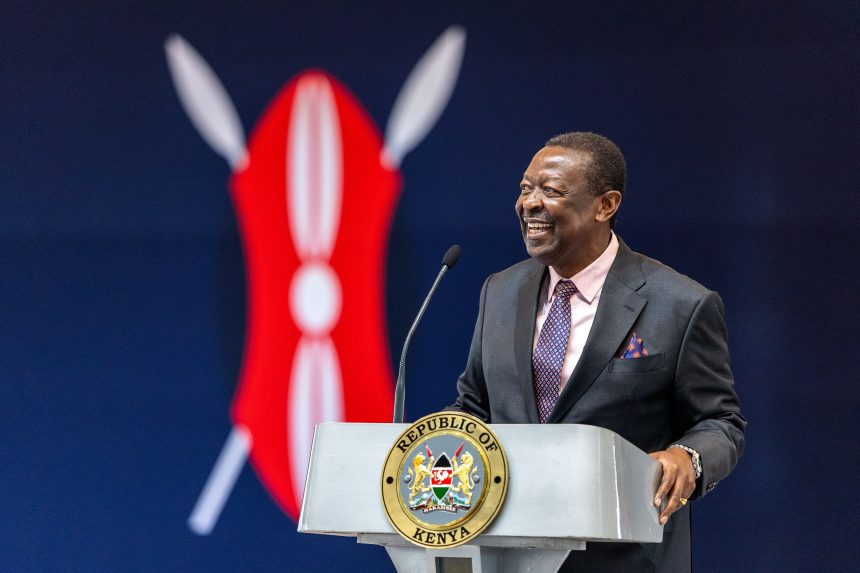

Africa’s efforts to expand intra-continental trade will depend increasingly on the African Union’s ability to mobilise sustainable domestic financing, strengthen financial independence and fund institutions capable of accelerating economic integration, Prime Cabinet Secretary and Cabinet Secretary for Foreign and Diaspora Affairs Dr Musalia Mudavadi has said.
Mudavadi is expected in Accra, Ghana, for the 27th Extraordinary Session of the Executive Council of the African Union (AU) on Friday, November 13, 2026, where African foreign and finance ministers will deliberate on sustainable financing for the continental body and its Peace Fund.
The meeting comes amid growing calls for African governments to reform the financial architecture of the AU to reduce dependence on external donors and ensure predictable funding for continental development priorities.
The reforms are particularly important as African countries seek to implement the African Continental Free Trade Area (AfCFTA), which aims to create a single market covering more than 50 countries, with a combined population of approximately 1.4 billion people.
Despite the continent’s enormous market potential, intra-African trade remains constrained by inadequate infrastructure, fragmented financial systems, limited access to trade finance, high transaction costs and inconsistent implementation of regional trade agreements.
A financially independent and better-resourced AU could play a stronger coordinating role in addressing these challenges, supporting cross-border infrastructure, harmonising trade policies and strengthening institutions responsible for implementing continental economic agreements.
Kenya considers sustainable financing of the African Union a strategic priority in building a stronger and more effective continental institution capable of responding to Africa’s development and security challenges, according to a statement from Mudavadi’s office.
The Accra meeting is jointly organised by the African Union Commission and the Government of Ghana, bringing together ministers responsible for foreign affairs and finance to examine mechanisms for strengthening the Union’s financial sustainability.
The discussions form part of institutional reforms championed by President William Ruto in his capacity as the AU Champion on Institutional Reform.
The reform agenda seeks to strengthen the Union’s financial independence, improve accountability, reduce reliance on external financing and establish predictable funding for continental programmes and peace support operations.
For Africa’s business community, the implications extend beyond the financing of the AU’s administrative operations. Sustainable funding could help strengthen the institutional capacity required to translate continental economic commitments into practical opportunities for businesses, investors and consumers.
One of the priorities is ensuring that African institutions have adequate resources to support AfCFTA implementation, including trade facilitation, customs cooperation, digital trade systems and the removal of non-tariff barriers that continue to make cross-border commerce expensive.
Access to affordable trade finance is another critical concern. Small and medium-sized enterprises, which account for a significant share of African businesses, often struggle to secure financing for cross-border transactions because of high borrowing costs, currency risks and limited access to financial services.
Stronger continental financial institutions and improved coordination among African development finance organisations could help address these gaps, enabling businesses to participate more effectively in regional value chains.
Africa also needs to accelerate reforms in cross-border payment systems, reduce dependence on foreign currencies in intra-African transactions and strengthen financial infrastructure to facilitate faster and cheaper settlements.
The Pan-African Payment and Settlement System (PAPSS), developed by Afreximbank in collaboration with the AU and AfCFTA Secretariat, represents one such initiative, allowing businesses to make cross-border payments in local currencies.
However, its effectiveness will depend on wider adoption, stronger financial-sector participation and supportive regulatory frameworks across member states.
Kenya views the Accra session as an opportunity to advance reforms that promote greater African ownership of the continental agenda, strengthen collective decision-making and improve the AU’s capacity to implement programmes responding to citizens’ aspirations.
The broader challenge is to ensure that financial reforms translate into measurable economic benefits, particularly increased trade, investment, industrial development and employment.
For Africa to realise the AfCFTA’s ambitions, the AU must evolve into a financially sustainable institution capable of supporting economic integration rather than relying heavily on external development partners to finance its priorities.
The outcome of the Accra deliberations could therefore shape not only the future financing of the African Union but also the continent’s capacity to build a more integrated and competitive African economy.