
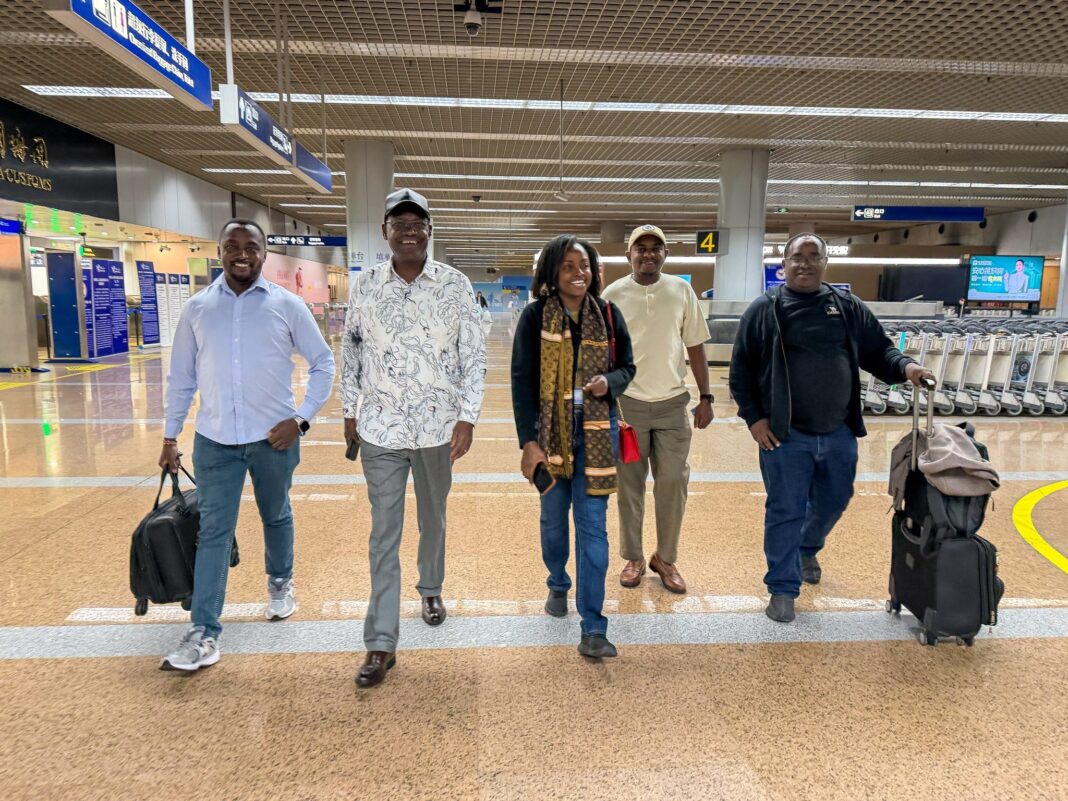

Kenya is seeking to deepen its economic partnership with China beyond infrastructure financing as Principal Secretary for the National Treasury and Economic Planning Dr. Chris Kiptoo begins high-level engagements in Beijing aimed at unlocking investment, sustainable financing and greater trade opportunities.
Dr Kiptoo arrived in the Chinese capital for bilateral and technical meetings with Chinese government authorities and financial institutions, in what Nairobi views as an important step towards strengthening Kenya-China economic relations.
“This evening, I arrived in Beijing, People’s Republic of China, for a series of bilateral and technical engagements with Chinese Government authorities and financial institutions,” Dr Kiptoo said on his X platform.
His visit comes ahead of an anticipated trip to China by Prime Cabinet Secretary and Foreign Affairs Minister Dr Musalia Mudavadi later this month or in early October, setting the stage for intensified diplomatic and economic engagement between Nairobi and Beijing.
Dr Kiptoo was received by Lynette Ndile Mwende, Kenya’s Deputy Head of Mission at the Embassy of Kenya in Beijing.
The Treasury PS’s meetings are expected to focus on infrastructure financing, investment and economic cooperation, with Kenya seeking to secure funding for priority projects while ensuring that future financing arrangements remain sustainable.
Among the projects highlighted by Dr Kiptoo is the Rironi-Mau Summit Highway, a major transport infrastructure investment intended to improve connectivity along one of Kenya’s busiest economic corridors.
“Our engagements in Beijing will build on this strong foundation, advance priority projects, and explore sustainable financing and investment opportunities to further support Kenya’s economic development,” he said.
China has been a major partner in Kenya’s infrastructure development over the past two decades, with Chinese companies and financial institutions involved in transport, energy, manufacturing and other sectors.
The relationship, however, is increasingly evolving as Nairobi seeks to move away from an emphasis on large infrastructure projects towards a broader economic partnership centred on trade, investment, industrialisation and technology.
For Kenya, one of the biggest priorities is narrowing the trade imbalance with China by increasing exports of Kenyan products to the Chinese market. Nairobi is also seeking to attract Chinese manufacturers and investors who can establish production facilities in Kenya and use the country as a gateway to the wider East African and African markets.
Such investment could support local value addition, create jobs and strengthen Kenya’s manufacturing base while giving Chinese companies greater access to regional markets.
The shift is particularly important as Kenya seeks to position itself as a regional hub for logistics, finance, technology and manufacturing. Chinese participation in sectors such as renewable energy, electric mobility, digital technology, agriculture, healthcare and industrial production could provide new areas for bilateral cooperation.
At the same time, Kenya is seeking financing arrangements that support development without placing additional pressure on public finances. The government’s emphasis on sustainable financing reflects the changing nature of Kenya’s economic relationship with China and the need to ensure that major infrastructure investments generate sufficient economic returns.
Dr Mudavadi’s expected visit could build on the technical and financial discussions being undertaken by Dr Kiptoo, providing a wider diplomatic platform for negotiations on trade, investment and bilateral cooperation.
The two engagements could therefore represent a coordinated effort by Nairobi to strengthen relations with Beijing while pursuing more commercially focused outcomes.
China remains one of Kenya’s most important trading and investment partners, but the next phase of the relationship is likely to be judged increasingly by how effectively it expands Kenyan exports, attracts productive investment and supports industrial development.
The timing also comes as global competition for economic influence in Africa intensifies. China, the United States, Europe and emerging powers are seeking stronger commercial relationships with African economies, increasing the importance of Kenya’s ability to negotiate partnerships that advance its own development priorities.
Dr Kiptoo’s Beijing mission therefore carries significance beyond infrastructure financing. It could help lay the groundwork for a new phase of Kenya-China relations in which trade, manufacturing, investment, technology and sustainable financing take greater prominence.
For Nairobi, the immediate test will be whether the high-level engagements can translate into concrete agreements that expand market access for Kenyan goods, attract Chinese investment and accelerate infrastructure and industrial development.



