South Sudan, Ethiopia Lead Africa’s 2026 Growth Outlook as Kenya Projects 4.5%

South Sudan and Ethiopia are projected to record some of Africa’s fastest economic growth rates in 2026, while Kenya is expected to expand at a more moderate pace, highlighting the continent’s uneven recovery and contrasting economic prospects.

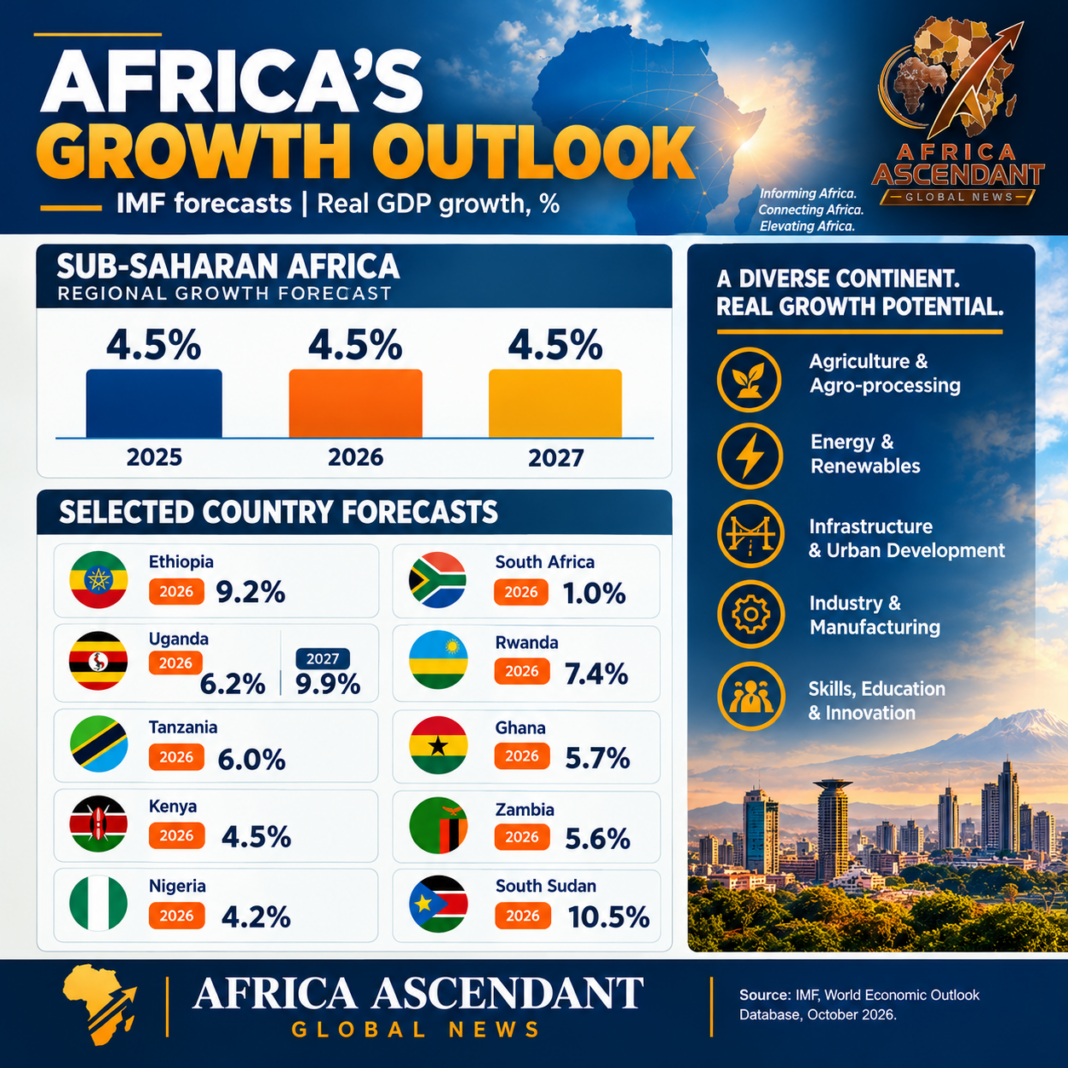
The projections show South Sudan leading the selected African economies with an estimated growth rate of 10.5%, followed by Ethiopia at 9.2% and Rwanda at 7.4%. Benin is projected to grow by 7.0%, while Uganda is expected to record 6.2%.

Côte d’Ivoire and Tanzania are both projected to expand by 6.0%, placing them among the continent’s stronger-performing economies. Ghana is forecast to grow by 5.7%, followed by Zambia at 5.6% and the Democratic Republic of Congo (DRC) at 5.2%.

Zimbabwe is projected to record 5.0% growth, while Kenya’s economy is expected to expand by 4.5%. Angola and Nigeria are forecast to grow by 4.4% and 4.2%, respectively.

South Africa is projected to record the slowest growth among the 15 countries listed, at just 1.0%, reflecting the persistent structural challenges facing the continent’s most industrialised economy.

The figures, presented as International Monetary Fund (IMF) projections for 2026, underline the diversity of Africa’s economic performance, with some countries expected to benefit from investment, expanding domestic markets and activity in key productive sectors, while others continue to face structural constraints.

For Kenya, the projected 4.5% growth rate places it below several East African peers, including Ethiopia, Rwanda, Tanzania and Uganda. The comparison highlights the importance of strengthening manufacturing, agricultural productivity, infrastructure, exports and private-sector investment to accelerate economic expansion.

However, headline growth rates do not necessarily translate into improved living standards. Population growth, inflation, public debt, employment creation and income distribution will influence how much economic expansion benefits ordinary citizens.

Similarly, countries recording rapid growth must ensure that investment generates sustainable jobs, expands productive capacity and improves public services.

As African governments pursue economic transformation, the challenge will be to convert projected growth into stronger trade, industrial development and higher household incomes.


 

Hot this week

The Meal That Builds a Nation

Every school day in Kenya, before lessons begin and...

Kenya Sets National Research Agenda to Put Migrants’ and Refugees’ Health at the Centre

  Kenya has taken a major step towards building a...

Beyond Rebranding How LVCT Health Is Rethinking Healthcare Sustainability in Kenya

For more than two decades, LVCT Health has built...

WHO Urges Vigilance as Kenya Confirms Second Ebola Case

The patient, a 39-year-old man and relative of Kenya’s first Ebola victim, developed symptoms on October 13 while under quarantine. The first patient, a Kenyan who had been living in the DRC, died in hospital on October 5, two days after arriving in Nairobi via Uganda.

CRDB Bank Secures $75 Million FMO Facility, Expands African Financing Partnerships

CRDB Bank Plc has secured a $75 million long-term financing facility from Dutch development bank FMO, strengthened partnerships with Afreximbank and Shelter Afrique Development Bank, and launched a framework to measure its sustainable development impact.

Topics

The Meal That Builds a Nation

Every school day in Kenya, before lessons begin and...

WHO Urges Vigilance as Kenya Confirms Second Ebola Case

The patient, a 39-year-old man and relative of Kenya’s first Ebola victim, developed symptoms on October 13 while under quarantine. The first patient, a Kenyan who had been living in the DRC, died in hospital on October 5, two days after arriving in Nairobi via Uganda.

CRDB Bank Secures $75 Million FMO Facility, Expands African Financing Partnerships

CRDB Bank Plc has secured a $75 million long-term financing facility from Dutch development bank FMO, strengthened partnerships with Afreximbank and Shelter Afrique Development Bank, and launched a framework to measure its sustainable development impact.

EAC Moves to Harmonise Digital Trade Rules as Intra-Regional Trade Hits $19.65 Billion

East African Community (EAC) member states are stepping up...

Trade, Energy and Geopolitics: Kenya and Azerbaijan Seek a New Economic Partnership

Kenya offers Azerbaijan access to East Africa’s growing markets and regional trade networks, while Azerbaijan brings expertise in oil and gas, industrial development and connectivity between Europe and Asia. The challenge for both countries is to translate diplomatic goodwill into increased trade, productive investment, technology transfer and employment.

EAC Adopts 10-Year Tourism Plan, Targets AFCON 2027 to Boost Regional Tourism

East Africa is positioning tourism as a regional economic...
spot_img

Related Articles

Popular Categories