
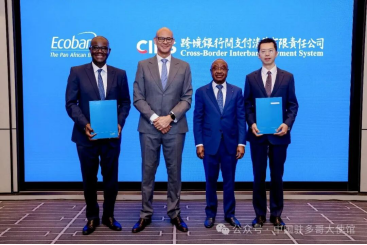

Africa’s efforts to reduce cross-border payment costs and diversify trade settlement currencies are gaining momentum following a new partnership between Togo-headquartered Ecobank and China’s Cross-Border Interbank Payment System (CIPS), which could make the Chinese yuan more accessible to businesses across the continent.
The memorandum of understanding signed in Beijing on October 10 marks a step towards connecting Ecobank’s extensive African banking network to renminbi (RMB) settlement services, potentially streamlining payments for importers, exporters and investors engaged in China-Africa trade.
With operations across 34 African countries and a presence in Paris, Ecobank offers a significant platform for extending yuan-based financial services to businesses that trade with China. The agreement could help reduce reliance on multiple intermediary banks when settling transactions, although the precise implementation arrangements and rollout timetable have not been specified.
The development comes as African governments and financial institutions explore alternative payment channels to manage foreign-exchange pressures, improve trade efficiency and strengthen financial links with major commercial partners.
China-Africa trade drives demand for alternative currencies
The agreement comes against the backdrop of expanding commercial ties between Africa and China. Bilateral trade reached approximately $348 billion in 2025, according to Ecobank, reinforcing the need for financial infrastructure capable of supporting growing transactions between Chinese suppliers and African markets.
For African importers purchasing machinery, electronics, vehicles, construction materials and industrial equipment from China, settling invoices directly in yuan could reduce the need to convert local currencies into US dollars before making payments to Chinese suppliers.
Such arrangements could also help companies manage currency conversion expenses and reduce exposure to fluctuations between the dollar and local currencies. However, the actual savings will depend on exchange rates, banking fees, yuan liquidity and the terms offered by participating financial institutions.
China’s currency is increasingly attracting attention as African economies seek to diversify their international payment arrangements. South African banking group Standard Bank and Rwanda’s Bank of Kigali are among the African financial institutions reported to have connected with China’s CIPS network, reflecting growing interest in yuan-denominated transactions.
Nevertheless, yuan adoption remains uneven across the continent. The Ecobank-CIPS agreement represents an expansion of payment options rather than evidence that most African states have adopted the Chinese currency as a primary mode of payment.
Intra-African trade seeks local-currency solutions
Alongside the growing use of the yuan in China-Africa commerce, African institutions are developing payment systems intended to make trade between African countries less dependent on external currencies.
The Pan-African Payment and Settlement System (PAPSS), developed by the African Export-Import Bank in collaboration with the African Union Commission and the African Continental Free Trade Area Secretariat, enables cross-border payments in African currencies.
In February 2026, Kenya’s Pesalink partnered with PAPSS to connect more than 80 participating banks, fintech companies, savings and credit cooperatives and telecommunications providers to a network of more than 160 banks and fintechs. The arrangement is designed to facilitate cross-border transfers in local currencies.
Ethiopia’s central bank also joined PAPSS in October 2026, strengthening efforts to integrate national payment networks and reduce reliance on foreign currencies for intra-African transactions.
These developments point to a dual strategy: African countries are seeking to simplify payments within the continent using their own currencies while expanding access to alternative settlement arrangements for international trade.
For a Kenyan company importing goods from China, yuan settlement could offer an additional channel. For a Kenyan exporter selling agricultural products to Uganda or Rwanda, local-currency payment systems could provide a different route to faster and potentially cheaper settlement.The two approaches address distinct but complementary needs.
Financial connectivity and Africa’s trade ambitions
The success of these initiatives will depend on whether banks can make the services accessible to small and medium-sized enterprises, which often face higher transaction costs and limited access to foreign exchange.
Businesses will also need reliable exchange rates, sufficient yuan liquidity, transparent transaction fees and safeguards against settlement delays. Regulatory coordination and the ability to convert currencies when required will remain critical.
For Ecobank, linking its 34 African markets with China’s payment infrastructure could strengthen its role as a financial intermediary between the two regions. For African businesses, the opportunity lies in having more choices over how international transactions are financed and settled.
As the AfCFTA seeks to expand commerce across African borders, the combination of local-currency payment systems and stronger links to China’s yuan infrastructure could help address longstanding barriers to trade.
The broader objective is not necessarily to replace the US dollar with a single alternative currency, but to build a more diversified payment environment in which African businesses can transact more efficiently across regional and international markets.



