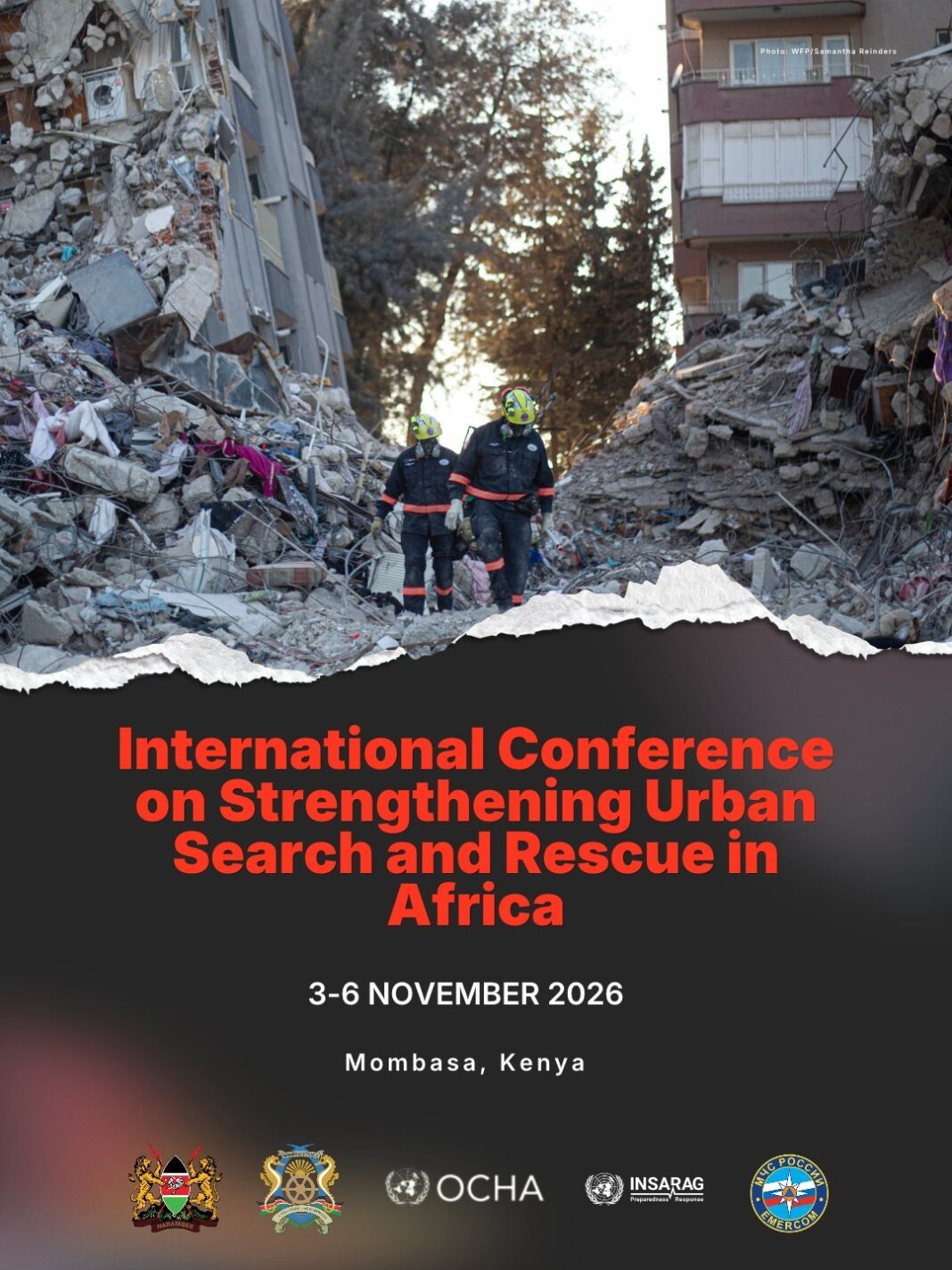

African countries are seeking stronger emergency preparedness and regional cooperation as floods, cyclones, landslides and building collapses continue to threaten lives, displace communities and stretch the capacity of national disaster-response systems.
The Government of Kenya, the United Nations Office for the Coordination of Humanitarian Affairs (OCHA) and Russia’s Ministry of Emergency Situations (EMERCOM) are convening a regional conference to bring together search-and-rescue teams to exchange experiences, assess operational gaps and strengthen cooperation in responding to major emergencies.
The meeting comes as African governments face growing pressure to improve their ability to anticipate disasters, mobilise emergency personnel and equipment, and coordinate rapid responses when communities are struck by natural hazards or human-induced incidents.
For many countries, the challenge extends beyond the availability of rescue personnel. Effective emergency response also depends on early-warning systems, reliable communication networks, specialised equipment, trained medical teams, evacuation plans and clear coordination between government agencies, humanitarian organisations and neighbouring states.
The conference is expected to provide a platform for countries to examine these challenges and identify practical ways to improve readiness before disasters occur.
Preparedness before disaster strikes
Across Africa, emergencies can quickly overwhelm local response capabilities, particularly where communities lack adequate infrastructure, emergency services are under-resourced or disasters affect several areas simultaneously.
Flooding can cut off roads and isolate entire communities, while cyclones can destroy homes, disrupt electricity supplies and force thousands of people to seek shelter. Landslides can bury settlements with little warning, and building collapses can require specialised teams capable of searching unstable structures for survivors.
These incidents demand more than an immediate rescue operation. They require advance planning, regular training, functioning emergency command structures and the ability to deploy resources where they are needed most.
African governments therefore face the task of strengthening national disaster-management institutions while building systems that allow countries to support one another when emergencies exceed domestic capacity.
Investing in preparedness can help reduce avoidable deaths, accelerate the delivery of humanitarian assistance and limit the economic damage caused by disasters. It can also improve the protection of vulnerable populations, including children, older people, persons with disabilities and communities living in high-risk areas.
Strengthening regional cooperation
The participation of national search-and-rescue teams offers an opportunity to compare operational experiences, identify weaknesses and improve coordination across borders.
Disasters do not always respect administrative or national boundaries. Floods can affect shared river basins, cyclones can disrupt several countries across a region, and major emergencies can require specialised personnel and equipment that individual governments cannot readily provide.
Regional cooperation can help address these challenges through joint exercises, common operating procedures, information sharing and arrangements for the rapid deployment of assistance.
Countries can also benefit from exchanging lessons on incident management, technical rescue operations, emergency medical care, logistics and the safe evacuation of affected populations.
For African states, stronger collaboration could help establish more predictable mechanisms for requesting and receiving assistance, reducing delays caused by unclear responsibilities, incompatible procedures or logistical bottlenecks.
International partnerships can complement these efforts by supporting technical exchanges, professional training and the sharing of specialised search-and-rescue expertise. However, sustainable preparedness will ultimately depend on national investment, institutional capacity and the consistent implementation of disaster-management plans.