
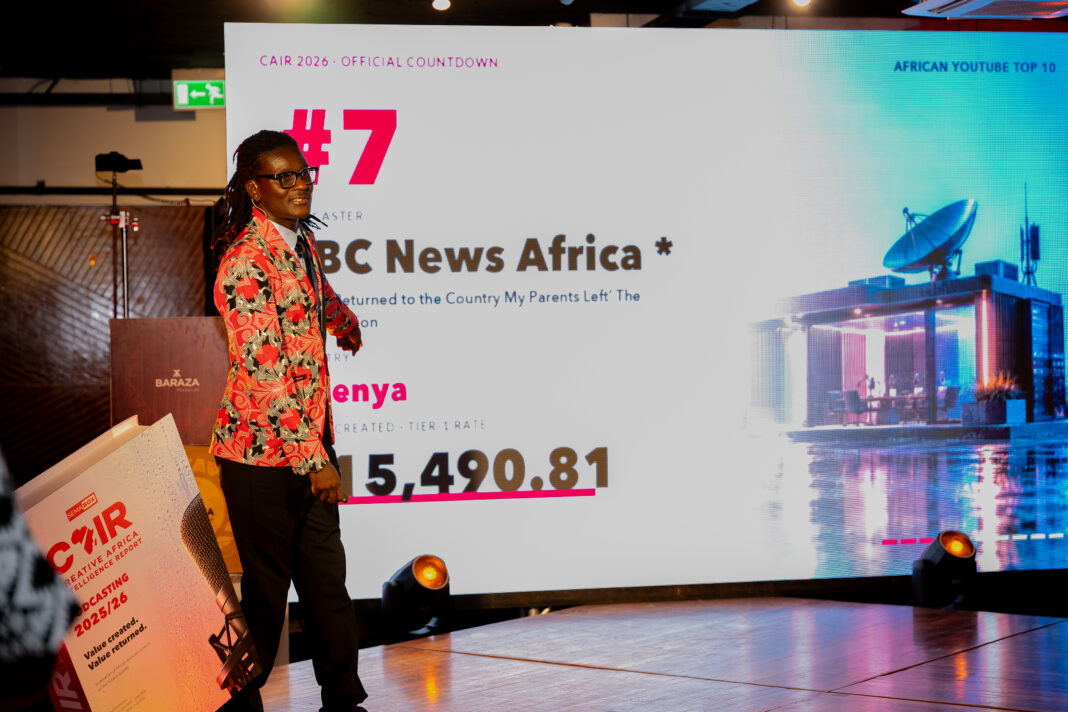

SemaBOX report finds African podcast content delivers stronger engagement than global benchmarks but earns less, exposing a growing gap between audience value and creator revenue.
African podcasters are attracting audiences that rival or surpass engagement benchmarks in wealthier markets, yet the commercial value of their work remains significantly lower, raising questions about who benefits from the continent’s fast-growing digital media industry.
A new report estimates that 330 podcast episodes published on YouTube and Spotify could have generated more than $2.3 million in advertising value if priced at rates available in markets such as the United States, the United Kingdom and Australia. At prevailing African market rates, however, the same content generated an estimated $900,000, leaving a potential valuation gap of approximately $1.4 million.
The findings are contained in the Creative Africa Intelligence Report 2026, published by SemaBOX on October 20, 2026, which argues that African podcasting faces a structural problem: audiences are consuming and engaging with content, but the advertising market is not rewarding creators at comparable rates.
The report challenges the assumption that lower earnings reflect weaker content or limited audience interest. Instead, it identifies what it calls a “geography discount”, in which the commercial value assigned to content is influenced by the location of its creators and audiences rather than the quality of their work.
For Africa’s expanding creator economy, the implications extend beyond podcasting to the broader question of whether digital platforms can translate the continent’s growing audiences into sustainable income for local media businesses.
Strong engagement, weaker returns
The report analysed 330 pieces of content published between June 2025 and July 2026, comprising 227 YouTube videos and 103 Spotify episodes.
Its findings suggest that African podcast creators are already producing content capable of attracting substantial audience attention.
The YouTube sample recorded a weighted engagement rate of 2.75%, compared with a benchmark range of 1.5% to 2.2% in higher-paying markets. This puts engagement in the African sample between 25% and 83% above the comparison range.
Yet the stronger engagement has not translated into equivalent advertising value.
 According to the report, the sample’s blended advertising rate was approximately 71% lower than the comparator markets. The disparity varied considerably across the continent, reaching about sevenfold in Kenya and Nigeria and nearly elevenfold in Ghana, Uganda, Tanzania, Senegal and Egypt.
The report cautions that the latter comparisons rely on a shared fallback advertising rate because reliable country-specific benchmarks were unavailable.
These figures highlight a disconnect between the attention African creators attract and the revenue advertisers are willing to pay for that attention.
For creators investing time and resources in producing interviews, documentaries, cultural commentary and long-form discussions, audience growth alone may not guarantee financial sustainability.
The report’s central argument is that the continent’s creative economy cannot reach its full potential if commercial systems continue to undervalue content produced for African audiences.
The monetisation barrier behind the numbers
Beyond advertising rates, access to platform monetisation remains a major obstacle.
During the study period, Spotify’s Partner Program was unavailable in every African market, while YouTube’s Partner Program was accessible in only 13 of Africa’s 54 countries.
This means creators can build audiences and generate engagement without necessarily having access to the same revenue opportunities available to their counterparts elsewhere.
The report estimates that, under platform revenue-sharing arrangements, approximately half of the modelled advertising value could accrue to creators. At higher market rates, the same content could have generated about 890 monthly income equivalents of $100 over the 14-month study period, compared with approximately 352 at current rates, without any additional views.
These are modelled estimates rather than verified earnings or payments received by individual podcasters. Nevertheless, they illustrate the potential financial consequences of differences in advertising rates and monetisation access.
The problem could become more pronounced as the audience for African digital audio continues to expand.
The report estimates that African podcast audiences are growing by between 20% and 28% annually, while the infrastructure supporting monetisation is expanding by only 7% to 14%.
If that disparity persists, the continent could attract increasingly large audiences without building the advertising, measurement and payment systems needed to support the people producing the content.
In effect, Africa risks expanding its digital media consumption faster than its capacity to generate sustainable income from it.
An expanding market with an uneven revenue picture
The report also attempts to quantify the scale of Africa’s podcast production.
It models annual African podcast output at approximately 710,000 publications, based on an estimated 10,000 open RSS feeds and 20,000 YouTube channels.
However, the report acknowledges that the estimate has not been deduplicated and should be treated as a scenario rather than a verified total of unique publications.
At the broader regional level, it places the Middle East and Africa digital audio market at $1.37 billion in 2024/25, projecting that the combined market could reach $7.99 billion by 2030.
The regional estimate does not establish how much of that revenue originates from Africa, making it difficult to determine the continent’s precise share of the market.
Even so, the projections point to a potentially significant commercial opportunity, provided creators can access the infrastructure and revenue channels needed to benefit from it.
The challenge is therefore not simply to produce more podcasts. It is to build a market in which audience attention can be measured, sold to advertisers and converted into reliable earnings.
Calls for platforms, advertisers and policymakers to act
SemaBOX is urging global brands and advertising agencies to include African podcasts in their media plans and evaluate campaigns against measurable outcomes, including completed views, referral traffic and conversions.
The report also calls on investors to support the infrastructure linking content creators to advertising demand, including dynamic ad insertion, audience measurement tools, catalogue aggregation and creator payment systems.
It recommends that YouTube and Spotify widen monetisation access in Africa, including through a phased Spotify Partner Program pilot in Kenya, Nigeria and South Africa, alongside the publication of country-level market indicators.
For policymakers, the recommendations focus on improving transparency around advertising rates, ad-fill rates and creator payouts while supporting locally developed advertising technology and payment systems.
The report’s recommendations reflect a wider shift in how the African creative economy is being discussed: from celebrating the growth of digital content production to examining whether the people behind that growth can build viable businesses.
Baraza Media Lab, which partnered with SemaBOX on the report’s launch, argues that the creative sector needs institutions that help emerging media ventures develop beyond occasional opportunities.
Its Executive Director, Eric Kinanga, said African creators need spaces where ideas can be tested, experimentation encouraged and emerging institutions supported as they grow.
The partnership positions the report as more than an assessment of podcast advertising rates. It is also an argument for building the institutions and commercial systems that allow African creative enterprises to mature.
Closing the gap between attention and income
 For Dan Aceda, SemaBOX’s founder and chief executive, the geography discount represents both a structural challenge and a commercial opportunity for advertisers, investors and advertising technology developers seeking to enter Africa’s growing digital audio market.
The report’s findings suggest that closing the gap will require coordinated action across platforms, advertising agencies, investors and governments.
Expanding monetisation access could help creators earn directly from their audiences, while better measurement systems could give advertisers stronger evidence of the value generated by African podcasts.
More transparent market data could also help creators negotiate commercial partnerships from a better-informed position.
However, the report’s estimates should be interpreted within their methodological limits. Its sample of 330 pieces of content does not represent every African podcast, and the modelled advertising values are not evidence that the estimated revenue would automatically be realised. Actual earnings would depend on audience composition, advertiser demand, platform eligibility, campaign performance and other market conditions.
Even with those limitations, the findings raise a fundamental question for Africa’s digital media industry: what happens when audience attention grows faster than the systems designed to pay for it?
African podcasters may be demonstrating that their content can compete for attention in the global digital marketplace. The next challenge is ensuring that the economic value generated by that attention is not systematically discounted because of geography.
As the continent’s creator economy expands, its long-term success may depend less on how much content African creators produce and more on whether they can turn that production into sustainable businesses.
The full Creative Africa Intelligence Report 2026 is available through SemaBOX’s website at SemaBOX Creative Africa Intelligence Report
https://semabox.africa/cair.



