
Ghana is seeking to turn its recent macroeconomic stabilisation into a broader economic transformation centred on agriculture, local processing, infrastructure, digital connectivity and private-sector investment, as President John Dramani Mahama steps up engagement with the International Finance Corporation (IFC).
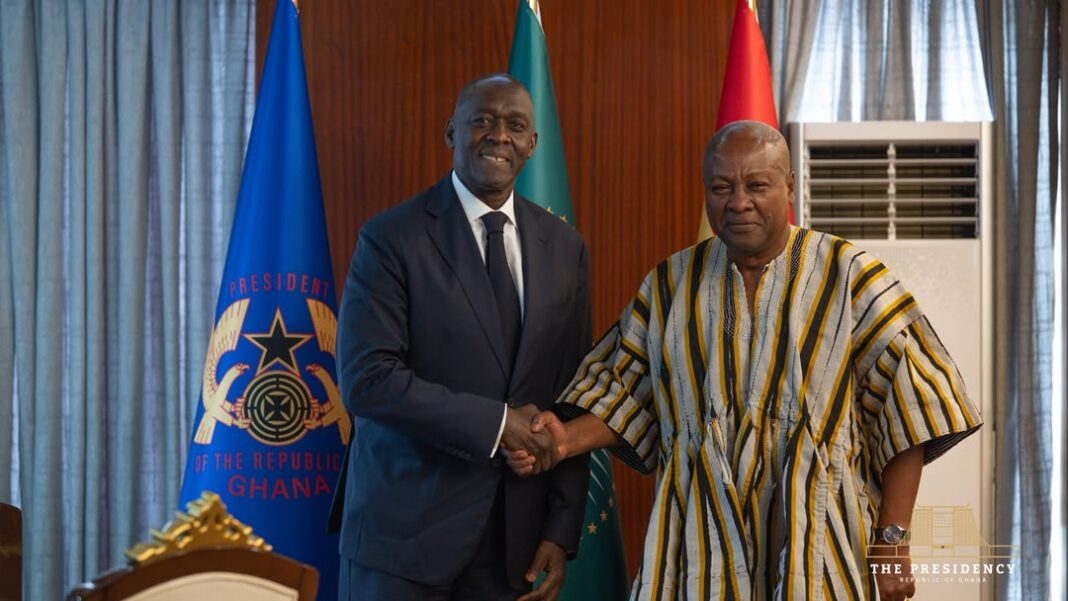
President Mahama held talks with IFC Managing Director Makhtar Diop at the Presidency in Accra on September 16, with discussions focusing on strategic investments that could expand productive capacity, create jobs and strengthen Ghana’s economic resilience.
The meeting comes as Ghana moves from crisis management towards a new phase of economic development following the severe debt and macroeconomic crisis of 2022. The IMF says Ghana has made substantial progress in stabilising the economy, with inflation falling sharply, international reserves rebuilding and the country’s debt-distress risk returning to moderate. Real GDP grew by 6 percent in 2025 and expanded by 6.4 percent year-on-year in the first quarter of 2026.
Against this backdrop, agriculture is emerging as a major pillar of Mahama’s economic transformation agenda. The government wants to scale up commercial production in cocoa, oil palm and poultry while attracting greater private-sector participation in value chains.
A central objective is to move Ghana beyond the export of largely unprocessed commodities. Mahama reiterated the government’s policy of processing at least 50 percent of Ghana’s cocoa, agricultural produce and minerals domestically, a strategy aimed at retaining more value within the economy and creating employment.
The government is also looking to expand investment in cocoa processing, palm oil, poultry and sugar. Finance Minister Cassiel Ato Forson separately identified these areas as priorities for increased private investment, alongside an ambition to develop Ghana into a pharmaceutical hub for West Africa.
For the IFC, the agenda provides an opportunity to expand private-sector financing into productive sectors capable of generating jobs and export earnings. Diop commended Ghana’s economic reforms and pledged the IFC’s continued support for commercial agriculture and efforts to build a more resilient and sustainable economy.
Infrastructure is another major component of the transformation strategy. The discussions covered the expansion of Ghana’s road, railway and aviation networks, alongside digital infrastructure under the government’s Big Push Infrastructure Development programme.
Improved transport connectivity is particularly important for agriculture and manufacturing because high logistics costs and inadequate infrastructure can constrain access to domestic and international markets. The World Bank has identified weaknesses in transport maintenance, fragmented governance and limited integration between transport modes as constraints on productivity, trade and job creation.
Energy also remains a critical issue for Ghana’s economic ambitions. The IMF has warned that further reforms are needed in the energy sector and in the management of state-owned enterprises to protect fiscal sustainability.
Mahama also announced a $300 million World Bank financing package to expand infrastructure in senior high schools and permanently phase out the double-track system by the end of 2027. The system was introduced to accommodate increased enrolment under the Free Senior High School programme amid infrastructure constraints.
The education investment forms part of the broader economic transformation agenda, with improved infrastructure and human capital expected to support Ghana’s longer-term productivity.
Ghana’s recent economic recovery provides a stronger foundation for this next phase. The IMF reports that inflation fell to 5.3 percent in June 2026, while the primary fiscal balance moved into surplus and progress was made on comprehensive debt restructuring.
However, the transition from stabilisation to sustained development will depend on whether macroeconomic gains translate into productive investment, higher-quality jobs and stronger household incomes. The World Bank has cautioned that Ghana must maintain fiscal and monetary discipline while protecting priority social and infrastructure spending.
The Mahama administration’s expanding partnership with the IFC therefore places private investment, industrialisation and value addition at the centre of Ghana’s next economic chapter—seeking to convert improved macroeconomic stability into broader structural transformation.