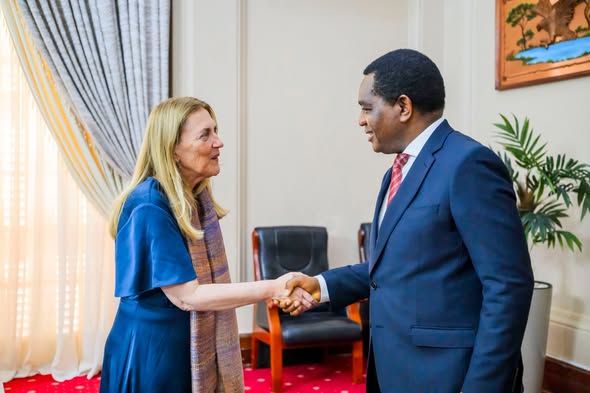

Zambian President Hakainde Hichilema has called for increased Swiss investment in mining, technology, agriculture and manufacturing, as his government shifts from economic recovery towards accelerated growth, industrialisation and job creation.
Speaking at State House during a meeting with Swiss business executives and multinational company representatives, Hichilema said Zambia was seeking to strengthen trade and investment ties with Switzerland through a proposed Comprehensive Economic Partnership Agreement.
The delegation included representatives from commodity trading firms Trafigura, Glencore, Mercuria and Vitol, alongside technology company ABB, logistics operator MSC/Africa Global Logistics and Koenig & Bauer Banknote Solutions. It was led by Swiss State Secretary for Economic Affairs Helene Budliger Artieda.
Hichilema said Zambia had made progress in restoring economic stability following the debt crisis and sovereign default that preceded his administration’s assumption of office in 2021. He said reforms and debt restructuring had helped establish a foundation for renewed investment and sustainable growth.
“We came from a very difficult place in 2021 where our economy was declining and we had defaulted on our debt obligations. Since taking office, we have worked hard to recover the country, stabilise the economy and create the foundation for growth,” he said.
The President thanked Switzerland for supporting Zambia’s debt restructuring process, noting that the assistance had helped create fiscal space for economic recovery and development. He also highlighted efforts to revive the mining sector, identifying opportunities for Swiss-linked businesses to support the country’s next phase of economic expansion.
“Our focus now is growth. We seek accelerated economic growth through investment and trade, and we want to work with Switzerland and its global business networks to achieve that objective,” Hichilema said.
A key priority is expanding cooperation beyond the traditional focus on copper and cobalt to include manganese, nickel, lithium and rare earth elements. These minerals are increasingly important to global supply chains for electric vehicles, renewable energy technologies and advanced manufacturing.
Hichilema said Zambia wanted to move beyond exporting unprocessed commodities by developing domestic industries capable of generating higher-value products, creating employment and strengthening the country’s industrial base.
“We do not want to remain a country that simply exports raw materials. We want to add value here in Zambia and build industries that create jobs and opportunities for our people,” he said.
The proposed economic partnership agreement would provide a framework for strengthening commercial relations, attracting investment and facilitating trade between the two countries. For Zambia, closer engagement with Swiss businesses could also open access to international commodity markets, advanced technologies and specialised expertise.
The President urged Swiss commodity traders to help Zambian producers secure structured international markets for agricultural products and other exports. He said the government was committed to maintaining a predictable business environment and protecting investors, rejecting expropriation as a basis for economic policy.
He also encouraged European companies to pursue joint ventures with Zambian businesses rather than relying exclusively on conventional investment models. Such arrangements, he said, could strengthen local participation, facilitate skills transfer and expand employment opportunities for the country’s young population.
Artieda expressed Switzerland’s interest in increasing direct investment in Zambia and establishing a government-to-government economic framework to deepen bilateral commercial relations.
She said Switzerland’s investment approach prioritised technology, innovation and domestic value creation, rather than simply extracting resources. The country, which has expertise in advanced manufacturing, finance and technology, sees opportunities to combine its capabilities with Zambia’s natural resources.
“When we invest, it is smart investment. We create value for local communities. We bring technology, innovation, and are committed to creating value domestically,” she said.
Artieda also highlighted Zambia’s potential role in helping Switzerland diversify its access to critical minerals as the global transition towards cleaner energy accelerates.
“With the climate transition underway, Zambia is an indispensable partner, particularly as Switzerland seeks to diversify its access to critical minerals,” she said, adding that Swiss expertise and technology could complement Zambia’s resource base.
The discussions underscore Zambia’s efforts to attract investment that supports economic diversification and increases the domestic benefits of natural resource development.
For Switzerland, stronger economic ties with Zambia offer opportunities to diversify critical mineral supply chains and expand commercial engagement in a resource-rich African economy.
The success of the proposed partnership will depend on translating diplomatic commitments into concrete investments, stronger local supply chains and industrial projects that deliver measurable economic benefits for both countries.