

Israel’s decision to recognise Somaliland as an independent sovereign state has opened a new chapter in the Horn of Africa’s diplomatic landscape, deepening bilateral relations while triggering strong opposition from the Federal Government of Somalia.
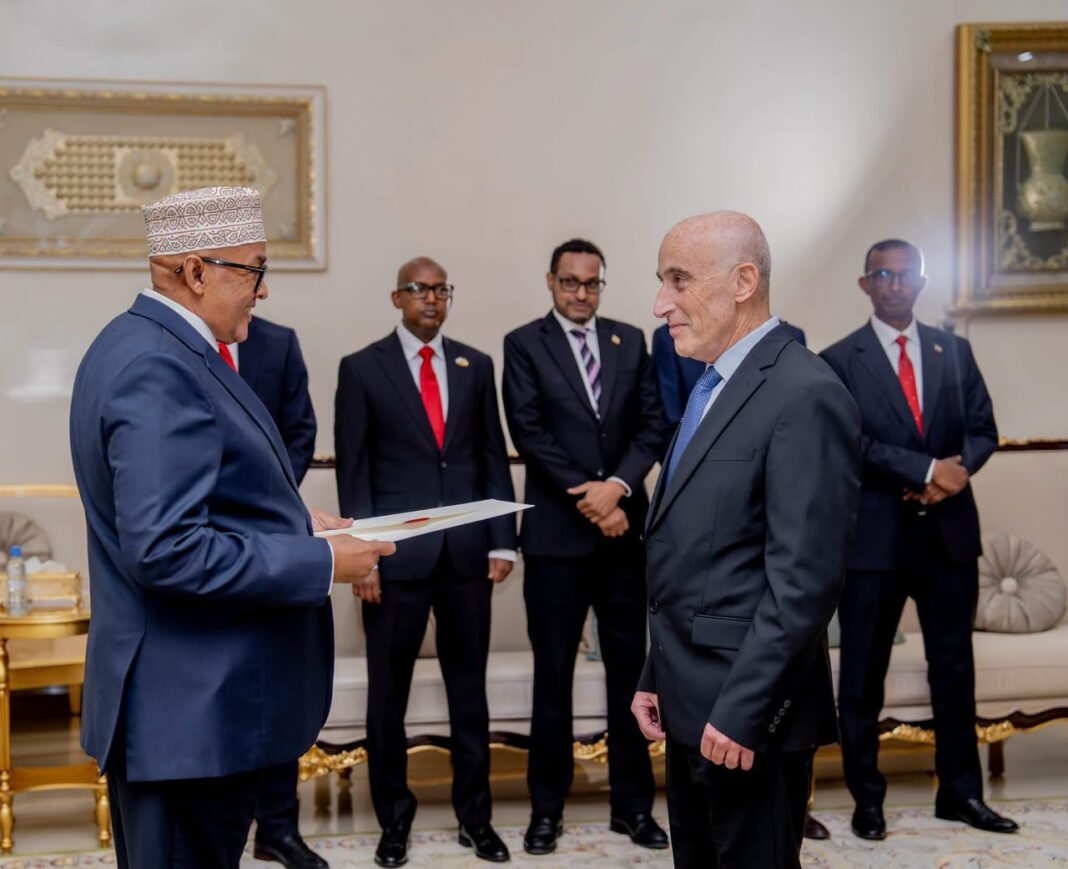
The diplomatic engagement gained further momentum after Somaliland President Abdirahman Mohamed Abdillahi, popularly known as Irro, received the credentials of Israel’s Ambassador to Somaliland, Michael Lotem, at the Presidential Palace.
The presentation of credentials marks an important step in translating Israel’s recognition of Somaliland into formal diplomatic representation, creating a framework for direct government-to-government engagement and cooperation.
For Somaliland, the development represents a significant diplomatic breakthrough in its decades-long campaign for international recognition since declaring independence from Somalia in 1991.
The emerging partnership is expected to create opportunities for cooperation in areas including trade, investment, agriculture, water management, technology, security and regional stability.
The recognition followed a joint declaration signed on December 26, 2025, by Israeli Prime Minister Benjamin Netanyahu, Foreign Minister Gideon Sa’ar and President Irro, making Israel the first United Nations member state to formally recognise Somaliland as an independent and sovereign country.
Netanyahu said Israel would pursue immediate cooperation with Somaliland in agriculture, healthcare, technology and the economy. He also invited President Irro to visit Israel, signalling the intention to establish a broader strategic relationship. Somaliland, in turn, committed to joining the Abraham Accords, the diplomatic framework initially established in 2020 to normalise relations between Israel and several Arab countries.
The latest diplomatic development is significant because Somaliland has spent more than three decades seeking international recognition after declaring independence from Somalia in 1991. Although it has maintained its own administration, security institutions and political structures, most of the international community has continued to regard it as part of the Federal Republic of Somalia.
Somalia rejects recognition, warns of sovereignty violation
The recognition has been strongly rejected by Mogadishu, which considers Somaliland an integral part of Somalia and views Israel’s decision as a direct challenge to its sovereignty and territorial integrity.
The Federal Government of Somalia described the recognition as an unlawful action and a deliberate attack on its national sovereignty, warning that no foreign government has the authority to alter Somalia’s internationally recognised borders.
President Hassan Sheikh Mohamud condemned the move, describing it as illegal aggression and contrary to established international legal and diplomatic principles.
The Somali government has also vowed to pursue diplomatic, political and legal measures to defend its territorial integrity, maintaining that any agreements or arrangements entered into with Somaliland without its consent have no legal standing in Somalia’s constitutional framework.
Somalia’s parliament also rejected the recognition, declaring it invalid and without international legal effect. Mogadishu has further warned against any foreign military bases or security arrangements that could draw the Horn of Africa into wider geopolitical confrontations.
The dispute has attracted wider regional and international attention, with the African Union, Arab League, Organisation of Islamic Cooperation and several governments expressing opposition to Israel’s decision.
The European Union has also reaffirmed its support for Somalia’s unity, sovereignty and territorial integrity, urging Mogadishu and Hargeisa to resolve their longstanding differences through meaningful dialogue.
Strategic importance of the Red Sea and Gulf of Aden
Beyond diplomatic recognition, the relationship carries considerable geopolitical significance because of Somaliland’s location along the Gulf of Aden, close to the Bab el-Mandeb Strait, one of the world’s most important maritime passages connecting the Red Sea with the Indian Ocean.
The corridor is vital for international shipping, energy transportation and trade between Europe, Asia, the Middle East and Africa. Its proximity to Yemen, where Houthi attacks have disrupted commercial shipping, makes Somaliland’s geographical position particularly important to Israel’s regional security calculations.
Israel is therefore expected to pursue closer cooperation with Somaliland in maritime security, intelligence, technology and defence, alongside economic engagement.
However, the military dimension remains politically sensitive. During President Irro’s June 2026 visit to Israel, the two sides discussed expanding security cooperation. Somaliland’s Defence Minister Mohamed Yusuf Ali subsequently confirmed that Israel was providing training to Somaliland’s police and military forces but denied that negotiations were taking place to establish an Israeli military base in the territory.
Economic opportunities and diplomatic implications
For Somaliland, recognition by Israel offers an opportunity to attract foreign investment, expand international partnerships and strengthen its position as a commercial gateway to the Horn of Africa.
The territory is particularly interested in Israeli expertise in agricultural technology, livestock production, water management, renewable energy, healthcare, cybersecurity and infrastructure development.
Its proximity to the Port of Berbera, which is strategically positioned along major international shipping routes, also offers opportunities for investment in logistics, maritime services and regional trade.
The two governments have identified trade, investment, technology, education and security as priority areas for cooperation. However, concrete commercial projects, financing arrangements and implementation timelines will determine whether the diplomatic partnership translates into substantial economic benefits.
For Israel, closer relations with Somaliland could strengthen its diplomatic and economic presence in the Horn of Africa while providing another partner near strategically important Red Sea shipping routes.
The presentation of Ambassador Lotem’s credentials and plans for an Israeli embassy in Hargeisa demonstrate that both sides are moving beyond symbolic recognition towards establishing permanent diplomatic institutions.
Nevertheless, Israel’s recognition has not resulted in wider international acceptance of Somaliland’s independence. The territory remains diplomatically contested, with Somalia continuing to mobilise regional and international support against the decision.
The latest development therefore places the Somaliland-Israel relationship at the intersection of diplomacy, international trade and regional security, with implications extending beyond the two governments to the wider Horn of Africa and Red Sea region.
.



