

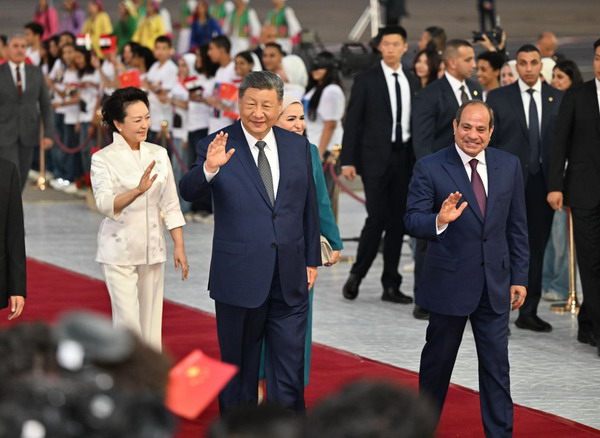
China’s growing influence across Africa is becoming one of the defining geopolitical and economic trends of the 21st century. From railways and ports to telecommunications, manufacturing, energy and trade, Beijing has positioned itself as one of the continent’s most important economic partners. The latest demonstration of this deepening relationship came with Chinese President Xi Jinping’s arrival in Cairo for a state visit to Egypt.
Xi arrived in Cairo on Tuesday , accompanied by his wife, Peng Liyuan, after accepting an invitation from Egyptian President Abdel Fattah El-Sisi. The Egyptian president and his wife personally received the Chinese leader at Cairo International Airport, where an honour guard and Egyptian youths waving both countries’ flags welcomed the delegation.
While the ceremonial reception highlighted the warmth of China-Egypt relations, the visit carries a significance that extends far beyond diplomatic protocol. It reflects how China has steadily transformed its relationship with Africa from one based largely on trade and political solidarity into a broad strategic partnership encompassing infrastructure, industrialization, technology, finance and development.
For African governments, China’s appeal is increasingly linked to its willingness to finance and build large-scale projects while presenting itself as a partner in economic development rather than simply a traditional donor.
Egypt occupies a particularly important position in this relationship. It is Africa’s second-largest economy by nominal GDP in many recent rankings, controls the Suez Canal, and sits at the crossroads of Africa, the Middle East, Europe and Asia. Its strategic importance makes deeper cooperation with Beijing significant not only for Egypt but also for China’s wider economic ambitions across the continent.
Xi, in his arrival statement, described China and Egypt as ancient civilizations whose friendship has endured for generations. He highlighted the more than 70 years of diplomatic relations between the two countries and said their comprehensive strategic partnership had achieved significant progress in recent years.
The Chinese president also pointed to political trust, economic cooperation and coordination in multilateral institutions as pillars of the relationship.
But the broader story is China’s expanding economic footprint across Africa.
Through the Belt and Road Initiative, Chinese companies and financial institutions have participated in major infrastructure projects across the continent. Railways, highways, ports, power plants, industrial parks, telecommunications networks and housing developments have become visible symbols of Beijing’s presence.
For many African governments struggling with infrastructure deficits, the attraction is straightforward. China has demonstrated an ability to mobilize financing, engineering expertise and construction capacity for projects that can take years to complete.
This has helped Beijing develop relationships with governments across different political systems and regions of Africa.
China has also become a major trading partner for many African countries. African exporters seek access to the enormous Chinese market for commodities and agricultural products, while Chinese manufacturers see Africa as both a growing consumer market and a potential production base.
One reason is that many African countries increasingly want alternatives in a changing global economic order. Governments are seeking to diversify their partnerships rather than remain dependent on a small number of Western markets, institutions and financing mechanisms.
Beijing’s approach also resonates with African governments because of its emphasis on state-to-state relations and non-interference in domestic political affairs. This differs from some Western partnerships, which frequently link economic cooperation to governance, human rights and political reforms.
For African leaders, the ability to negotiate infrastructure, trade and investment agreements without the same level of political conditionality can be attractive.
Technology is becoming another critical dimension of China’s African influence.
Chinese companies have become major players in African telecommunications, digital infrastructure, mobile technology, e-commerce, renewable energy and smart-city development. As African economies pursue digital transformation, Chinese technological expertise is increasingly becoming part of the continent’s development landscape.
Xi’s visit also reinforces Beijing’s broader diplomatic strategy of strengthening relations with developing countries and the Global South.
China increasingly portrays itself as a partner for countries seeking greater economic sovereignty and a stronger voice in global institutions. African governments, meanwhile, are seeking greater representation in international decision-making, reform of global financial institutions and expanded South-South cooperation.
This convergence of interests explains why China’s influence in Africa has continued to expand.
The question for Africa is therefore no longer whether China will remain an important partner. Its presence is already deeply embedded in many sectors of the continent’s economy.
The more important question is how African countries can turn Chinese engagement into long-term economic transformation.
African governments will need to negotiate partnerships that go beyond infrastructure construction and commodity exports. Technology transfer, local manufacturing, employment, skills development, agricultural value addition and access to Chinese markets will determine whether the relationship produces sustainable industrial growth.
China’s rise in Africa is consequently not simply a story of Beijing expanding its influence. It is also a story of African governments actively searching for capital, technology, infrastructure and new markets.
Xi Jinping’s Cairo visit provides another illustration of this changing relationship.
As China deepens its engagement with Egypt and the wider African continent, Beijing’s economic and diplomatic presence is likely to remain one of the most consequential forces shaping Africa’s future.
For Africa, the challenge will be to ensure that embracing China does not create a new dependency, but instead becomes a strategic opportunity to accelerate industrialisation, strengthen economic sovereignty and secure a more influential position in the emerging multipolar world.



