

China’s currency, the renminbi (RMB), is steadily gaining ground across Africa as expanding trade, investment and financial connectivity deepen economic ties between the continent and the world’s second-largest economy.
From Tanzania’s introduction of direct RMB settlement services to the expansion of China’s Cross-Border Interbank Payment System (CIPS) in Kenya and Namibia, a series of recent developments points to the growing importance of the Chinese currency in Africa’s cross-border trade and financial transactions.
The RMB’s growing presence is no longer limited to the settlement of goods traded between China and African countries. Increasingly, the currency is finding its way into payment and clearing systems, government transactions, financing arrangements and capital markets.
The shift reflects both the rapid growth of China-Africa commerce and the development of financial infrastructure designed to make RMB transactions faster, cheaper and more accessible to businesses and governments.
International use of any currency is closely linked to trade and investment. As economic relations between China and Africa continue to expand, demand for alternative payment and settlement mechanisms is also increasing.
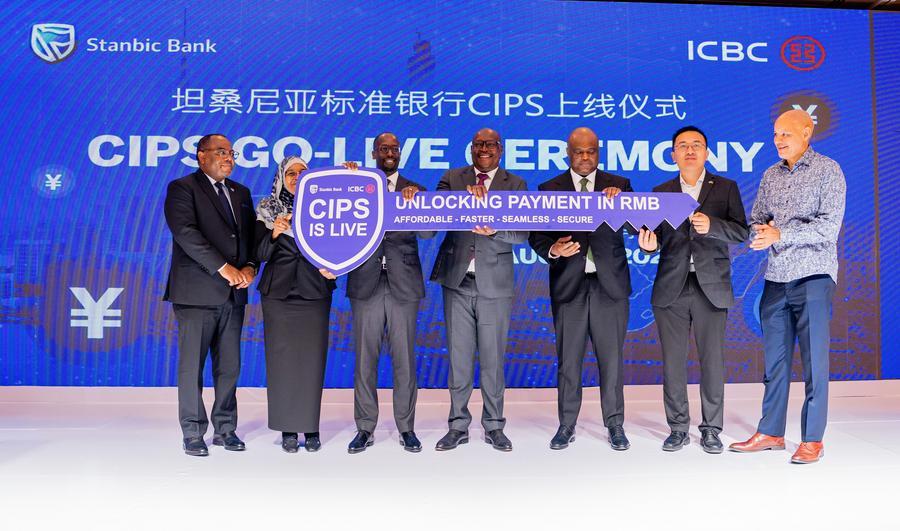
In August, Stanbic Bank Tanzania launched a direct RMB settlement service, enabling Tanzanian businesses trading with China to make and receive payments directly in the Chinese currency.
The move is expected to reduce the need for multiple currency conversions, which can increase transaction costs and expose businesses to exchange-rate fluctuations.
Tanzanian Deputy Minister for Industry and Trade Dennis Londo said direct RMB settlement would give businesses another option when conducting trade with Chinese partners while reducing unnecessary currency conversions.
The development reflects a broader trend across Africa, where companies with growing exposure to Chinese suppliers, investors and markets are increasingly seeking more efficient ways of managing cross-border payments.
In Zambia, the RMB has moved beyond commercial trade into government revenue collection. The country’s central bank began accepting RMB payments for mining taxes in October 2025.
For Zambia, where copper remains a major pillar of the economy and China is an important trading partner and investor, the new payment channel provides both companies and government institutions with another mechanism for managing foreign exchange requirements.
The numbers illustrate the growing momentum.According to the People’s Bank of China’s RMB Internationalization Report 2025, cross-border RMB receipts and payments between China and Africa reached 155.33 billion yuan, equivalent to approximately $23.14 billion, in 2024. This represented a year-on-year increase of 28.1 percent.
RMB payments related specifically to trade in goods reached 56.37 billion yuan, or about $8.4 billion, marking an increase of 35.9 percent from the previous year.
Over the longer term, growth has been even more striking. Between 2020 and 2024, cross-border RMB settlement between China and Africa nearly doubled, rising from 80.02 billion yuan to 155.33 billion yuan. This represents an average annual growth rate of 18.1 percent.
Companies that regularly buy goods from China or sell products into the Chinese market can potentially reduce conversion costs by settling transactions directly in RMB. Direct settlement can also help firms manage exposure to fluctuations involving intermediary currencies, particularly when payments would otherwise pass through multiple currency conversions.
The expansion of trade opportunities could further accelerate demand for RMB services.
China’s decision to grant zero-tariff treatment to 53 African countries with which it maintains diplomatic relations is expected to create additional opportunities for African exports to enter the Chinese market. As trade volumes grow, demand for efficient payment, settlement and financial services is also likely to increase.
However, trade alone is not enough to internationalise a currency. Businesses must also have access to the banking and payment infrastructure needed to move money across borders.
This is where recent developments across Africa are becoming increasingly significant.
In late July, Stanbic Bank Kenya launched CIPS services, connecting customers to China’s cross-border RMB payment infrastructure. In August, Standard Bank Namibia became the first bank in Namibia to provide CIPS services.
Standard Bank of South Africa had earlier become the first African commercial bank to join the system.
The expansion of CIPS services is helping to build a broader financial ecosystem for RMB transactions across the continent.
In June, the People’s Bank of China authorised Standard Bank of South Africa and the Industrial and Commercial Bank of China to operate as joint RMB clearing banks for Africa. The arrangement is expected to strengthen the continent’s payment and clearing network and improve access to RMB liquidity.
Meanwhile, Bank of China says its RMB business now covers more than 20 African countries. The bank serves as an RMB clearing bank in South Africa, Zambia and Mauritius.
Huang Meibo, dean of the Institute for International Development Cooperation at Shanghai University of International Business and Economics, said improved payment infrastructure is making RMB transactions increasingly convenient for African businesses and financial institutions.
As more local banks connect to cross-border RMB payment systems, companies gain wider access to RMB services while links between the Chinese currency and African financial markets continue to deepen.
The changes represent an evolution from isolated banks offering RMB products towards a wider ecosystem involving commercial banks, clearing institutions and international payment systems.
Payment convenience, transfer speed and access to RMB liquidity will increasingly influence whether businesses choose to use the currency.
A more significant stage of RMB internationalisation, however, lies beyond trade settlement. Financing and investment are beginning to emerge as new areas of engagement between Africa and China.
Kenya’s 2026/2027 Annual Borrowing Plan indicates that the government is exploring the possibility of issuing RMB-denominated panda bonds as part of efforts to diversify its external financing sources and ease fiscal pressures.
Egypt became the first African country to issue panda bonds in China’s domestic bond market when it raised 3.5 billion yuan, equivalent to approximately $521.5 million, in 2023.
In 2025, the African Export-Import Bank issued a 2.2 billion yuan panda bond, becoming the first African multilateral development bank to access China’s domestic bond market through such an instrument.
The movement from trade settlement into sovereign and institutional financing suggests that the RMB is beginning to assume a broader role in Africa-China economic relations.
For African governments and institutions, access to RMB-denominated capital markets could provide additional financing options and reduce overreliance on traditional sources of external borrowing.
For China, greater participation by African governments, banks and institutions in RMB financing expands the currency’s international role.
Trade volumes alone will not determine its success. Financial market depth, the availability of RMB-denominated investment assets, efficient payment systems and the willingness of international investors and institutions to hold RMB assets will all remain critical.
As China’s economic relationship with the continent deepens, Africa’s financial architecture is also adapting. The result is an increasingly interconnected system in which the RMB is gradually moving from being simply a trade settlement currency to becoming a more visible component of Africa’s banking, payments and financing landscape.



