
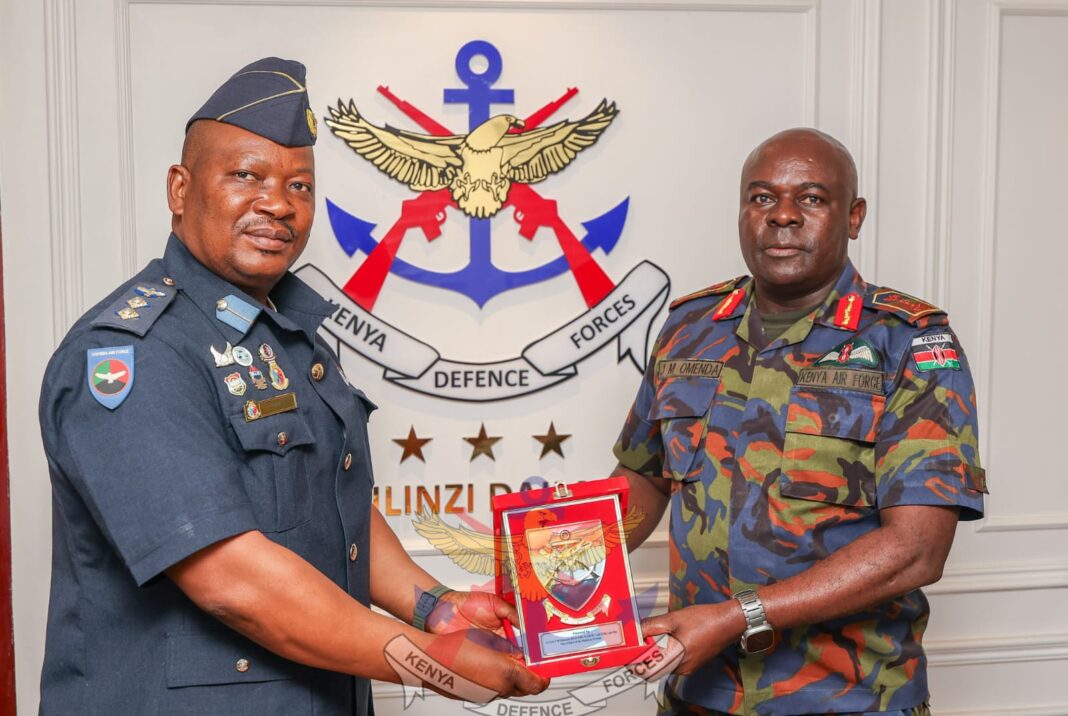

Kenya and Zambia are deepening military-to-military cooperation, with professional military education emerging as a platform for strengthening strategic planning, operational readiness and collaboration in emerging defence technologies, including aerospace and air-power capabilities.
On September 28, 2026, the Kenya Defence Forces (KDF) hosted a 25-member delegation from the Zambia Command and Staff College in Nairobi, reinforcing the longstanding defence relationship between the two countries.
The delegation, led by Colonel Charles Chembo, paid a courtesy call on the Vice Chief of the Defence Forces (VCDF), Lieutenant General John Omenda, at Defence Headquarters, where discussions focused on areas of mutual interest and opportunities to expand Kenya-Zambia defence cooperation.
The engagement comes as African militaries increasingly seek to strengthen their capabilities through professional military education, technology exchange and closer cooperation in areas such as air operations, aerospace awareness, surveillance, communications and strategic planning.
Welcoming the delegation, KDF Chief of Training Brigadier Alex Nteere highlighted the importance of sustained cooperation between military training institutions. He said exchanges between the two countries provide an avenue for sharing operational experience, strengthening institutional capacity and developing military leaders capable of responding to increasingly complex security environments.
The Zambian delegation received strategic briefings covering the global and regional security environment, Kenya’s strategic profile, national security architecture, defence policy and the KDF’s contribution to regional peace and stability.
The discussions also provided an opportunity to examine Kenya-Zambia defence cooperation and exchange perspectives on contemporary security threats, military leadership, strategic planning and operational preparedness.
Of particular strategic significance is the growing importance of aerospace and air-power capabilities to national and regional security. African defence forces are increasingly operating in an environment where air surveillance, intelligence gathering, communications, unmanned systems and other aerospace-enabled capabilities are becoming important components of military planning and border security.
For Kenya and Zambia, professional military exchanges provide an avenue for officers to understand different approaches to the development and employment of these capabilities while strengthening interoperability and institutional knowledge.
Colonel Chembo said the visit was part of the Zambia Command and Staff College’s strategic engagement programme, which exposes military officers to different approaches and best practices in leadership, administration and defence management across the region.
He emphasised the importance of greater collaboration and knowledge exchange among African armed forces in developing professional, interoperable and mission-ready forces capable of responding to increasingly interconnected security challenges.
The engagement also reflects a broader shift towards defence cooperation that goes beyond traditional military exercises. Training, strategic dialogue, institutional exchanges and technology-related cooperation are increasingly becoming important tools through which African countries strengthen national defence capabilities while contributing to regional security.
For Kenya, engagement with Zambia provides another avenue for expanding its defence diplomacy and sharing experience acquired through its participation in regional peace and security operations. For Zambia, such exchanges provide access to regional perspectives on military leadership, strategic planning and the evolving security environment.
The Nairobi study tour therefore strengthened the Kenya-Zambia defence relationship while demonstrating how professional military education can support wider cooperation in defence, air power and emerging aerospace-related capabilities.
Continued military exchanges between the two countries could provide a foundation for deeper cooperation in training, strategic studies, air-force capabilities, defence technology and regional security, while enhancing the preparedness of both forces to respond to emerging threats.



