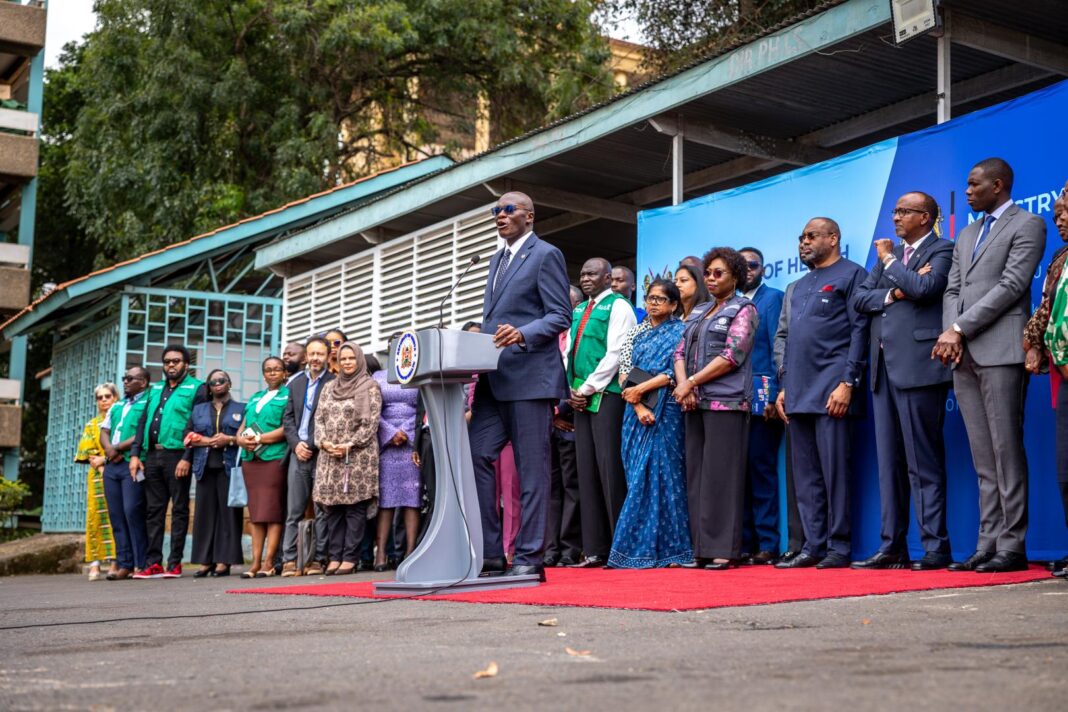

Kenya has discharged its last Ebola patient, marking a major milestone in the country’s efforts to contain the outbreak and triggering a 42-day countdown towards being declared Ebola-free.
Health Cabinet Secretary Aden Duale announced on Wednesday, November 11, 2026, that the patient had fully recovered and was discharged from hospital. The last 11 contacts under monitoring were also released after completing their observation period in good health.
“He has been discharged healthy and free of the virus,” Duale said at Afya House in Nairobi, confirming that Kenya currently has no patients undergoing treatment and no contacts in quarantine.
The development marks a significant step in containing the Bundibugyo virus disease outbreak, although health authorities have cautioned that surveillance and emergency response measures must remain in place.
The 42-day countdown begins on Thursday, November 12, representing twice the longest incubation period of the Ebola virus. If no new infections are detected during this period, Kenya is expected to be declared Ebola-free on December 23, 2026.
The World Health Organization (WHO) congratulated Kenya on the milestone, praising the country’s response and the recovery of the final patient.
“Surviving Ebola is a remarkable achievement, and we wish the survivor continued recovery, good health and successful reintegration into their community,” said Dr Abdourahmane Diallo, Director for Programme Management at the WHO Regional Office for Africa, speaking on behalf of Regional Director Dr Mohamed Janabi.
Kenya confirmed its first case of Bundibugyo virus disease on October 6, 2026, involving a Kenyan national who had travelled home from the Democratic Republic of the Congo (DRC) through Uganda.
Following the confirmation, health authorities identified 135 people who had been in close contact with the initial patient, including individuals in Kenya and abroad. Contact-tracing teams placed those considered at risk under quarantine and conducted daily monitoring to detect potential infections.
Eight additional people subsequently tested positive, comprising four family members of the initial patient and four healthcare workers who had attended to him before Ebola was suspected.
According to Duale, all eight were already in quarantine when they developed symptoms, preventing further transmission into the wider community.
The last infection was confirmed on October 19, and no additional cases have been reported since.
The latest discharge brings to seven the number of patients who have recovered from the disease. Five patients were discharged on November 3, marking the first recoveries from the outbreak, followed by another patient on November 6. Two people died from the disease.
WHO expressed condolences to the families of those who lost their lives while commending the healthcare workers and emergency response teams involved in containing the outbreak.
Duale recognised the contribution of doctors, nurses, laboratory personnel, contact tracers and support staff, alongside Kenyatta National Hospital, The Nairobi Hospital, county governments and international partners.
“Four of our colleagues were infected in the line of duty. Your courage carried this response and the nation sincerely thanks you,” he said.
WHO also praised the government’s transparency, timely reporting and coordination throughout the outbreak.
“I commend the Government of Kenya for its transparency, timely reporting, strong coordination mechanisms and commitment to protecting the health and well-being of its people,” Diallo said, adding that the professionalism and dedication of healthcare workers had helped save lives and prevent further transmission.
Despite the milestone, authorities have warned against complacency as Kenya enters the final phase of its response.
Duale said rapid response teams would remain on alert across all counties, with suspected cases investigated promptly. Recovered patients will also continue receiving medical follow-up and support to facilitate their reintegration into communities.
“Let me be clear. The countdown is not the end of our response,” he said.
The development comes as Ebola remains a public health concern in the DRC, where the outbreak has reportedly resulted in nearly 11,000 confirmed cases and more than 5,000 deaths.
WHO has advised against imposing travel and trade restrictions on countries affected by Ebola, emphasising that such measures are not necessary when appropriate public health safeguards are in place.
Duale reassured Kenyans and international travellers that the country remained open for business, tourism and trade, with no restrictions on movement or public gatherings.
Health authorities have urged members of the public to seek medical attention promptly if they experience symptoms including fever, weakness, muscle pain, vomiting, diarrhoea or unexplained bleeding, particularly after travelling to an Ebola-affected area. The public can call the free health hotline 719 to report suspected cases or seek guidance.
WHO said Kenya’s experience demonstrated the importance of early detection, community cooperation, effective contact tracing and strong health systems in controlling infectious disease outbreaks.
“Today’s milestone demonstrates that when communities, governments, health workers and partners work together, even the most serious public health threats can be overcome,” Diallo said.
Duale urged Kenyans to maintain vigilance and cooperate with health authorities throughout the countdown period.
“We are not yet at the finish line, but we can see it at a distance. Let us walk these last 42 days together with the same discipline and unity that brought us here until Kenya is declared Ebola-free,” he said.