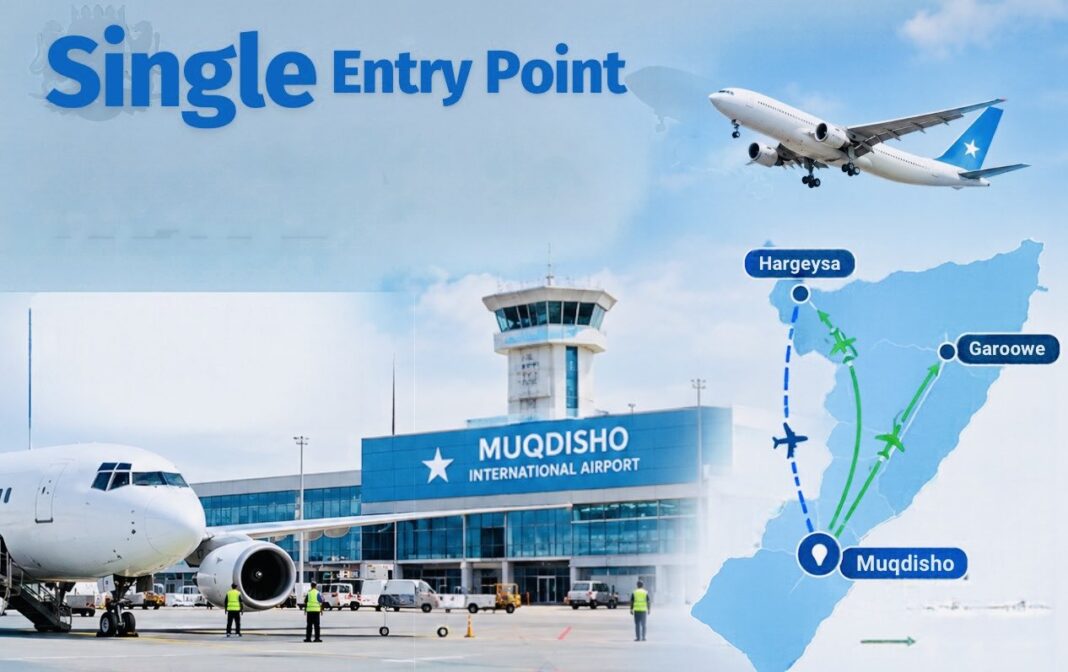

Somalia’s plan to introduce a “Single Entry Point” system for international air travel could reshape the country’s aviation market, potentially forcing flights destined for Hargeisa and Garowe to transit through Mogadishu for security screening and other formalities.
The proposed arrangement by the Federal Government of Somalia could alter airline route planning, passenger connections and airport operations, while raising questions about the balance between national aviation oversight, commercial efficiency and regional autonomy.
Under the proposed system, international flights arriving in Somalia would first land at Mogadishu’s Aden Adde International Airport before continuing to other destinations, including Hargeisa and Garowe. The plan would centralise entry procedures at the capital’s main international gateway, giving federal authorities a single point for conducting security checks and processing passengers.
However, the proposal could introduce additional operational requirements for airlines serving northern Somalia, particularly carriers operating direct international connections to Hargeisa and Garowe.
For passengers, a journey that currently involves a direct international flight could become longer and more complicated if a stop in Mogadishu becomes mandatory. Additional landing procedures, security checks and possible connecting arrangements could increase travel time and costs, depending on how the system is implemented.
Implications for airlines and airports
The commercial impact would depend on whether airlines could continue operating direct services while complying with the new procedures or would be required to make an intermediate landing in Mogadishu.
An additional stop could increase fuel consumption, airport charges, ground-handling expenses and aircraft turnaround times. Airlines might also need to revise schedules, crew arrangements and passenger connections, potentially affecting the profitability of routes with relatively limited traffic.
Carriers could respond by adjusting fares, reducing frequencies or reassessing their services, although the actual outcome would depend on implementation rules, demand and negotiations with aviation authorities.
For Mogadishu, the proposal could strengthen Aden Adde International Airport’s position as Somalia’s principal international aviation hub. More international traffic passing through the capital could increase demand for airport services, including passenger handling, security screening, ground operations and onward connections.
Such a shift could create commercial opportunities for aviation service providers in Mogadishu. However, those gains would need to be weighed against the possibility of longer journeys and higher operating costs across the wider aviation network.
Hargeisa and Garowe could face different commercial consequences. Direct international connectivity is important for passengers travelling for business, family visits, humanitarian operations and other purposes. Any requirement to transit through Mogadishu could affect the attractiveness of these destinations, depending on available connections and the time required to complete formalities.
For airlines, the central question will be whether the proposed system improves operational coordination and security without making services less competitive.
Aviation regulation and federal authority
The proposal comes as Somalia continues to strengthen its aviation regulatory and passenger-processing systems. The Somali Civil Aviation Authority’s published regulations require international flights entering or departing Somali territory to use airports where customs and immigration services are available.
Somalia has also introduced an electronic travel authorisation requirement for foreign passport holders, with airlines responsible for checking passengers’ documentation before departure. The system, which took effect on 1 September 2025, reflects the government’s broader efforts to centralise immigration procedures.
The proposed Single Entry Point would represent a further step towards centralising international passenger processing, although its precise relationship with existing aviation regulations and airport procedures remains unclear.
Its implementation could also raise broader governance questions because Hargeisa is in Somaliland, which declared independence from Somalia in 1991 but is not internationally recognised as an independent state. The federal government’s approach to international flights serving Hargeisa therefore carries implications beyond aviation, touching on competing claims over territorial authority and the administration of international travel.
For airlines, clarity on the legal basis of the proposed arrangement, the scope of mandatory stops and the treatment of transit passengers will be essential before operational changes can be assessed.
A test for Somalia’s aviation recovery
The proposal comes at a significant moment for Somalia’s aviation industry. On 18 October 2026, Prime Minister Hamza Abdi Barre inaugurated the restoration of the International Air Transport Association’s Billing and Settlement Plan, a system designed to facilitate international airline ticket sales and financial settlements through travel agencies.
The development signals continued efforts to reconnect Somalia’s aviation market with international commercial systems and improve the infrastructure supporting airlines and travel businesses.
Whether the Single Entry Point plan advances those ambitions will depend on its design and implementation. A centralised system could improve coordination and oversight, but additional stops and administrative requirements could undermine efficiency if they increase costs or complicate direct international connections.
The government’s challenge will be to strengthen security and regulatory coordination while preserving reliable, affordable air links to Somalia’s different regions.