
The Emirates Group has reported a profit before tax of AED 4.1 billion (US$1.1 billion) for the first half of its 2026-27 financial year, maintaining profitability despite regional conflict, operational disruptions and a sharp increase in global fuel prices.
The performance, covering the six months to September 30, 2026, represents a 66 per cent decline in profit after tax to AED 3.6 billion (US$1 billion), compared with the corresponding period last year, when the Group recorded its strongest-ever financial results.
Group revenue declined 12 per cent to AED 66.2 billion (US$18 billion), from AED 75.4 billion (US$20.6 billion) a year earlier. Earnings before interest, taxes, depreciation and amortisation (EBITDA) fell 41 per cent to AED 12.5 billion (US$3.4 billion), compared with AED 21.1 billion (US$5.7 billion) in the previous financial year.
The decline reflects mounting operating costs, particularly aviation fuel, whose global prices doubled compared with the same period last year, alongside intermittent airspace restrictions and closures across the Gulf region.
Despite the pressures, the Group maintained a substantial cash position of AED 54.1 billion (US$14.7 billion) at the end of September, down from AED 59.6 billion (US$16.2 billion) at the close of March 2026.
The cash reserves have enabled the Group to finance operational requirements, aircraft pre-delivery payments and existing debt obligations. It also completed payment of the remaining AED 2 billion (US$545 million) dividend to its owner, the Investment Corporation of Dubai, out of the AED 3.5 billion declared for the 2025-26 financial year.
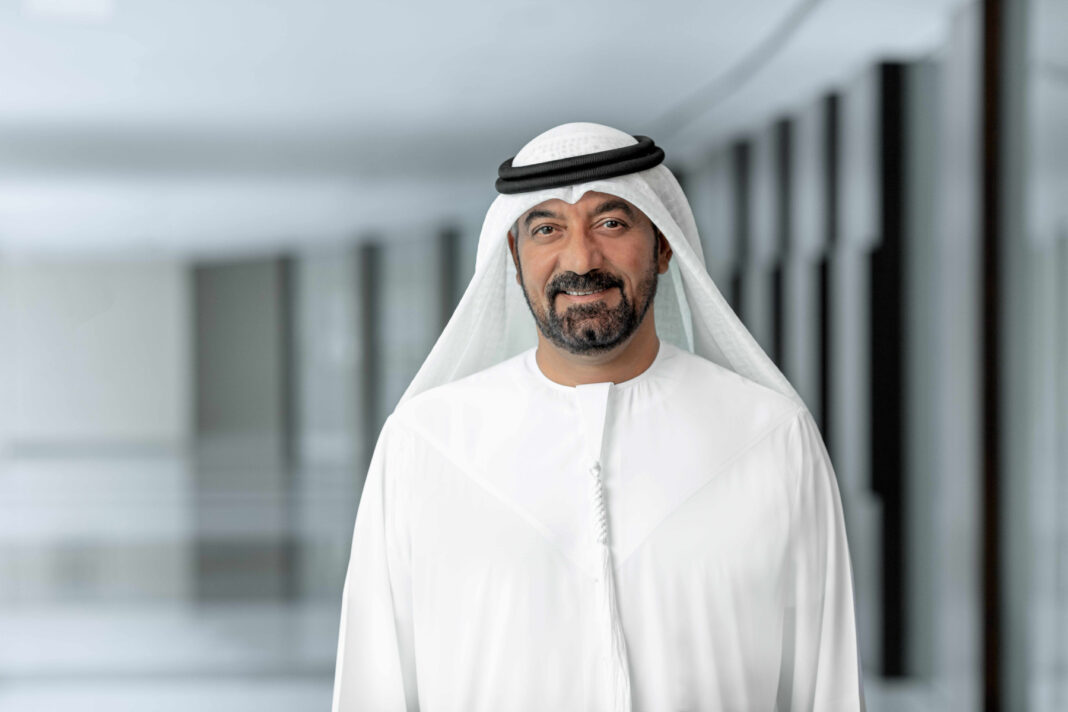
Emirates Group Chairman and Chief Executive Sheikh Ahmed bin Saeed Al Maktoum said resilient customer demand and strong cargo operations had helped sustain revenue and liquidity despite the challenging operating environment.
He credited the UAE government’s coordination and response following military activity across the Gulf region for facilitating the safe resumption of air transport and restoring confidence in travel.
“Throughout this time, we have not paused our investments. Emirates and dnata continue to commit significant resources to expand our fleet, enhance our products and services, and develop capabilities that will shape the future of our business,” Sheikh Ahmed said.
The Group is maintaining its investment programme while closely monitoring geopolitical developments and operating costs as it enters the second half of the financial year.
Fleet and infrastructure investments

Emirates operated 91 per cent of its pre-disruption network by September 30, connecting passengers and cargo to 150 airports across 78 countries and territories through its Dubai hub.
During the six-month period, the airline received nine new Airbus A350 aircraft and completed cabin refurbishments on 12 aircraft, comprising nine Airbus A380s and three Boeing 777s.
The airline is implementing a fleet-wide cabin refurbishment programme valued at more than US$7 billion, aimed at upgrading passenger experience and expanding its Premium Economy offering.
It also accelerated the installation of Starlink high-speed internet, equipping 36 additional aircraft during the reporting period and bringing the total number of connected aircraft to 57.
In May, Emirates broke ground on a US$5.1 billion engineering and maintenance, repair and overhaul facility at Al Maktoum International Airport, with completion expected in the mid-2030s.
The airline also introduced new cabin features, including U-dream headrests in Economy Class and electronically controlled privacy dividers in Premium Economy, as part of efforts to strengthen its competitive position in the global aviation market.
Meanwhile, dnata continued investing in cargo handling, catering, logistics and ground services to expand its international operations.
The aviation services provider announced an AU$32 million investment in a new cargo facility at Western Sydney International Airport, while construction of a catering facility at the airport is progressing towards a 2027 opening.
In Dubai, dnata commissioned a AED100 million (US$27 million) logistics facility at Dubai South and opened an integrated command centre to support growing cargo operations.
The company is also planning a AED37 million investment in Alat, Azerbaijan, while expanding cargo operations at East Midlands Airport in the United Kingdom and Zurich Airport in Switzerland.
Across the Group, the workforce stood at 128,237 employees at the end of September, representing a two per cent decline from March, although both Emirates and dnata continue recruitment to meet operational requirements.
The results highlight the resilience of the Group’s aviation and logistics businesses, with continued investment in fleet modernisation, airport infrastructure and cargo capacity providing a foundation for growth despite geopolitical uncertainty and elevated fuel costs.