
From physical assaults and police violence to online harassment, threats and economic insecurity, journalists are entering the 2027 election season facing an increasingly hostile environment, with documented press freedom violations more than doubling in a year.
A journalist leaves the newsroom carrying a camera, a microphone, a notebook and the responsibility of telling a story that the public needs to hear. But increasingly in Kenya, the assignment comes with another uncertainty: whether they will return safely.
For journalists covering political events, demonstrations and other sensitive public-interest stories, the danger is no longer limited to hostile crowds or confrontations in the field. It is increasingly coming from people expected to uphold the law, political actors, organised groups and coordinated online attacks.
And as Kenya approaches the 2027 General Election, new figures from the Media Council of Kenya (MCK) suggest that the risks facing the country’s media practitioners are intensifying rather than receding.
In its Press Freedom Violations Situation Report for the first quarter of the 2026/2027 financial year, the Council documented 47 cases involving attacks, threats, arrests, intimidation, harassment, abductions and surveillance against journalists.
The figure represents a significant increase from 17 cases recorded during the corresponding quarter in 2025 and 24 in 2024.
In one year, documented violations have increased by almost threefold, raising questions about the country’s preparedness to protect journalists during an election period historically characterised by heightened political tensions.
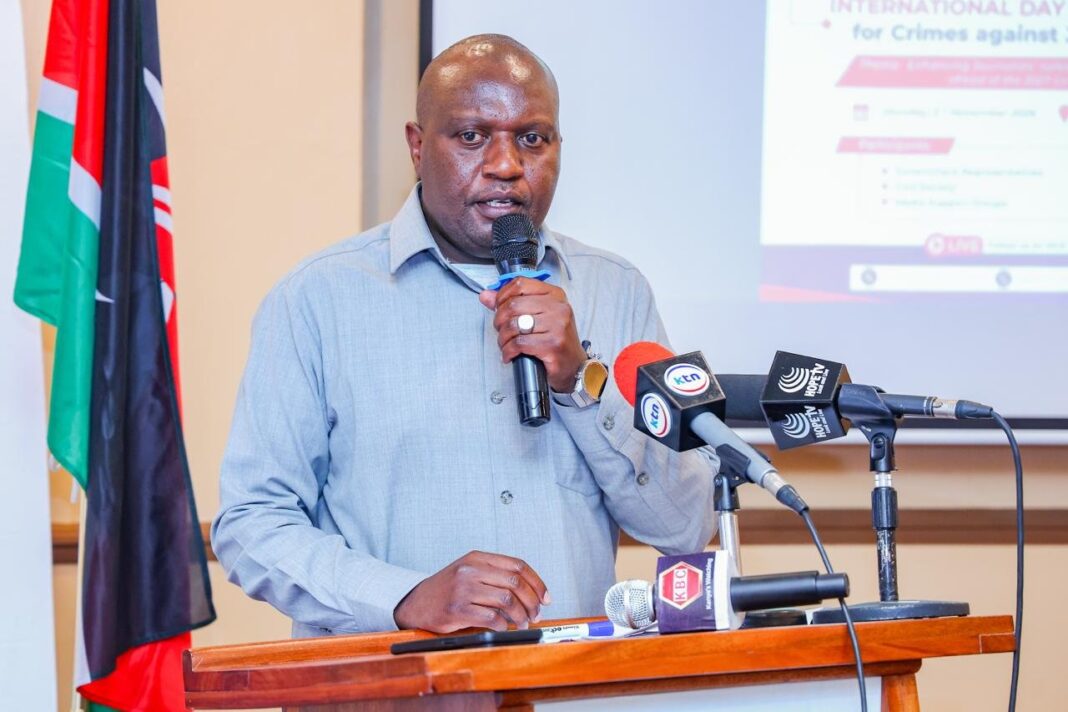
Presenting the findings during Kenya’s commemoration of the International Day to End Impunity for Crimes Against Journalists, Rebecca Mutiso, Manager of Press Freedom, Safety and Advocacy at MCK, outlined a pattern of violations extending across nine counties.
Nairobi recorded the highest number, with 13 cases, followed by Homa Bay with eight, Meru with seven and Bungoma with six. Nyandarua recorded four cases, while Embu, Nakuru and Mombasa each recorded two. Garissa accounted for one case.
But beyond the geographical distribution, the nature of the violations reveals a disturbing picture of the environment in which journalists are expected to work.
Assaults accounted for 34 of the 47 cases, making physical violence the most frequently documented violation. Five cases involved threats, while arrests and intimidation accounted for two cases each. The Council also documented one abduction, one harassment case, one threat-and-assault incident and one surveillance incident.
The perpetrators were equally revealing.
Criminal gangs and political activists were linked to 17 cases, while police officers accounted for 12. Politicians were implicated in eight cases, six incidents involved unidentified perpetrators, while a bodyguard, a county government official and a bandit were each recorded in one case.
The figures expose a difficult contradiction: those expected to guarantee public safety, including security personnel, also feature among the perpetrators of violence against the very people documenting events in the public interest.
For Kenya’s journalists, this is not simply a question of professional inconvenience. It is about the ability to work without fear, the protection of their livelihoods and the public’s constitutional right to receive information.
Speaking at the commemoration, Kenya Editors Guild President Zubeidah Kananu challenged security agencies to explain what had happened to investigations into previous attacks against journalists.
She revealed that the Guild had written to the Inspector General of Police and the Independent Policing Oversight Authority (IPOA), requesting updates on investigations into attacks, particularly those committed during political events.
The Guild wants to establish how many cases have been investigated, how many have been forwarded for prosecution, what action has been taken against perpetrators and what remedies are available to journalists whose lives have been endangered or equipment destroyed.
The questions point to a central problem confronting press freedom in Kenya: documenting an attack is not the same as delivering justice.
“Impunity is not simply the absence of justice. It is an invitation for the next attack,” Kananu said.
Her remarks captured the significance of this year’s International Day to End Impunity for Crimes Against Journalists, commemorated under the global UNESCO theme, Threats Evolve, Impunity Endures, and Kenya’s national focus on strengthening journalist safety and protection mechanisms ahead of the 2027 General Election.
The day is intended to move the conversation beyond condemning attacks towards establishing whether institutions are capable of preventing violence, investigating violations and ensuring those responsible are held accountable.
When the people meant to protect journalists become perpetrators
The 12 cases in which police officers were identified as perpetrators raise particular concerns as the country prepares for another election cycle.
Journalists covering demonstrations, political rallies and public protests often depend on security agencies to maintain order and facilitate their work. When those same agencies become associated with attacks, the relationship between the media and law enforcement becomes increasingly difficult.
Kananu insisted that journalists should not be treated as adversaries simply because they are documenting events.
“A press card is not a target. A camera is not a weapon. Journalism is not a crime,” she said.
She called for a shift from responding to attacks after they occur to establishing preventive mechanisms before the election period intensifies.
Among the proposals were clear operational protocols between media organisations and security agencies, designated liaison officers, rapid-response mechanisms, accessible reporting channels and transparent systems for tracking attacks and investigations.
The concern is not limited to physical assaults.
David Omwoyo, Chief Executive Officer of the Media Council of Kenya, warned that the threats facing journalists are evolving in several directions simultaneously.
While digital harassment, cyberbullying and doxing have become increasingly prominent, he said the country is also witnessing a return to physical intimidation through the use of organised groups and hired goons.
This creates a more complicated environment for journalists, who may face threats from identifiable security personnel, political actors and individuals whose identities and affiliations are difficult to establish.
Omwoyo also drew attention to the disproportionate targeting of women journalists through online harassment.
The concerns echo UNESCO’s wider findings on the vulnerability of women journalists. According to UNESCO consultant Lea Simonini, 73 per cent of women journalists report experiencing online attacks, while one in five has experienced offline attacks or abuse connected to previous online violence.
The threats are increasingly interconnected. Online intimidation can spill into physical spaces, while coordinated disinformation campaigns can undermine the credibility of journalists and make them targets of public hostility.
For women reporting on politics and public affairs, the consequences extend beyond professional criticism to attacks that seek to intimidate, discredit and discourage their participation in public-interest journalism.
The cost of impunity extends beyond Kenya
The situation in Kenya reflects a wider global crisis in which journalists continue to face violence despite international commitments to protect media freedom.
Presenting UNESCO’s remarks, Simonini said that since the organisation began systematically monitoring the killing of journalists in 2006, 1,641 journalists have been killed worldwide, equivalent to one journalist every four days.
Almost nine in ten of these crimes remain unpunished.
In Africa, the number of journalists killed fell from 14 to six over the last two years. However, the rate of impunity increased to 83 per cent.
Of the 171 killings recorded on the continent since 2006, only 29 cases have been resolved.
The figures demonstrate why a decline in the number of killings should not automatically be interpreted as evidence that journalists are safer.
Beyond killings, journalists face surveillance, online harassment, physical attacks and legal intimidation, with the intention or effect of restricting their ability to investigate and report freely.
The economic conditions under which journalists work further compound these vulnerabilities.
A continental survey conducted by the Federation of African Journalists with UNESCO’s support found that 61 per cent of journalists said their income was insufficient to meet their basic needs. Sixty-five per cent had experienced threats or intimidation, while 84 per cent reported practising some form of self-censorship. Almost half had considered leaving journalism.
In Kenya, respondents raised concerns about low and irregular pay, freelancers working without formal agreements and journalists employed on short-term or insecure contracts.
Online intimidation, surveillance and coordinated disinformation targeting independent media were also reported to have intensified during election and protest periods.
These findings suggest that press freedom cannot be measured exclusively by whether journalists are permitted to publish. It must also consider whether they have the financial stability, institutional protection and professional independence necessary to do their work.
The journalist behind the byline
For Kananu, protecting journalists must begin with recognising that those who report the news are themselves human beings whose safety and welfare cannot be separated from the work they perform.
She cited findings from a survey conducted by the Kenya Union of Journalists and the Media Council of Kenya titled The Pain Behind the Byline, which examined the working conditions and welfare of 120 journalists.
The findings revealed that 52 per cent earned less than Sh50,000, while only 45 per cent were permanently employed. Another 42 per cent received no employment benefits.
Even more concerning, 83 per cent reported depressive symptoms on a screening assessment, with 65 per cent falling within moderate-to-severe categories.
Kananu emphasised that these were screening findings, not clinical diagnoses, but warned that they represented serious indicators of distress within the profession.
Behind the familiar faces on television, voices on radio and names attached to newspaper stories are journalists dealing with financial uncertainty, anxiety, professional pressure and inadequate institutional support.
The findings raise an uncomfortable question about election preparedness: how can newsrooms adequately prepare journalists to cover a politically charged election when many are already struggling with insecure employment and limited welfare support?
Kananu challenged media owners and editors to examine their own responsibilities, arguing that the demand for government protection must be matched by protection within newsrooms.
Journalists, she said, deserve timely salaries, fair contracts, medical cover, insurance, reasonable working hours, mental health support and safe working environments.
She also urged editors to conduct risk assessments before deploying reporters, provide adequate protection and ensure that freelancers, correspondents, photographers and camera operators are not excluded from newsroom safety arrangements.
Omwoyo reinforced the economic dimension of the crisis, questioning how journalists could be expected to withstand threats in the field while struggling with delayed salaries and poor working conditions.
The issue is particularly important for freelance journalists and correspondents who may lack the employment protections and institutional support available to permanent newsroom staff.
A journalist without adequate insurance, protective equipment or a reliable employer response mechanism may be left to bear the consequences of an attack largely alone.
Accountability must translate into action
Despite the troubling statistics, Kenya has institutional mechanisms that could provide a foundation for stronger protection.
Simonini noted that Kenya is among only four African countries with an operational national safety mechanism for journalists.
Established following the 2017 Nairobi Declaration and convened by the Media Council of Kenya, the mechanism brings together media organisations, police, prosecutors and human rights institutions to prevent attacks, protect journalists in distress and pursue accountability.
However, the rising number of documented violations raises questions about how effectively these structures are functioning and whether they can respond to the changing nature of threats.
The Office of the Director of Public Prosecutions (ODPP) reaffirmed its commitment to prosecuting perpetrators of crimes against journalists.
Presenting remarks on behalf of the Director of Public Prosecutions, Jacinta Nyamosi, Senior Deputy Director in the Department of Offences Against the Office, said attacks on journalists undermine democracy and the public’s right to information.
She cited the prosecution of three individuals who were sentenced to 15 years in prison in connection with a Nairobi raid, as well as the prosecution of a senior police officer over the assault of Capital FM journalist Angela Meruri.
Nyamosi also urged journalists to maintain accuracy, fairness and objectivity as the country approaches the 2027 elections, warning against the amplification of misinformation and hate speech.
On safety, she encouraged journalists covering demonstrations and potentially violent events to conduct risk assessments, work in teams, maintain regular communication with their newsrooms, identify safe exit routes and establish emergency contacts and safety check-in arrangements.
The ODPP’s position reinforces the importance of the justice system in addressing crimes against journalists, although the broader challenge remains ensuring that investigations consistently lead to timely and meaningful accountability.
For UNESCO, the evidence from other countries shows that progress is possible.
Since the adoption of the UN Plan of Action on the Safety of Journalists in 2012, impunity in countries not experiencing conflict has declined from 94 to 77 per cent.
UNESCO data also indicates that cases are more likely to be resolved where security and judicial institutions are functional and accessible.
Simonini warned that elections have become particularly dangerous environments for media practitioners. UNESCO recorded attacks against more than 750 journalists and media professionals during elections in 70 countries over a period of just three and a half years.
Artificial intelligence is adding another layer of complexity, increasing the speed and scale of disinformation through manipulated speech, deepfakes and attempts to discredit independent journalists.
As the 2027 elections approach, these technologies could make it increasingly difficult for the public to distinguish authentic information from fabricated content while exposing journalists to further accusations, harassment and intimidation.
The challenge, therefore, is not only to protect journalists from physical attacks but also to defend the integrity of the information environment in which elections are contested.
A democracy cannot afford a silenced press
Kenya’s position in the 2026 World Press Freedom Index provides another measure of the challenges facing the region. The country ranked 106th, behind Tanzania at 117th, Uganda at 131st, Rwanda at 139th and Burundi at 119th, while the Democratic Republic of Congo ranked 130th.
The rankings offer a wider regional context for examining the conditions under which journalists operate, although they do not replace the need to address specific violations documented within the country.
For Omwoyo, the growing hostility towards media practitioners also reflects a dangerous misunderstanding of journalism’s place in society.
He warned against treating the media as an unnecessary inconvenience, arguing that weakening independent journalism creates room for misinformation and disinformation to flourish.
Without credible media institutions, the public loses an important source of verified information, while those exercising public power face fewer opportunities for scrutiny.
His warning was particularly relevant as Kenya prepares for a politically sensitive election period in which access to reliable information will be essential.
Kananu similarly challenged the government to work with security and justice institutions, MCK and other stakeholders to establish a coordinated national journalist safety and welfare framework ahead of 2027.

Such a framework, she argued, should cover prevention, protection, emergency response, investigation and accountability.
The Ministry of ICT was also urged to strengthen media sustainability, address legitimate outstanding payments to media houses, ensure fair and transparent public advertising and support policies that safeguard media independence.
Ultimately, the question confronting Kenya is whether the institutions responsible for protecting journalists will move beyond public assurances and demonstrate measurable progress before the next election.
The 47 cases documented in the first quarter of 2026/2027 are not merely entries in an institutional report. Each represents a disruption to someone’s professional responsibility, a newsroom’s ability to gather information and the public’s access to stories that matter.
For a journalist whose equipment is destroyed, the consequences may extend beyond the immediate attack to lost assignments and income. For a reporter threatened for covering a political event, the next assignment may come with greater uncertainty. For a newsroom whose journalists are intimidated into silence, the consequences reach far beyond its own walls.
As Kananu put it, journalists leave every day to tell Kenya’s story, expose injustice, question authority and hold power accountable. Yet when they become victims, difficult questions remain about who speaks for them, who supports their families and who ensures that perpetrators face justice.
Her closing appeal was a reminder that the courage of journalists should not be celebrated only after they have suffered.
“Protect the journalists, not just the story,” she urged.
With the 2027 General Election approaching, Kenya has an opportunity to demonstrate that press freedom is more than a constitutional guarantee or a statement repeated during international commemorations.
It must be reflected in the safety of journalists on assignment, the independence of newsrooms, the welfare of media workers and, above all, the ability of institutions to deliver justice when violations occur.Because when journalists are attacked or intimidated into silence, the damage does not end with the individual reporter.
It reaches every Kenyan whose right to know depends on a free, independent and protected press.