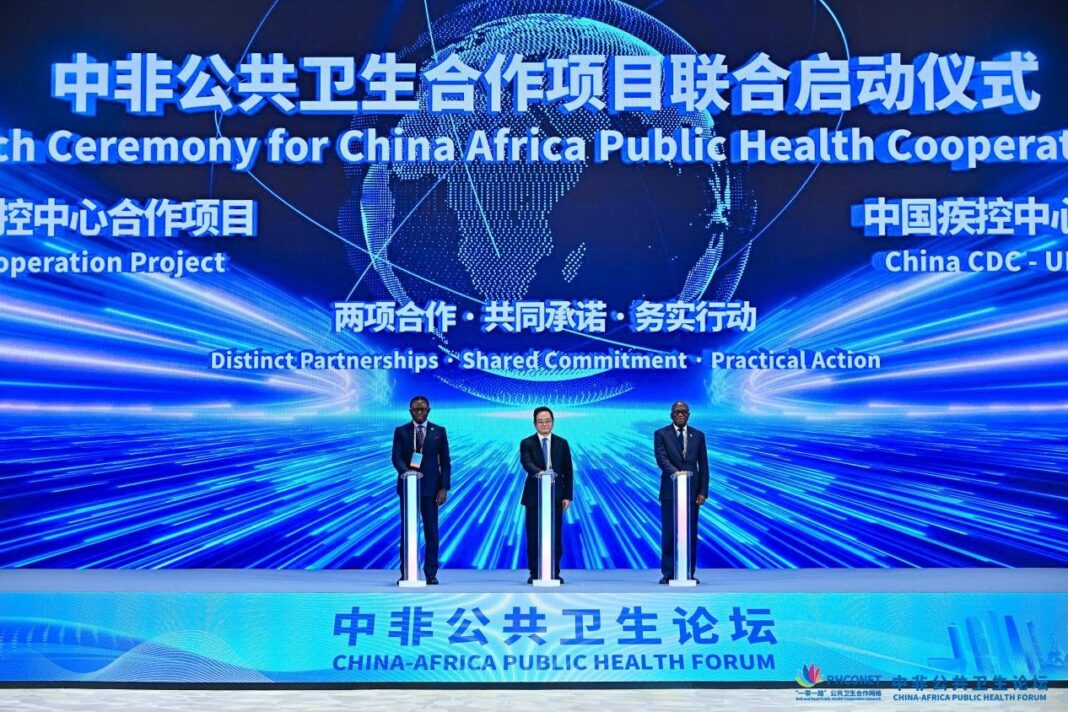

China and African countries have stepped up cooperation in public health, disease prevention and medical capacity-building following the inaugural China-Africa Public Health Forum in Guangzhou, China, which brought together approximately 700 delegates from more than 20 African countries and international organisations.
The forum, co-hosted by the Chinese Center for Disease Control and Prevention (China CDC) and the Africa Centres for Disease Control and Prevention (Africa CDC), marked a new phase in efforts to strengthen Africa’s public health infrastructure through technical cooperation, knowledge exchange and coordinated responses to infectious diseases.
The meeting brought together representatives from the World Health Organization (WHO), UNICEF, the Joint United Nations Programme on HIV/AIDS (UNAIDS) and the African Medicines Agency, reflecting growing international recognition of the importance of stronger China-Africa collaboration in addressing public health challenges.
One of the major outcomes was the release of the Initiative on Building a New Line of Defence for China-Africa Infectious Disease Prevention and Control, which seeks to strengthen cooperation in preventing, detecting and responding to infectious disease outbreaks.
The forum also launched public health technical assistance and South-South cooperation programmes involving China CDC, Africa CDC and UNICEF, providing a framework for closer institutional collaboration and the exchange of expertise between Chinese and African health authorities.
The initiatives come at a time when African countries are seeking to strengthen their healthcare systems against recurring disease outbreaks, limited diagnostic capacity, shortages of skilled health professionals and inadequate public health infrastructure.
For Africa, the partnership presents an opportunity to improve disease surveillance systems, strengthen laboratory networks and enhance the capacity of national health institutions to identify and respond to emerging health threats before they escalate into regional or international emergencies.
Infectious diseases remain a major public health concern across the continent. Outbreaks of cholera, malaria, tuberculosis, HIV/AIDS, measles and other communicable diseases continue to place considerable pressure on national healthcare systems, particularly in countries with limited financial and technical resources.
The COVID-19 pandemic exposed significant weaknesses in Africa’s ability to manufacture essential medical supplies, conduct large-scale testing and respond independently to global health emergencies.
It also demonstrated the importance of international partnerships in ensuring access to vaccines, medical equipment, diagnostic technologies and technical expertise.
Against this background, stronger cooperation between China CDC and Africa CDC could help African countries develop more effective disease monitoring systems, improve epidemiological research and strengthen preparedness for future public health emergencies.
China’s experience in building extensive public health infrastructure, developing disease surveillance capabilities and expanding access to medical technologies offers opportunities for practical knowledge exchange with African institutions.
Through technical assistance and professional exchanges, African health authorities could benefit from training in laboratory management, disease detection, outbreak investigation and emergency response coordination.
Such cooperation could also support the development of locally relevant public health policies, allowing African countries to respond more effectively to disease patterns and healthcare challenges within their populations.
The involvement of UNICEF in the newly launched South-South cooperation programmes further expands the partnership’s potential, particularly in areas involving maternal and child health, immunisation, nutrition and access to essential healthcare services.
These areas remain critical to Africa’s development agenda, given the significant disparities in healthcare access between urban and rural communities and the continuing challenges facing vulnerable populations.
The participation of the African Medicines Agency also highlights the importance of strengthening pharmaceutical regulation, improving medicine quality assurance and expanding cooperation on access to safe and effective medical products.
For Africa, building stronger regulatory institutions is essential to reducing dependence on imported medicines and creating an enabling environment for local pharmaceutical manufacturing.
The continent imports a substantial proportion of its pharmaceutical products, exposing healthcare systems to international supply chain disruptions, price fluctuations and shortages of essential medicines.
Closer China-Africa cooperation could therefore complement ongoing African efforts to strengthen pharmaceutical production, technology transfer and regional medicine supply chains.
However, the long-term impact of the Guangzhou forum will depend on how effectively its commitments translate into practical programmes at national and regional levels.
African countries will need sustained investment in healthcare infrastructure, research institutions, laboratories, skilled personnel and reliable health information systems to maximise the benefits of international cooperation.
There is also a need to ensure that technical assistance goes beyond short-term training and supports the development of sustainable local expertise and institutional capacity.
The partnership should increasingly prioritise technology transfer, joint research, local vaccine and pharmaceutical production, and the strengthening of African-led public health institutions.
For Africa CDC, the collaboration provides an opportunity to advance continental health security priorities while supporting member states in developing stronger and more coordinated disease prevention and response mechanisms.
Ultimately, the first China-Africa Public Health Forum signals an expanding dimension of China-Africa relations, moving beyond traditional medical assistance towards deeper institutional cooperation and shared responsibility for global health security.
As Africa works towards more resilient and accessible healthcare systems, the success of the partnership will be measured by its ability to improve disease detection, expand access to essential medicines, strengthen local medical expertise and reduce the continent’s vulnerability to future health emergencies.
The Guangzhou initiative therefore offers an important platform for turning international health cooperation into tangible improvements in the quality, accessibility and sustainability of healthcare services across Africa.